There is a new development occurring on the southwest corner of 16th Street and E Street, 30 affordable apartments, apparently called Studio 30. This is something that I always support, more housing, more affordable housing.

There is a new development occurring on the southwest corner of 16th Street and E Street, 30 affordable apartments, apparently called Studio 30. This is something that I always support, more housing, more affordable housing.
Posts related to the work zone guidelines are linked via category ‘Work Zones‘ within City of Sacramento category. Posts previous to the release of the draft guidelines, of which there are a considerable number, are linked via tag ‘construction zone‘ within Active Transportation category.
The problem with work zones at this time, before the adoption of a new Guidance to Accommodate Active Transportation in Work Zones and at Events policy (https://www.cityofsacramento.org/Public-Works/Transportation/Planning-Projects/Work-Zone-and-Event-Detours), is that the city accepts incomplete and non-compliant Temporary Traffic Control Plans, and then does not monitor them for compliance. The success and safety of construction zones should not have to rely on the public reporting non-compliant locations, it should be the job of city staff to monitor compliance.
City staff should monitor construction zones at the beginning of the construction project when signs, barricades, and channelizing devices are installed, and at any point when there is a significant change to the locations closed or detoured sidewalks or bikeways. As an example, 9th Street between K Street and L Street changed dozens of times during the construction project, and in fact, the sidewalk at that location is still closed long after construction appears to be complete. Almost every change had one or more non-compliant aspects, though it did improve over time. At beginning of construction, the sidewalk and bikeway were closed without warning signs, and there was unrelated construction on the other side of the street which closed the sidewalk. This sort of issue should never have happened! It has long been a requirement to comply with MUTCD and ADA (even before PROWAG was finalized).
The draft guidelines define five work durations:
I would not suggest that monitoring is necessary for durations C, D, and E, unless there is a citizen complaint about safety. For duration B, it should be inspected once, at the beginning. For duration A, it should be inspected at the beginning, and once per week thereafter. The additional monitoring would ensure that changes are captured and addressed, and that fallen signs, barricades or channelizing devices are corrected.
If there seems to be insufficient staff for monitoring, then the construction company must be charged more for the Temporary Traffic Control Plan and encroachment permit, sufficient to staff. The majority of construction is occurring in the central city, but there are locations throughout the city that must be monitored.
The draft guidelines do provide for administrative remedy, as follows. This will be sufficient, if Public Works staff follows through. However, in the past, staff has shown little concern for compliance, and has only responded to repeated citizen complaints.
Administrative Penalties
Implementation of the requirements for accommodations within these criteria and guidance must be paid for by the construction sponsor and it must be the responsibility of the construction sponsor to comply with the requirements of these criteria and guidance. Should the construction sponsor fail to comply, the Public Works Director or their delegate has the authority to stop all work until compliance has been achieved (§12.20.020). Such work will not be resumed until the necessary modifications have been implemented (§12.20.020). The Public Works Director or their delegate may issue an order imposing an administrative penalty to any person violating any provision of Chapter 12.20 Closure of Primary Streets for Construction.
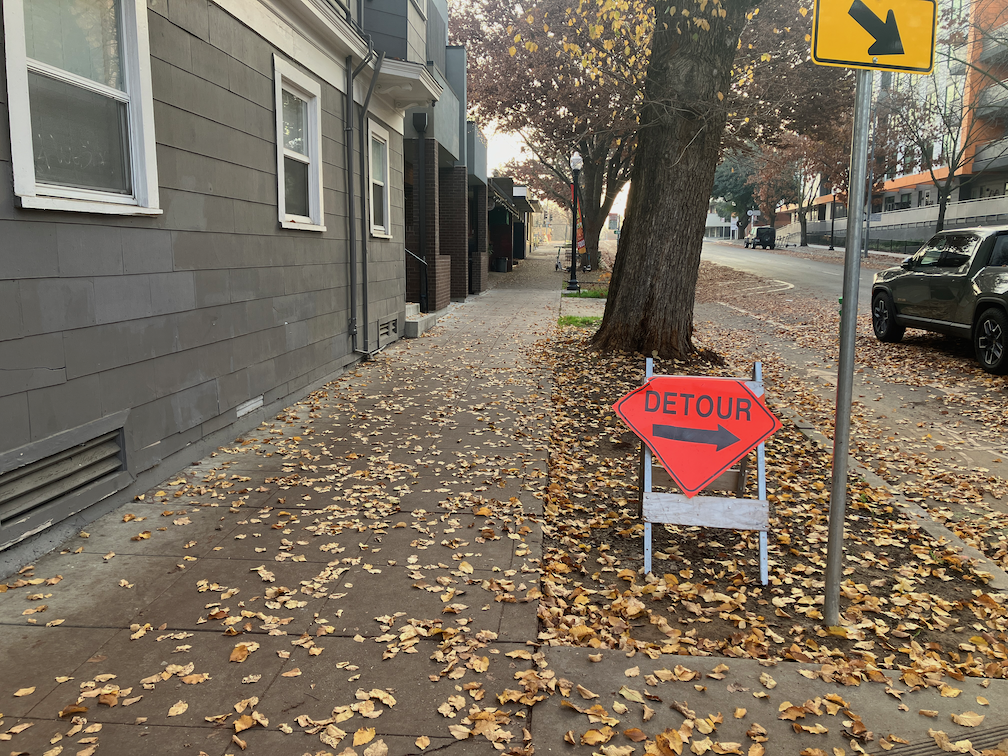
There is a construction zone at the northwest corner of Q Street and 21st Street which serves to illustrate what can go wrong with work zone signing. I am not picking on this particular construction site, as it is a rehabilitation of historical housing, which I fully support. I’ve seen worse construction sites, I’ve seen better construction sites, but this is a current example.
On Q Street at 20th Street, at the last crosswalk before the construction zone, there is the sign below. It is a roadway construction sign, not a sidewalk closure sign. Note that this sign was not here until I reported the location to 311. Following is the sign that should be here, MUTCD R9-11a.

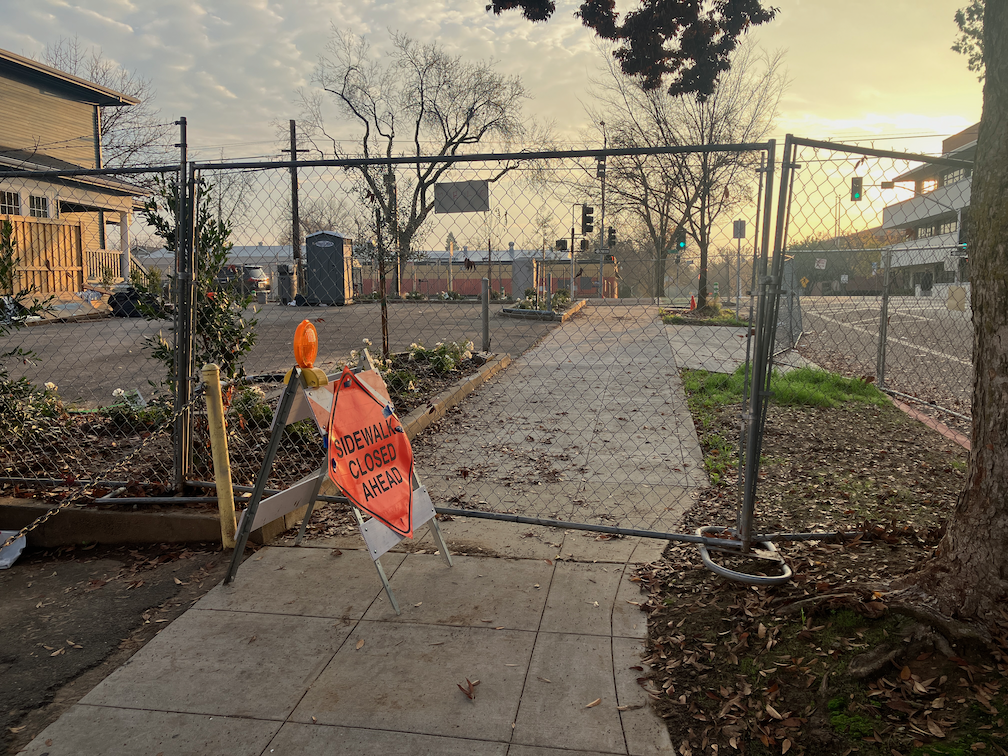
On Q Street approaching 21st Street, at the point of closure, there is this sign and a chainlink fence. This sign has been turned so it is not visible to someone approaching, and the traffic barricade on which it is mounted is a trip hazard. Following is the sign that should be here, MUTCD R9-11. Chain link fence is not an acceptable detectable barricade. Imagine using a long cane and running into this. What would you think? What would you do?
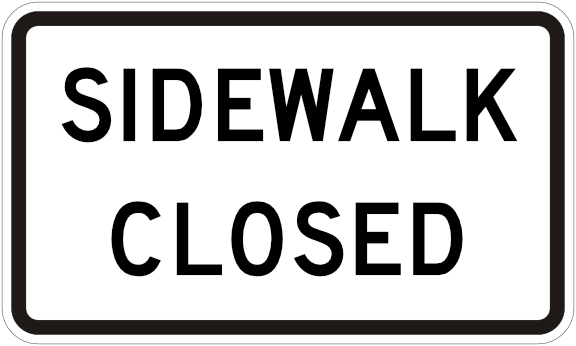
For the crosswalk over Q Street at 21st Street, here is the sign. Note that this sign was not here until I reported the location to 311. Following is the sign that should be here, MUTCD R9-10.

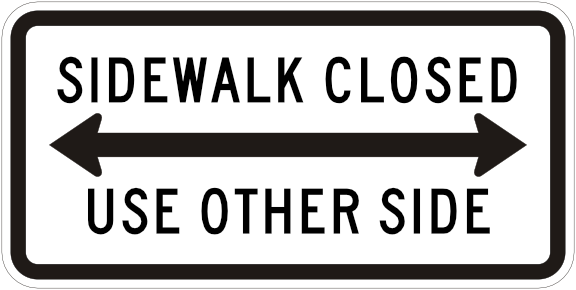
On 21st Street crossing at Q Street, north side, there is a sign on the ground that was intended to mark the closed crosswalk, before it was knocked down by the wind or by people. This is what happens when work zone signing is not monitored by the construction company. Note that this sign was not here until I reported the location to 311. Following is the sign that should be here, MUTCD R9-10.

On 21st Street at P Street, there should be an advance warning sign. There is not. Following is the sign that should be here, MUTCD R9-10.

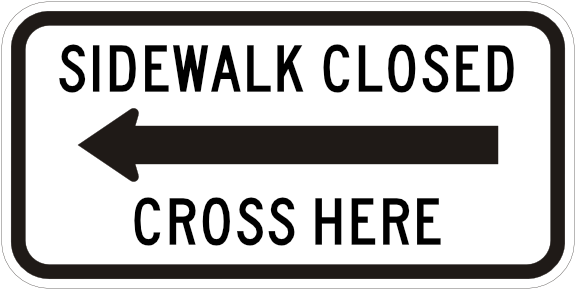
On 21st Street at Powerhouse Alley, where the sidewalk is closed, there is the sign shown below. Again, it is the incorrect sign, mounted on a traffic barricade that is in itself a trip hazard since it does not meet detectability requirements. The chain link fence is not an acceptable detectable barricade. Following is the sign that should be here, MUTCD R9-11.
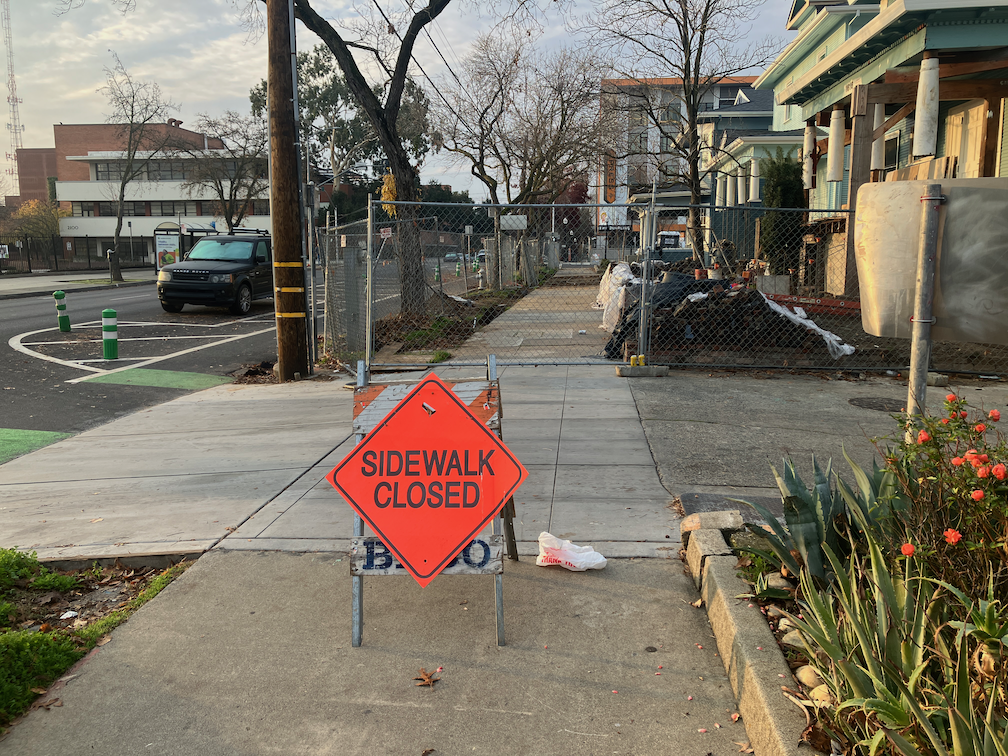
The use of incorrect signs, missing signs, and lack of detectable barricades, are problems that could be corrected, if the construction company had a compliant Temporary Traffic Control Plan, and if the city monitored the location for compliance. More about that in the next post.
I’ve spent more time looking at the 2023 MUTCD, Part 6, Temporary Traffic Control. The document is a bit convoluted, and I didn’t realize there were references in several locations, which taken together though not separately, provide better guidance for sidewalk barricades.
Figure 6K-2 provides a diagram for ‘pedestrian channelizing device’. The example is for the side of a temporary walkway, shown curved (though Figure 6P-29 shows right angles).

In a separate location, the notes page for Figure 6P-29, the text reads, Standard 1 “When existing pedestrian facilities are disrupted, closed, or relocated in a TTC zone, the temporary facilities shall be detectable and include accessibility features consistent with the features present in the existing pedestrian facility. A pedestrian channelizing device (see Figure 6K-2) that is detectable by a person with a vision disability traveling with the aid of a long cane shall be placed across the full width of the closed sidewalk.” The same channelizing device can be used as a barricade to close sidewalks. Imagine the left-most panel in the diagram, extending across the width of the sidewalk. I think that the three examples I used in my previous post (SacCity work zone comments) would be compliant, though I am not certain.
Another item of critical importance, that I did not initially pick up on, is the new requirement for audible warning: Notes for Figure 6P-28, Standard 5 (page 914): “SIDEWALK CLOSED CROSS HERE signs shall include audible information devices to provide adequate communication to pedestrians with vision disabilities.” The ‘sidewalk closed cross here’ sign is MUTCD R9-11a, which is the advance warning, used at the last available crosswalk.
I developed comments on the Draft Criteria and Guidance to Accommodate Active Transportation in Work Zones and at Events, and submitted them to the city, attached if you wish to take a look. There is a roundtable meeting for stakeholders on January 9, and a community meeting later in the month, possibly January 24.
PROWAG (Public Right of Way Accessibility Guidelines), released in August 2023, has the force of law, whereas MUTCD and CA-MUTCD are advisory, so relevant sections of PROWAG must be referenced in the work zone guidance.
PROWAG Chapter 3 says: [R303.2 Signs: Signs identifying alternate pedestrian access routes shall be provided in advance of decision points and shall comply with R410. Proximity actuated audible signs or other non-visual means within the public right-of-way of conveying the information that identifies the alternate pedestrian access route shall also be provided.]
The draft guideline says: ‘Proposed design and placement of the temporary traffic control signs, devices, and roadway markings must follow the most recent edition of the CA MUTCD.’
The draft guidelines must make clear that CA-MUTCD/MUTCD signs as shown on the diagrams must be used. This is a common failing of construction zone signing. Companies, and the city, use whatever similar signs happen to be on hand. They use roadway construction signs, and paper signs that melt in the rain and blow away in the wind. Note: I submitted a comment to FHWA for the MUTCD revision that these signs should be construction orange, as they are temporary construction closures, not permanent. They didn’t listen.

MUTCD text and figures show barriers in crosshatched orange. Unfortunately, neither MUTCD nor PROWAG show details of what that barrier should look like. It is common in construction projects to use chain link fence or roadway construction barriers on sidewalks, but these do not meet the requirements for detectability by persons using canes. Though PROWAG does not specifically address barriers (unfortunately), it does have the text: R303.6.1 Top: The top of the top detectable edging shall be no lower than 32 inches (815 mm) above the walking surface and be free of sharp or abrasive surfaces, and R303.6.2 Bottom: The bottom of the bottom detectable edging shall be 2 inches (51 mm) maximum above the walking surface.
There are two diagrams that I’ve used before, left and center. Right is a commercial product (though note is is only compliant if the props are away from the walker, otherwise they are a trip hazard). This model has been used in several places in Sacramento, but they tend to fall down in wind, so may not be the best. The channelizer in center is often used as a barricade at crosswalks, and I believe this use is compliant, and they don’t fall down in wind. The draft guidelines must include some sort of diagram, otherwise, companies will use whatever is on hand, and whatever a sighted person thinks is sufficient.

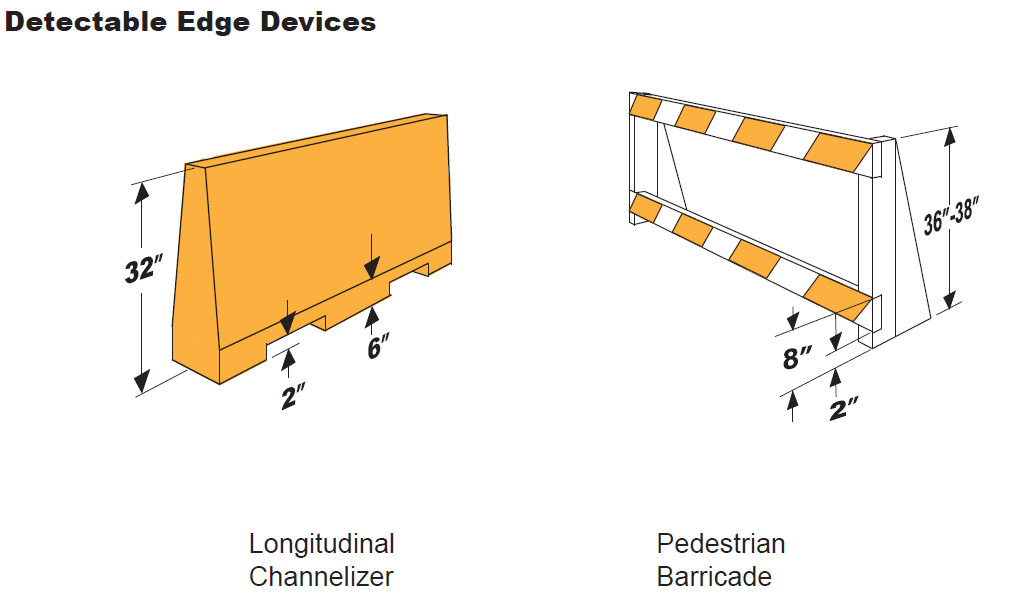

The left diagram is from Applying the Americans with Disabilities Act in Work Zones: A Practitioner’s Guide (https://workzonesafety.org/publication/applying-the-americans-with-disabilities-act-in-work-zones-a-practitioner-guide/), and the center diagram is from Work Zone Pedestrian and Bicycle Guidance (https://www.vdot.virginia.gov/media/vdotvirginiagov/doing-business/technical-guidance-and-support/technical-guidance-documents/traffic-engineering/WZ_Ped_Bike_Guide.pdf).
The sidewalk diagram in the new 2023 MUTCD Figure 6P-28 is better than the 2014 CA-MUTCD Figure 6P-28 because it makes clear that ramps from sidewalk level street level are necessary for a diversion. That diagram is below, and should replace the one in the draft guidelines. Figure 6P-29 is the same in both.

The City of Sacramento has released the Draft Criteria and Guidance to Accommodate Active Transportation in Work Zones and at Events. The related page is Work Zone and Event Detour Policy Update. The city’s Active Transportation Commission (SacATC), many advocates in the region, as well as myself, have long requested this document, as current city practice is simply unacceptable. Starting with this post, posts related to this document and the process will be under the category ‘Work Zones‘ within City of Sacramento. Previous posts, of which there are a considerable number, are linked via the tag ‘construction zone‘ within Active Transportation.
I will read through the document and no doubt have comments to offer to you, and the city. At a glance, it looks pretty good.
One issue that I note right of the top is that the document does not mention PROWAG (Public Right-of-Way Accessibility Guidelines). Though PROWAG includes text from the federal MUTCD, and therefore the CA-MUTCD, PROWAG supercedes both MUTCDs. PROWAG no longer accepts some outmoded and unsafe designs that are in the MUTCD.
I hope that readers will review the document and comment, here and to the city. There is a comment form linked from the city’s page, though it is not structured in such as way as to comment on specific sections. You can also email Casandra Cortez, Transportation Planner, cncortez@cityofsacramento.org.
 Getting Around Sacramento