more LPIs

I wrote some while ago about leading pedestrian indicator (LPI) signals, which give the pedestrian a head start of a few seconds before the parallel traffic light turns green. So far as I know, Sacramento has not added any locations to the list of eleven.

But the city should. In fact, I’d argue that any traffic signal where there are a significant number of walkers, and a significant number of turning drivers, should have an LPI. Drivers often fail to yield to people in the crosswalk when turning, or cut in right behind them, and the more chance the walker has to get out into the crosswalk and visible, the better. Of course nothing about the LPI prevents the driver from turning on red, unless turns on red are prohibited. Prohibiting turns on red has been much discussed lately, but I don’t think that treatment is the most important that can happen at intersections.

I live a few blocks from Fremont Park, which is the block between 15th Street and 16th Street, and P Street and Q Street. In fact, many of the parks in the central city are located between pairs of one-way streets, called couplets. 16th is one of the busiest streets in the central city, and the other two are moderately busy, and these four intersections see a lot of turning vehicles. Since I walk nearly every day to and around the park, I get plenty of chance to see how drivers interact with walkers in the crosswalk. I’ve never seen anybody hit, but I often see conflicts, the driver trying to intimidate the walker, trying to beat them to the crosswalk, stopping just short of hitting them, or cutting in close behind them.

P Street and Q Street are two-lane arterials, while 15th Street and 16th Street are three-lane arterials, with higher traffic volumes and vehicle speeds. 16th was a state highway.

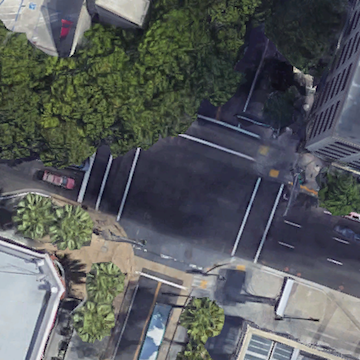
So, I’m asking the city to install LPI signals for the south crosswalk at 15th & P, the east crosswalk at 15th & Q, the north crosswalk at 16th & Q, and the west crosswalk at 16th & P. The photos below show the intersection of 15th & P from pedestrian level, and overhead. The video shows two pedestrians crossing, and mostly through the crosswalk before the driver encroaches. This was a low traffic time with only one turning vehicle. When I have a chance to capture a heavier traffic time with pedestrians, I’ll replace it.

P Street westbound, showing crosswalk over 15th St ahead
15th Street & P Street, south crosswalk
crosswalk over 15th Street at P Street

I often write about the Sacramento central city because that is where I live, and I have ample opportunity to observe transportation infrastructure and driver, walker and bicyclist behavior. However, I’d like to state that I DO NOT think that central city issues should be solved first. These issues occur in many places in Sacramento, where the traffic is higher speed, facilities are poorer, and neighborhoods have been disinvested. Drivers in the central city are just as bad as drivers elsewhere, in fact most of them are from elsewhere, the suburbs, but they have grown somewhat accustomed to seeing walkers and bicyclists, and are more careful around them.

Next: LPIs and bicyclists

Walkable Sacramento #3: pedestrian signals

Following on to the previous post on crosswalks, policies are needed for pedestrian signals, which are intended to provide some additional protection for pedestrians crossing at signalized intersections. I am not in favor of creating signalized intersections where they don’t exist (in fact, many should be considered for removal), but where they do exist, the pedestrian signals need to be done right.

It should be noted that the NCUTCD (National Committee on Uniform Traffic Control Devices) just today decided to not recommend that the MUTCD (Manual on Uniform Traffic Control Devices) require that signalized intersections have pedestrian signals. I’m not sure how I feel about this: sometimes I think that we over-sign and over-signalize roadways, causing lack of attention, but at the same time, such a limitation would never be accepted if it had to do with motor vehicle movement.

Pedestrian activation buttons are often called ‘beg buttons’ because the walker must ‘beg’ permission to cross by pressing the button and then waiting an uncertain length of time. Sometimes forever, because some buttons have failed or been disconnected, and no change has been made to the signal logic to address this. Motor vehicle drivers are not required to take any such action, they are detected in various ways, or the signal is set to change automatically without detection.

Some European cities have installed automatic pedestrian detection, which changes the signal based on the presence of a walker. I have heard that some of the detectors can even distinguish people in wheelchairs, with walkers and canes, or elderly, and adjust the cycle to accommodate. I’m not aware of any of these in the United States, but would be happy to hear about them if there are.

The policies are:

  • No crossing will require the pressing of a pedestrian button unless it is a roadway over over 30,000 ADT with a crossing frequency of less than 100 pedestrians per day, or is a mid-block crossing. 
  • All pedestrian buttons will be labeled to clearly indicate whether they have any effect on the signal cycle. Buttons may serve only the purpose of:
    • triggering infrequent crossings, as above, or
    • triggering audible information, or
    • lengthening the crossing time for walkers requiring a longer time, often seniors and the disabled
  • Existing buttons will be removed unless they provide one one of the functions above, and are signed to indicate their function. Removal of others within three years.
  • All pedestrian signals will have a countdown function, unless there is a crossing frequency of less than 50 pedestrians per day, within five years. 
  • Signals will normally have a cycle of 60 seconds or less in order to reduce pedestrian wait times. Revision within two years.
from Dhiru Thadani

change the signal at J St and 13th St

The signal at J Street and 13th Street in downtown Sacramento (shown at right) does not work well for pedestrians. The signal cycle is long, even compared to other signals on J Street, so the wait for pedestrians is quite long. I have seen the signal cycle skip both pedestrian crossings and vehicle crossings a number of times, which means that the wait is doubly long. Most walkers respond to this long wait by simply crossing the street against the pedestrian signal, and I don’t blame them at all.

A second issue is that the signal is set so that the east crosswalk walk mode occurs at the same time as the left turn from 13th Street southbound to J Street eastbound, meaning there is always a conflict between pedestrians and drivers at this point, and this conflict has been created by the signal setup. Many drivers cut directly behind or in front of people walking, as they know if they wait until the crosswalk is clear, as the law requires, they won’t make the signal.

This signal should be reconfigured so that it gives priority to pedestrians, without making them wait an unreasonable period of time, and does not create unnecessary conflict between turning drivers and people walking. The east crosswalk at a minimum needs a longer leading pedestrian interval (LPI).

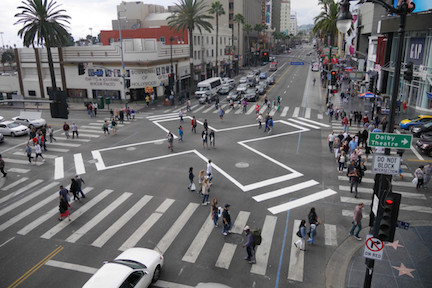
Even better would be to make this a pedestrian scramble intersection, with an all-direction crossing phase during which all vehicle turning movement are prohibited. The intersection can be marked with diagonal crosswalks, and additional diagonal pedestrian signal head added, however, simply changing the signal timing is sufficient as an initial step. This is a busy crosswalk intersection, with the convention center on one corner, the Sheraton Grand on another, and the parking garage for the Sheraton and others on the third corner. It is alway busy, and the people crossing here are commonly tourists, who are likely used to more advanced ‘world class’ cities where pedestrians are not second class citizens after car drivers.

Note: There are a number of busy pedestrian crossing intersection in the Sacramento central city that deserve an upgrade, but this is the one that most irritates me, whether walking or bicycling.

J & 13th needs a pedestrian scramble

Following the post yesterday, Morse-Cottage pedestrian scramble, here is my first suggestion for a pedestrian scramble in Sacramento. J Street and 13th Street would be a great location for one. It has high pedestrian traffic, it has pedestrian attractors on three corners (convention center, Sheraton Grand Hotel, and a parking garage), and many people cross more than one direction. I am not sure that it is the highest volume intersection, but it is quite possible the highest visitor location where people are less likely to be paying attention or to understand our signal system

Most importantly, the pedestrian signalization here is seriously screwed up, and it needs to be changed. On the west leg, the pedestrian phase is short. On the east leg,there is a ‘leading vehicle interval’ that allows southbound left turning vehicles to start before the pedestrian walk comes on, so almost every cycle creates pedestrian-vehicle conflicts. All the crossings require button pushes, none are on automatic recall that is standard at intersections in urban areas with heavy pedestrian flow. And the whole intersection cycle is much too long, giving preference to drivers on J Street over walkers, right here in the heart of a place where so many people walk. The cycle also sometimes skips the west leg completely, making pedestrians wait through two cycles of J Street traffic, which is a long, long time.

In addition to the exclusive phase, diagonal crosswalks should be marked to make it clear how the intersection works.

Let’s make this the first of many pedestrian scrambles in the central city.

Leading Pedestrian Interval (LPI) signals

Questions about using Leading Pedestrian Interval (LPI) signals at the community meeting on crosswalks reminded me that I had information on these in the city for some while, but hadn’t shared it. A LPI signal gives the pedestrian a 3-second (or more, but the Sacramento ones are all 3 seconds) head start, with the walk sign coming on before the light turns green, so that pedestrians will already be in the crosswalk and more visible before vehicles start to move. These address the common issue of both right-turning and left-turning vehicles failing to yield to pedestrians in the crosswalk. They are one of the pedestrian safety countermeasures identified by the Federal Highway Administration (FHWA), with a crash reduction factor of 60%. If you search for ‘leading pedestrian interval’ on the Internet, you’ll see a great number of useful links. The NACTO page is especially worthwhile.
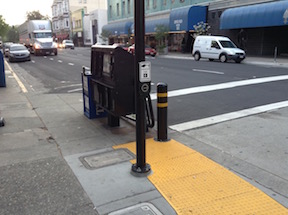
My purpose in sharing the specific locations is so you can go out and experience LPI for yourself. How does it work for you?

A LPI does slow traffic very slightly since there is an additional 3 seconds per direction during which most vehicles are not moving.

Lastly, this is not a solution that could have been used at the Freeport-Oregon intersection, which is not a signalized intersection. However, it is a solution for the signalized intersections along Freeport. Ryan Moore claimed that these can’t be used at low pedestrian locations, but the response to all such reactionary claims is: “You can’t judge the need for a bridge by the number of people swimming the river.” If crossings are not safe, then fewer people are walking than otherwise could be. The demand is there, but not the facility. LPIs are one solution.

Lead Pedestrian Interval (LPI) locations in City of Sacramento (as of 2015-08-28):

  • 9th Street and I Street
  • 9th Street and P Street
  • 10th Street and I Street
  • 10th Street and J Street
  • 15th Street and K Street
  • 29th Street and K Street
  • 30th Street and K Street
  • 9th Street and Q Street
  • 13th Street and I Street
  • 8th Street and P Street
  • 8th Street and Q Street

Beg buttons on K? Really?

Note: I discovered yesterday, to my chagrin, that I had a number of draft posts dating back to early 2013, which I’d never finished. So I’m going to post them now, all in a flurry. Some of these issues I’ll get back to and do an in-depth and up-to-date post, and some of them I probably never will. This is the fifth and last post, and I discarded two that were worth preserving. This just points out that I have more good ideas than I have time to carry them out.

My point here was that beg buttons should not be used on streets which are meant to encourage or emphasize walkability, of which K Street is certainly one. I will definitely be writing more about this.

Pedestrian beg button on a commonly used crosswalk (9th St at K St), this location should have a pedestrian signal on every cycle, not just when someone presses the button.

Original 2015-04-11: I have to admit that sometimes I walk past things every day and don’t notice them, but this morning I noticed the pedestrian activated buttons on K Street in downtown Sacramento. Yes, they’ve probably been here since the street was re-opened to cars on November 12, 2011. These are technically called pedestrian pushbuttons, and their purpose is to activate the pedestrian signal head and a change of the traffic signal. They are often called beg buttons, because the pedestrian has to “beg” to cross the street by pushing the button, rather than being an accepted part of transportation on the street.

green wave

A “green wave” is a traffic signal sequence set so that vehicles will encounter green lights for some distance, so long as they are traveling at the selected speed. A green wave can also be set for bicycle speeds, though it very rarely has been, and never in Sacramento.

To some degree, all signals are set this way, though the degree and distance of sequencing varies widely. Many of the east-west streets in the Sacramento grid have signals set for motor vehicles, and when traffic is not congested, it may be possible to go all the way across downtown and midtown on green lights, for example on J Street. Very few north-south streets are set this way, I can think of only the 15th & 16th couplet, and the 9th & 10th couplet. At intersections with the east-west couplets, these north-south couplets seem to have their green wave broken. Only if the grid spacing and the selected speed calculate out is it possible to have a green wave in all directions. Sadly, many signal sequences in the Sacramento region are set above the posted speed limit, encouraging drivers to speed so that they make all lights.

Read More »