more Central City Mobility Project

This is Central City Mobility Project update #5.

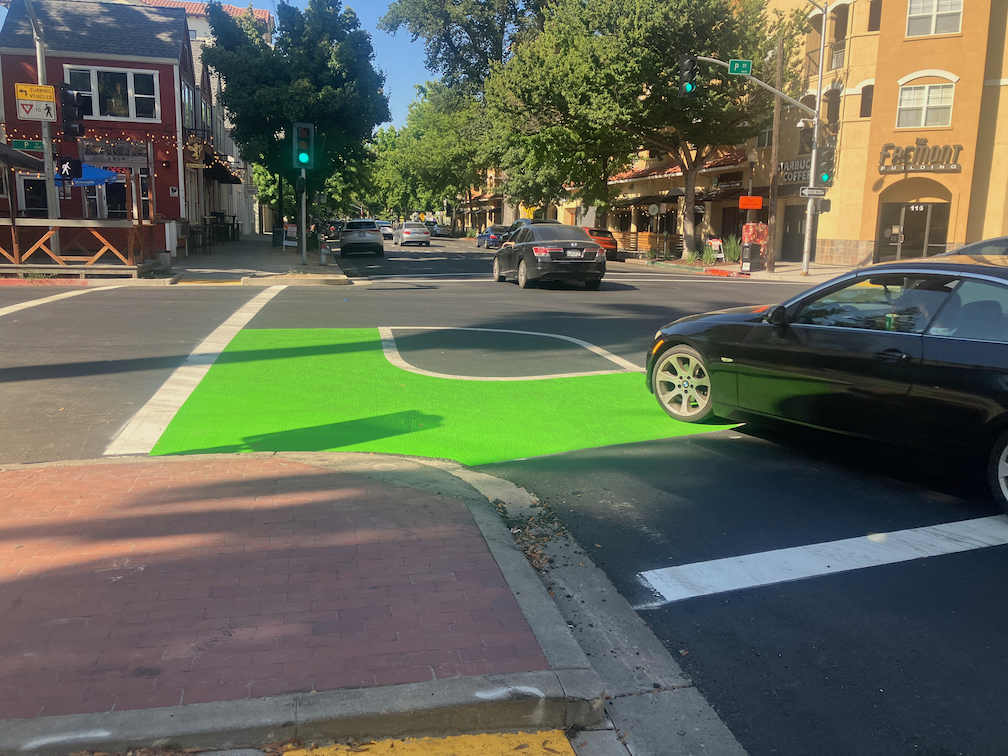
The City of Sacramento’s Central City Mobility Project is underway, and projected to finish by next May. The map below shows the major components of the project: new parking protected separated bikeways on 19th Street and 21st Street between W Street and I Street, extended parking protected separated bikeways on P Street and Q Street from 15th Street to 21st Street, a separated bikeway (not parking protected?) on I Street from 21st Street to 12th Street, and conversion of 5th Street from a one-way street to two-way from Broadway to I Street (the two-block section from L Street to J Street is already two-way). The project also includes upgrades of corner ramps to ADA compliance along 21St, 19th, P, Q and I streets. I notice that ramp upgrades are also occurring at some locations other than these streets, whether under this project or a separate initiative, I’m not sure.

Central City Mobility Project map

As far as it goes, this project looks to be great. The city is making an effort to create a grid of higher quality bicycle facilities in the central city, of a mile spacing, or less. But a bicycle network is only as good as it’s weakest spot, and this project leaves several weak spots in the grid. The map below highlights some of these, shown in cyan color:

  • P Street and Q Street parking protected separated bikeways should be extended west to 5th Street, which would include a reduction of lanes on those streets. Stopping the bikeways at 9th and 10th Street reduces access to Sacramento Valley Station, as well as many other destinations in this area, including using the Tower Bridge to access West Sacramento.
  • 9th Street parking protected separated bikeways should be extended from Q Street south to Broadway, to provide access to the higher quality bikeway along Broadway, and points south of Broadway.
  • I Street separated bikeway should be extended from 12th Street west to 5th Street, created a complete bikeway from 21st Street to Sacramento Valley Station.
  • J Street parking protected separated bikeway should be extended east from 5th Street to 19th Street, to proved a complete bikeway from 5th Street to 28th Street.
  • A separated bikeway should be constructed on 28th Street to provide a high quality bike route parallel to the unsafe 29th Street one-way southbound traffic sewer and 30th Street one-way northbound traffic sewer.
  • Regular bike lanes, at a minimum, should be installed on 13th Street between P Street and Capitol Park. 13th Street is one of the most heavily bicycled north-south routes in the entire central city, but this two block gap makes that trip less safe.

It is also possible that the P Street and Q Street bikeways should be extended east at least to 28th Street, or beyond, but I haven’t looked closely at that yet.

Central City Mobility Project map with recommended additions
Read More »

Central City Mobility update

This is Central City Mobility Project update #4.

The repaving of 21st Street between W Street and I Street is complete. The section has been marked with ‘temporary road marker tabs’ (these have various names). The marking is for parking lanes on both sides, of eight to ten feet, and ultra-wide general purpose travel lanes, of at least 16 feet. No bike lanes were marked, though the street previously had marked bike lanes. A typical move on the part of the city and its contractors, to take care of motor vehicle travel and parking, but forget about bicyclists. This is of course temporary, but state and federal law require accommodation of bicyclists in construction zones. No such accommodations was made.

21st St between J St and I St, ultra-wide travel lanes, parking lanes, NO bike lanes

There are temporary paint markings for the first several blocks north of W Street, showing what the paint configuration will be. The parking protected separated bikeway is, as was likely, on the left side because most of this stretch has bus service on the right. The bike area is about seven feet wide. The buffer strip of about three feet wide, and the parking lane is about eight feet wide. The buffer may or may have vertical delineators (soft hit posts) continuously or at conflict points. There is no indication at any location, so far, that there will be hard curbs to actually protect bicyclists when parked cars are not present. For information on why a seven foot bikeway is not sufficient, please see bike lane widths. NACTO recommends at least eight feet.

21st St temporary marking for separated bikeway

As I rode up 21st Street, I noticed that the bus stop is marked in the same way that the parking lane is. I hope this is just a temporary mistake, otherwise there will be parking in the bus stop despite the red curb. The city is still failing to do two things it can to better support transit: 1) install concrete bus pads so that the weight of the bus at the stops does not distort the pavement and cause potholes, and 2) paint the pavement red at each bus stop so as to make it clear that this is a place for buses only, and not private vehicles. And, yes, it would be nice if transit islands were installed so that the bus does not need to pull out of and then into traffic. The city keeps saying that it supports transit, but doesn’t actual do anything to support transit.

21st St bus stop, marked as though it were a parking lane

Lastly, in the category of ‘be careful what you wish for’… I had wondered why the city was not taking advantage of the ADA ramp project to put in curb extensions (bulb-outs) at some critical intersections for walker safety. This afternoon, I noticed that they are putting in curb extensions on the northeast and southeast corner of 19th Street and O Street. Yay? Nay? The problem is that the location of the extensions would extend into the separated bikeway on the left side of 19th Street southbound. The photo below, looking north along 19th Street at O Street, shows the extension under construction. There is supposed to be a curb-adjacent, parking protected separated bikeway here. I assume that bus stops for SacRT Route 62 southbound will be on the right hand side of the street, and the separated bikeway on the left hand side. Is there anyone paying attention? Anyone? Ferris? Anyone?

Parking reform for Sacramento

Note: Added item to Parking fees below, in italic, based on an idea from an article in Streetsblog USA.

Following on to the discussion group topic this week of Walkable City this week, Part 3: Get the Parking Right, here is a list of my thoughts about parking reform in the City of Sacramento. Almost all applies to parking anywhere. I think nearly every one of these has been mentioned in previous posts, but I’ve not brought them together in a single place.

The City of Sacramento has a Parking Services website. Parking Services is part of Public Works.

  • Parking management:
    • Parking must be managed under a city-wide parking management plan, and the plan must be consistent with city and state policy for reducing motor vehicle use and vehicle miles traveled (VMT). The city does not have a parking management plan, so far as is known.
    • Parking mandates must be removed city-wide, not just for the central city and transit oriented locations.
    • The city should foreswear any new structure parking (parking garages or parking decks). Though the city does not have any active plans for new parking, it has had recently, and they may come back.
    • Require all new housing or mixed use developments to unbundle parking, meaning that no free parking is provided for residents, and all parking is available to any person who wants to rent the space. Unbundling should be phased in over five years for all existing parking.
    • Prohibit commercial parking lots adjacent to sidewalks, meaning the buildings must face sidewalks and not parking lots.
    • Property assessment of surface parking lots will be at the same value as the productive land use that existed there before, to discourage building removal and and to keeping of land in less productive or unproductive uses; this requires cooperation from the county
  • Parking fees:
    • A base rate for all parking will be set such that it covers installation, maintenance, and management of all public parking; this rate might vary by whether parking is metered or not, or might be uniform throughout the city.
    • Charge at least the base rate for all street parking, everywhere in the city, via meters or permits, that recovers base rate; NO FREE PARKING!
    • Set variable rates for residential parking permits based on the size, weight, and fuel source of the vehicle
    • Formally implement variable pricing of street and structured parking to achieve Shoup’s 85% utilization
    • Charge for handicapped spaces (this eliminates the motivation for non-handicapped drivers to illegally use handicapped spots)
    • Eliminate all holiday or promotional free parking; research indicates that free parking actually reduces business customers by reducing parking turnover
    • Pilot ideas for charging for delivery use of street parking
  • Parking revenue:
    • Parking revenue will not go into the general fund or to pay off bonds not related to parking, but be used for specific purposes related to parking and neighborhood improvement
    • 50% of parking revenue (above base rate) will be spent on neighborhood improvements on the same streets or within parking districts
    • 50% of revenue (above base rate) will be allocated to transit operations and transit amenities
  • Parking conversion to higher uses:
    • Add trees in the parking lane on all streets without sidewalk buffers; many of the lower income neighborhoods in the city lack sidewalk buffers and private trees, making walking unpleasant and hazardous
    • Do not charge for conversion of street parking to dining space, and minimize permit costs for street dining
    • Provide one or more short-term (20 minutes or less) parking spaces on every block with retail
    • Provide one or more delivery spaces per block with any retail, and enforce against double-parking for delivery where delivery spaces are available
    • Replace parallel parking with diagonal parking on overly wide streets, to slow traffic; most streets in the city are overly wide
    • Where sidewalk or sidewalk buffer space is not available for micro-mobility (bike share, scooter share) parking, street parking will be converted in sufficient quantity
    • Modify development standards to allow only one-side parking in new residential developments
    • Allow conversion of parking to bike facilities where a reduction of travel lanes is not practical (on streets 30 mph or higher)

I strongly believe that the single city action most responsible for the renewal of midtown Sacramento, all the infill development and successful business, is the removal of parking minimums (mandates) from the central city in 2012. Since that time, the city has removed parking mandates from land near major transit stops, and in 2022, the state prohibited cities from establishing mandates near major transit stops (the definition of a major transit stop is fuzzy, however).

The city has proposed, in its draft 2040 General Plan, to remove parking mandates city-wide. It remains to be seen whether pressure from politicians and suburban protectors of ‘their’ street parking spot will subvert this recommendation. 2040 General Plan draft, Chapter 8 Mobility, Goals and Policies M-2.17 Parking Management Strategy, page 8-18.

Other resources:

Sac 2040 General Plan draft released

The City of Sacramento has released the draft 2040 General Plan. There are three ways to find out more:

  1. Self Guided Workshop
  2. Three orientation webinars (scroll down the page above to the webinar signups)
  3. The plan itself, available as a pdf on the General Plan page. The Climate Action and Adaptation Plan is also available there.

A number of organizations. and individuals, will be reviewing the plan, and providing information to their members. Dive in if you have the time, or wait for some guidance from others.

The General Plan is probably the most important document that the city will put out, since it will address zoning changes to allow more housing, and more affordable housing, which helps every other aspect of livability in the city.

update on SacCity ADA ramps

Note: I discovered that I have often used ‘detectible’, but should have been using ‘dectectable’ for detectable warning strips.

This is Central City Mobility Project update #2.

This is an update to the update on work being done on corner ADA ramps in the Sacramento central city, apparently as part of the Central City Mobility Project.

So far as I have seen, curb extensions are not part of this project.

There are now a number of locations where the concrete ramp is being cut so that the detectable warning strip can be installed, but the curbs are not being touched. See below for an example.

Q-St & 16th-St, SW corner, ADA ramp construction

One of the corners I have been monitoring, 21st St and O St northeast corner, is complete, but with temporary patches that make the ramps useable, though ironically still blocked by folding barricades and caution tape, which absolutely does not meet ADA guidelines for contruction signing and safety. This seems to be the pattern with the city, trying to make things better, but not paying attenteion to the details. I don’t know when the asphalt will be restored and the corner opened. Maybe the contractor is waiting until all the corners are ready before patching, though that would be stupid.

21st-St & O-St, NE corner, completed corner with ADA ramps

I am still not able to make sense of the asphalt cuts that are being done on the corners where the curb will be or has been modified. I’m guess that there was a standard cut design, implemented everywhere, no matter what the actual project.

Walking around the central city, it appear that most of the corners which did not have ADA-compliant ramps will have them when the project is done, but some may not. I don’t know what the criteria is for which corners are being done, and which are being done at a higher level of replacing the curbs and widening the ramps. Many of the existing ramps are narrow, with edging curbs, which was apparently the design at the time they were placed, but the new corners are a different design, with a sloping area between the two ramps, similar to the diagram below, from the 2020 Department of Utilities Standard Specifications: Transportation drawings, not from the 2009 Department of Public Works Street Design Standards, which contain no ADA diagrams. I think the detectable warning strip width is at least 60 inches on the new installations, which is an improvement. The 48 inch width does not allow two people to stand on the strip. Corners with new curb extensions seem to have 72 inch strips.

SacCity T-76 Curb Ramp Dual Combination Planter diagram
SacCity_T-76_CurbRampDualCombinationPlanter

SacCity intersection design

Part of an ongoing series of posts to support better streets in the City of Sacramento during their 2023 update of Street Design Standards. New standards must be innovative, safe, and equitable, and it will take strong citizen involvement and advocacy to make them so.

This intersection design post follows on to the SacCity intersections of local streets post, addressing intersections of larger streets. See SacCity street classification for detail on types of streets (local, neighborhood, corridor).

The most important point of intersection design is that multi-lane roundabouts have absolutely no benefit for people walking or bicycling, particularly those with vision or mobility limitations. They are no more safe than regular intersections, and some research indicates they are less safe. They are just more motor vehicle infrastructure masquerading as something innovative and safe. If the city were to include a design for multi-lane roundabout, it would be a travesty.

This is also the last of the design detail posts. I realize that the posts have veered off into related issues, and the piecemeal nature of the posts makes it hard to see the overall pattern, so I will try for a summary post in the near future.

Policy

  • New or reconstructed intersections of neighborhood streets will generally use protected intersection design
  • New or reconstructed intersections of corridor streets will use prote
  • New and reconstructed intersections will include curb extensions, raised crosswalks or raised intersections, and/or protected intersection design
  • ADA ramps at intersections will always be perpendicular to the roadway, never diagonal
  • Daylighting for visibility will be provided at all intersections, through red curbs, curb extensions, or protected intersections; if red curbs alone are used, the offset from intersection should be at least 15 feet
  • Roundabouts: single-lane roundabouts will be considered for any reconstructed intersection except local streets; multi-lane roundabouts have no safety benefits and will be prohibited
  • Intersection corner radii will be set to ensure slow and safe turning speeds for all motor vehicles; truck and bus routes will never be more than 15 feet
  • Safe crosswalks will be provided at no less than every 1/8 mile in all urbanized areas; 30 mph, crosswalks must have at least pedestrian activated or automated flashing beacons; at 40 mph, crosswalks must have full signalization
  • Slip lanes will be removed from existing streets and not installed on new or reconstructed streets
  • Pedestrian crossing prohibitions will be removed from all intersections except those with freeway onramps and off ramps

Design diagrams will include:

  • ADA ramps, including design which prevents accumulation of water at the base of ramps
  • intersections of local streets
  • intersections of neighborhood streets with neighborhood streets or local streets
  • intersections of corridor streets with corridor streets, neighborhood streets, or local streets
  • protected intersections
  • modal filters/traffic diverters
  • single lane roundabouts
  • curb extensions (bulb-outs), with concrete curbs
  • interim curb extensions with paint/post installations

Two design diagrams for protected intersections, the first from NACTO Don’t Give Up on the Intersection: Protected Intersections, the second from Alta Design+Planning Evolution of the Protected Intersection, for protected intersections, followed by NCHRP Roundabouts: An Informational Guide, for a single-lane roundabout.

NACTO protected intersection diagram
NACTO ‘Don’t Give Up on the Intersection’ Protected Intersections diagram
Alta Design+Planning Evolution of the Protected Intersection
Alta Design+Planning ‘Evolution of the Protected Intersection’ diagram
NCHRP 'Roundabouts: An Informational Guide' diagram
NCHRP ‘Roundabouts: An Informational Guide’ diagram

update on half-measure corners

This is Central City Mobility Project update #1.

There has been construction on several of the corners I had previously mentioned (half-measure corners?), with 21st Street and O Street being the most advanced. It seems that I was wrong about curb islands being put in – there is no evidence of such construction. I don’t know why the asphalt cutting implied that. When more of these are complete, I’ll post again.

What seems to be going on is simple updates to place ADA-compliant curb ramp with detectable warning strips. Of course any improvement to curb ramps helps everyone, disabled and otherwise, and I’m not criticizing that. Rather, wondering why when the city is changing these corners, they did not take the opportunity to do true curb extensions. The ADA ramp and detectable warning in place for O Street is wider, than previous ramps and strips, looks to be more than four feet rather than the prior narrow ones. If all the ramps end up wider, that will be a plus.

This work is probably part of the city’s Central City Mobility Project. The project detail mentions ‘turn wedges’. Maybe the wedges will be added later, or maybe these will be at different locations than the ones I’ve looked at. The page does not specifically mention ADA ramp improvements.

21st St & O St, northeast corner, ADA ramp construction, partially complete

I had mentioned in the previous post curb extensions being extended to serve as bus boarding areas. I am not aware of any of these in Sacramento, but San Francisco has many. Many earlier posts have mentioned bus boarding islands, but this is for a street without bike lanes (yet), which allows the bus to stop in-lane and people to board directly. Notice that the extension allows for a bus shelter without constraining the sidewalk width for walkers. This should be the standard for Sacramento for all streets with bus routes but not bike lanes.

curb extension and bus boarding extension, San Francisco, Leavenworth & Sutter

half-measure corners?

Summary: The city should not install curb islands at corners, as it is currently doing, but rather install much safer and more effective true curb extensions, even if fewer can be installed now. Temporary installations can be used at other corners.

The City of Sacramento is currently re-doing a number of intersection corners in midtown. Most of these corners are along 21st Street, so far as I’ve noticed, but some are on other streets, and there well may be other locations I’ve not noticed yet. Last week crews were out saw cutting asphalt at corners, in preparation for new concrete work. The existing corner concrete and ramps have been removed from at least two corners, and at the 21St Street and O Street corner there is form work for whatever is going to replace the old corners.

The first photo is of the saw cuts at P Street & 19th Street. The cuts don’t really stand out, but they do indicate the areas that will be changed.

19th St & P St, SW corner, asphalt cuts for corners changes

It appears from the saw cuts that what is going to be constructed is something similar to the existing northwest and northeast corners. Northwest is shown below. I am not sure what to call these. They are not in the city’s street design standards, and almost the only place where I’ve seen them is Sacramento. I looked at several other cities to see if these were in their street designs, and they were not. So, just to call them something, I’m going to call them ‘curb islands’. The City of Los Angeles calls these floating curb extensions, but apparently their intended use is with bike lanes, not with gutters.

19th St & P St, northwest corner, corner islands
Read More »

SacCity street classification

Part of an ongoing series of posts to support better streets in the City of Sacramento during their 2023 update of Street Design Standards. New standards must be innovative, safe, and equitable, and it will take strong citizen involvement and advocacy to make them so.

After much thought, and feedback from other transportation advocates, I am finally ready to propose street classifications for the revision of the street design standards. I have written about street classification before: how to classify streets?; NACTO yield street; NACTO neighborhood main street; NACTO downtown streets.

I am offering only three street classifications. I know most classification systems use more, but I’m for simplicity. A key part of this classification scheme is that streets with more than two lanes per direction are NOT streets, and should be called roads instead. Of course they are stroads, but the city is unlikely to use that term. A road is for traveling, and therefore should have few to no driveways and few to no turning movements. Every driveway and ever turning movement is an invitation to conflict and crashes. The arterial roadways in the city fit into the stroad category. We don’t need them, and we should never construct another.

Street classification (see below for diagrams):

  • local or yield: narrow lane (unmarked), parking, up to 20 mph; for local travel
  • neighborhood: two lanes, regular bike lanes, up to 30 mph; for local and through travel
  • corridor: two to four lanes, bus lanes, separated bikeways, up to 40 mph; for local and through travel
  • traditional functional classification system (arterial, collector, local) will not be used; classification into residential, commercial, etc will not be used since all areas may be mixed use
  • new or reconstructed streets will not be designed for more than two lanes per direction

Policies

  • All one-way multiple lane streets should be considered for conversion to two-way streets
  • One-way single lane streets will be considered for narrow right-of-ways widths or where right-of-way is needed for other purposes
  • Streets which are repaved and re-striped (reallocated) but not reconstructed will include striping that increases safety and reduces speeds
  • Reconstructed streets will be designed for the level of VMT (vehicle miles traveled) or  ADT (average daily traffic) that is desired for safety, livability and economic vitality; the design or posted speed limit prior to reconstruction will not control in any way the new design
  • Design for reconstructed streets will consider the reduction or consolidation of driveways, and particularly of driveways that are too close to intersections
  • Driveway width for single family residences will be no more than 10 foot width; driveways for multi-family and commercial areas will be the minimum required by fire agency
  • Center turn lanes will be used only where frequent turning movements into or out of driveways are expected and accepted; they will not be used to fill excess roadway width
  • Speed humps or tables on a street generally indicates a failure to design for the desired speed, and will not be used on new or reconstructed streets, and only as a temporary solution on other streets
  • When streets are re-striped after repaving, but are not reconstructed, the excess lane width will be devoted to other uses or marked off as invalid travel areas
  • Designs will not include dedicated right hand turn lanes, and will not include multiple left hand turn lanes
  • Rough pavement surfaces such as brick, cobblestone, or stamped concrete will be considered whenever reduced speeds are desired; however, crosswalks and bike facilities will be smooth
  • Rolled curbs will not be used on new or reconstructed streets  
  • Streets which are repaved will implement, to the degree possible, the same design as reconstructed streets via right-of-way reallocation and striping

Design diagrams:

  • NACTO-like diagrams which show the overall design of each street type
  • One-lane, one-way streets
  • Woonerfs (shared streets) without curbs and with design elements to ensure speeds of 10 mph or less
  • Bioswales for management of storm water

The remaining post in this series will be about intersection of neighborhood streets, and corridor streets. Stay tuned!

local or yield street diagram, 58 foot right-of-way width, center lane is bi-directional and narrow, from StreetMix
neighborhood street diagram, 90 foot right-of-way width, from StreetMix
corridor street diagram, 90 foot right-of-way width, from StreetMix

SacCity motor vehicle parking

Part of an ongoing series of posts to support better streets in the City of Sacramento during their 2023 update of Street Design Standards. New standards must be innovative, safe, and equitable, and it will take strong citizen involvement and advocacy to make them so.

  • Street design will recognize that on-street parking may have a traffic calming effect, however, this effect will not preclude the use of existing parking for other purposes, including but not limited to wider sidewalks, bicycle facilities, parklets, street dining, bicycle and shared mobility parking, planting strips or parking lane trees, and transit lanes
  • Where current streets with parallel parking have excess width that encourages speeding, one or both sides of the street should be converted to diagonal parking; new diagonal parking will be back-in
  • Parking design will offer dedicated loading and delivery zones as needed; and will include time-limited green curb as needed by businesses
  • Parking spaces will be sized for normal passenger vehicles; oversized width or length vehicles may be restricted to certain spots or areas which are designed for them
  • Parking areas of streets need not be maintained to the same level as travel lanes

Parking Management

  • Parking will be managed and priced so as to create about 15% open parking on every block
  • Free parking will be eliminated throughout the city; where metered parking is not practical, parking permit fees will be set at a level that recovers the complete expense of parking space installation, maintenance and management

▾ Design diagrams:

  • Parallel marked and unmarked spaces
  • Diagonal parking (back-in)
  • Curb and pavement markings for prohibition (red), loading (white), delivery (yellow), and time limited (green) parking
diagonal parking on 26th St, Sacramento