Central City Mobility: new beg buttons on 5th Street

This is Central City Mobility Project update #33. Note that 5th Street has not yet been converted from one-way to two-way.

When looking at 5th Street, part of the Central City Mobility Project to convert this from a one-way street to a two-way street, I was focused on the looking at the new signals and the mast arms. I failed to notice all the new beg buttons that have been installed. These are the ‘wave at’ variety. Installations are at Q Street, P Street, N Street and Capitol Mall. At Q, P, and N Streets, there are 8 new buttons per intersection. At Capitol Mall there are six, all on the east side of the intersection, because there is a pedestrian crossing prohibition on the west side. I don’t have documentation of what was here before these were installed, but I’m pretty sure that these intersections were on auto-recall, meaning that the button did not need to be pressed, or waved at. I have to admit I have been fooled again by City of Sacramento Public Works. I had been assuming that either things would remain the same, or things would get better. They have proved me wrong by making things worse.

photo of 5th St & Q St SE new wave beg button
5th St & Q St SE new wave beg button

There are beg button posts installed at R Street as well, but since this crossing of 5th St has not been activated, I don’t know how the beg buttons will be labeled.

Read More »

construction violation on 6th St

You may be getting tired of these posts on construction zone failures to accommodate walkers and bicyclists, to to comply with ADA regulations. Well, I’m getting tired of the City of Sacramento Public Works Department completely failing at its responsibility to protect people walking and bicycling. I wonder why it falls to the public to report these issues, rather than to city employees whose job it is to take care of these things. Maybe they should not have their jobs.

This most recently noticed problem is on the east side of 6th Street between I Street and Improv Alley. The building is Riverview Plaza Apartments, a Sacramento Housing and Redevelopment Agency (SHRA) housing, and the project is apparently Riverview Plaza Rehabilitation Project. This construction is not on the city’s AgencyCounter website, perhaps because SHRA is a city/county partnership and assumes it does not need to inform the public.

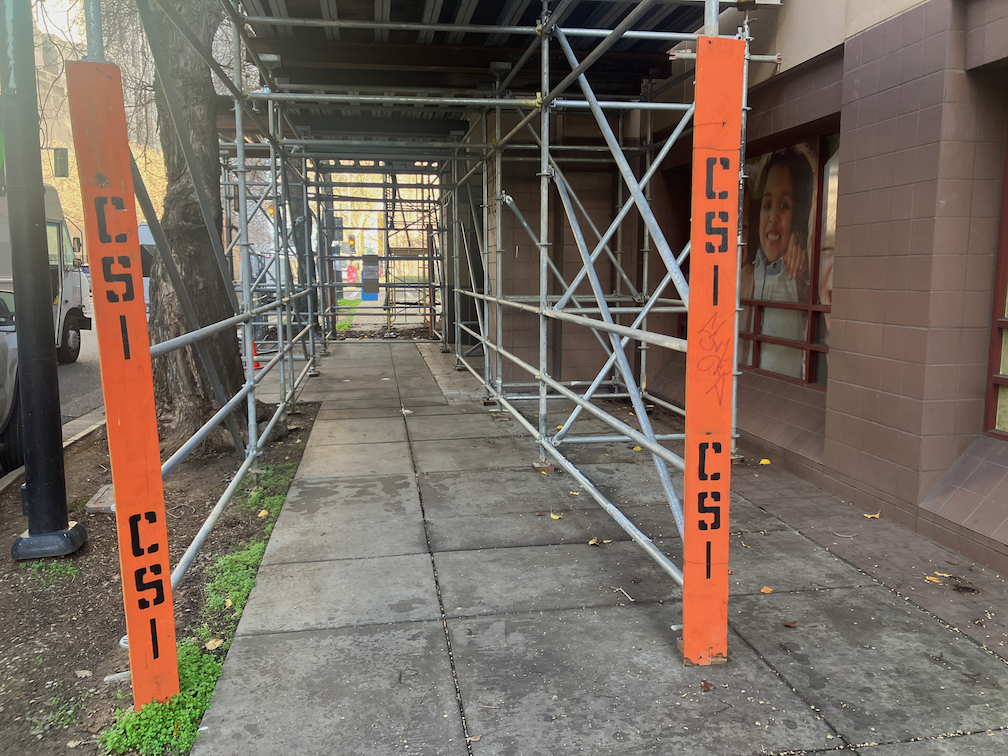
The sidewalk on the east side of 6th Street is completely blocked by construction. At I Street, there is no advance warning of the sidewalk being closed ahead. At the closure, southbound, there is a chainlink fence, which is not a detectable barrier, and no sidewalk closed sign. The construction extends to the curb, including the sidewalk buffer. From the south, there is no advance warning of the sidewalk being closed ahead, either at Improv Alley or at J Street. At the closure, there is a scaffolding, which is not a detectable barrier, and a small paper sidewalk closed sign, not compliant with CA-MUTCD or PROWAG. At the time I walked past, there were two delivery vehicles double-parked on the street, so even if a person wanted to walk around the closure, they would be forced out into traffic on 6th Street. This situation is a complete failure on the part of the construction company, and the city.

photo of SHRA construction on 6th St, no advance warning, no sign on chainlink fence
SHRA construction on 6th St, no advance warning, no sign on chainlink fence
photo of SHRA construction on 6th St, scaffolding as barrier, non-compliant paper sidewalk closed sign
SHRA construction on 6th St, scaffolding as barrier
photo of SHRA construction on 6th St, scaffolding as barrier, non-compliant paper sidewalk closed sign

SHRA construction on 6th St, scaffolding as barrier, non-compliant paper sidewalk closed sign

Work Zone webinar January 24

The City of Sacramento is hosting a webinar on the draft Work Zone and Event Detour Policy Update, tomorrow, January 24, 6:00PM. You can register for the Zoom webinar here (registration is not available on the Work Zone webpage).

With two posts today on construction zone violations, and hundreds of reports to 311, and a series of posts on the work zone policy, I hope that you will agree with me that this is a critical issue for everyone who walks or bicycles in the city (or drives, for that matter), and will attend this webinar. This will probably be the last chance for public education and input before the policy goes to city council, perhaps in February.

The two most important steps to improve the draft policy are:

  • acknowledge PROWAG (Public Right-of-Way Accessibility Guidelines) as the overriding legal requirement for alternate pedestrian access routes
  • establish a monitoring program which requires city staff (or contracted services) to monitor construction projects of more than one day with a visit at the beginning of the project, and at reasonable intervals thereafter

For other improvements to the policy that could be made, please see previous posts in category ‘Work Zones‘.

Work Zone and Event Detour Policy banner

reason #937 against diagonal ramps

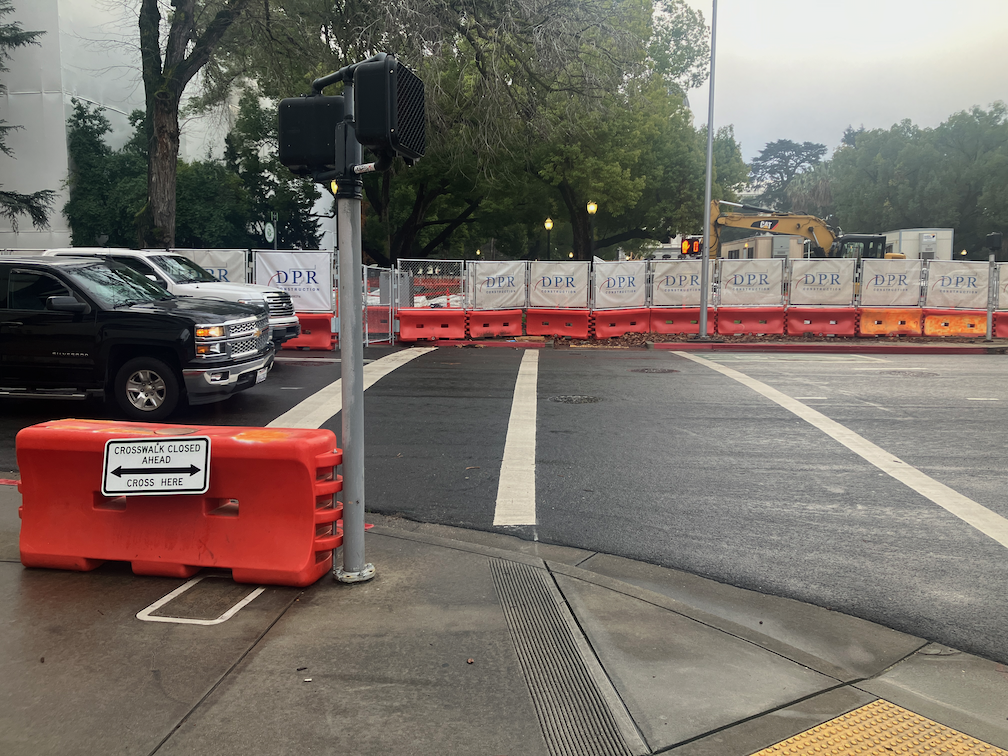
On the northwest corner of 9th Street and Capitol Mall, the construction project on the east side, Jesse Unruh State Office Building Renovation, has closed the sidewalk on the northeast corner, and therefore the crosswalk over 9th Street north side. In general, the construction project has done a good job of signing and barriers to comply with ADA. State projects, though not perfect, are more likely to be compliant with ADA than any of the city or private projects.

photo of 9th St & Capitol Mall NW difficult corner
9th St & Capitol Mall NW difficult corner

There should be a barrier across the crosswalk at this location, to indicate that the crosswalk is closed and the opposite side inaccessible. There is a barrier, and the correct sign, but the barrier is not blocking the crosswalk. But it can’t! If the barrier were placed to block this crosswalk, it would also block the crosswalk over Capitol Mall, which is not a closed crosswalk. That is just one of the things wrong with diagonal ramps. They make it impossible to correctly place barriers and signing for closed crosswalks and sidewalks.

Two actions could make this better. One, cover the pedestrian countdown signal so that it is not visible, and therefore subject to misunderstanding by limited vision walkers. But this would only be safe if, two, the crosswalk were completely blocked by barriers, and a temporary ramp to the Capitol Mall crosswalk placed, to the right of the barriers.

Diagonal ramps are now illegal everywhere via PROWAG, but of course existing diagonal ramps do not need to be corrected unless the corner is subject to modification for other reasons. The city has known for years that diagonal ramps are poor practice, but has continued to build them, or allow them to be built. And sadly, has even allowed illegal ramps to be built: serious concerns about Broadway.

Posts related to the work zone guidelines are linked via category ‘Work Zones‘ within City of Sacramento category. Posts about construction project issues, previous to and after the release of the draft guidelines, of which there are a huge number, are linked via tag ‘construction zone‘ within Active Transportation category.

16th & E construction uncorrected

The construction project at 16th Street & E Street, southwest corner, 500 16th Street, apparently called Studio 30, an affordable apartment complex, still has not corrected its significant flaws in ADA signing and barriers. An earlier post covered the difficulty in properly signing and routing due to the city’s mistake in prohibiting crossing on the north side of the 16th Street and F Street intersection: SacCity bad work zone and bad street design converge.

I reported the ADA violations on January 3, 2024. I checked the project today, 20 days later. Nothing has been corrected. Every violation of ADA standards, which is basically every one, is the same as it was. Apparently the city has decided not to follow up on my 311 report, or the construction company has decided not to correct anything. This is sad.

One thing I noticed today that I had not noticed last time is detour signs on the northeast corner of E Street & 15th Street. The sign directions are nonsensical. The signs may have once been set correctly, but if so, they have been moved, and now communicate incorrect information. This is what happens when signs are placed and then not monitored, by the city and by the construction company.

photo of E St 15th St NE confusing detour signs
E St 15th St NE confusing detour signs

The folding barricades used around this project (which are trip hazards) are labeled with JVB, for JVB Construction Management. I have more recently been paying more attention to who places the construction signs and barriers. This is the first project I’ve noticed by this company, not surprising since it is a southern California company. From now on when I blog about work zone failures, I will do my best to identify who is responsible. Of course it is not just the construction company that is responsible, the city is also responsible.

N Street & 14th Street construction

At a recent meeting, people asked me about the crossing of N Street at 14th Street, what I thought of the pedestrian prohibition, and why I hadn’t reported it as I do most other construction related issues.

N Street is a three lane one-way street, reduced to two lanes by construction at the state capitol, and the CADA construction project on the southwest corner of N Street and 14th Street. At this construction project, the parking lane and rightmost lane are closed, with a barrier and fence along N Street. The barrier and fence block driver view of the crosswalk on the east side of the N Street/14th Street crosswalk, until just before the crosswalk. This is a situation not addressed by CA-MUTCD, nor the proposed city Draft Criteria and Guidance to Accommodate Active Transportation in Work Zones and at Events, or work zone guide for short.

There are probably ways of safely handling this limited visibility situation, but it is not immediately obvious to me how. So I have not reported the closure of this crosswalk. It is a low volume crosswalk, I believe. Any detour for walkers is an issue, and this one requires a detour of a block to the east or west, because both the east crosswalk and the west crosswalk are closed.

While it is true that this crosswalk closure is no absolutely necessary, it is also true that it would take some sort of traffic control at this location to make it safe for walkers.

photo of N St approaching 14th St, poor visibility
N St approaching 14th St, poor visibility
photo of closed crosswalk over N St at 14th St, east
closed crosswalk over N St at 14th St, east leg, northeast corner
photo of crosswalk closed over N St at 14th St, east, southeast corner
crosswalk closed over N St at 14th St, east leg, southeast corner

SacBee: sidewalk repair

The SacBee published an article in January entitled ‘$20k? Homeowners in some Sacramento neighborhoods are billed more for sidewalk repair‘. The article is about the charges the City of Sacramento has made to homeowners, primarily in low income areas.

City code specifies that property owners are completely responsible for repair of sidewalks adjacent to their property. State streets and highways code seems to allow the city to claim this. The two relevant sections within Chapter 22: Maintenance of Sidewalks are: Article 2. Repairs and Article 3. Collection of Cost of Repair. I have previously made the claim that both state code and city code are unconstitutional, because they make persons responsible for maintenance of property that belongs to the city, not the person. In almost all cases, sidewalks and the land on which they lie is city property, not private property. This is particularly egregious when the sidewalk damage is due to city-owned trees in the sidewalk buffer (which the city calls planting strips).

Therefore, I believe that it is illegal for the city to charge property owners for sidewalk repair.

The major focus of the article is that low income communities are being unfairly targeted for sidewalk repair, with a graph that indicates that. That is one interpretation of the data, and it would not be surprising. The city has always and continues to treat lower income communities and people of color with bias. There is another explanation however. Sidewalks in lower income communities were very likely built to lower standards than in others, and it is likely that the city has never maintained any of them, except in some locations placing ADA ramps at corners. I notice in the central city that many sidewalk cracks are covered with asphalt patches, which were placed by the city. I have not noticed these patches in lower income neighborhoods. It is likely that the city is doing work in moderate and high income areas that they are not doing in lower income areas. The central city has more construction projects than other areas, which often result in the sidewalks being repaired or replaced. The central city has also seen a lot more installation of new corners with ADA ramps that other areas of the city. This makes some sense because much of the central city has higher pedestrian (walker) levels, but this fact does not overcome the fact that there are walkers in disinvested neighborhoods, and in particular, children walking to and from school deserve good sidewalks more than anyone else.

I have been in the habit of reporting sidewalk issues through the city’s 311 app. This article has made me rethink reporting. Am I causing unaffordable repair bills for people who can’t afford it? Is the sidewalk flaw really that bad? I’ve decided to stop reporting sidewalk locations, until these issues are resolved.

My next steps are to make a suggestion for how the city can mitigate these repair costs, and for the city to inventory its sidewalks so that it knows what the situation is throughout the city, rather than a complaint-driven system that is almost certain to have bias. Coming up!

photo of broken sidewalk, V St, Sacramento
broken sidewalk, V St, Sacramento
photo of sidewalk repaired due to damage by a city owned tree in a city owner sidewalk buffer, P St
sidewalk repaired due to damage by a city owned tree in a city owner sidewalk buffer, P St

SacBee: city response to crashes

The SacBee published an article yesterday: After a deadly crash, Sacramento fixed a dangerous road. Why isn’t this the norm? Apologies for linking to a firewalled article; if you have a subscription or access to a printed newspaper, it is well worth reading.The article is quite in-depth, more like the investigative reporting that the SacBee used to do, but rarely does any more. The author is Ariane Lange.

The article highlights changes made to the intersection of Broadway and Martin Luther King, Jr. Blvd (MLK) after a fatal crash single-vehicle crash in 2021. Though the article did not make clear, the driver was likely eastbound on Broadway and continued straight into the building. Google maps, below, does not show the changes, but a photo from the article does (second).

Broadway & MLK intersection, Google Maps (not up to date)
Broadway & MLK, SacBee photo (more recent)
Read More »

SacATC meeting January 18

The Sacramento Active Transportation Commission (SacATC) will meet on Thursday, January 18, at 5:30PM. This meeting will be at Historic City Hall, hearing room 2nd floor, though it usually meets in council chambers in new city hall. You can watch in person or online via https://meetings.cityofsacramento.org. You can comment via the eComment function on the meetings page, and in person. eComments are placed in the meeting record, but if you want to be heard, you must attend. Apparently Zoom is no longer available.

Agenda

Commission Staff Report (Oral Report)

Consent Calendar

  1. Approval of Active Transportation Commission Meeting Minutes
  2. Active Transportation Commission Log

Discussion Calendar

  1. Selection of Chair and Vice Chair for Calendar Year 2024
  2. Draft Work Zone and Event Detour Policy
  3. Log Item Report Back: Sacramento’s Alleys

Commissioner Comments – Ideas and Questions

Public Comments-Matters Not on the Agenda

Work Zone

The most important agenda item is 4, Draft Work Zone and Event Detour Policy. I have several prior posts on this. Please read if you want to make comments. Though there could be a number of improvements to the policy, it is overall very good, and far, far better than anything that exists today. The two critical improvements are that the policy must address PROWAG (Public Right of Way Accessibility Guidelines), which are now the law of the land (though not yet enforceable until adopted by US DOT and US DOJ), and that there must be monitoring of all projects that are more than one day duration. The city has claimed that they have contractors (not the construction companies, but separate compliance contractors) monitoring at least once, but clearly that is not happening, as there are violations of ADA on nearly every construction project, and corrections are either slow to occur or never occur.

A report on alleys is also on the agenda.

Truxel Bridge on STAR

STAR, Sacramento Transit Advocates and Riders, has created several posts on Truxel Bridge, the City of Sacramento effort to add a motor vehicle, transit, walking and bicycling bridge over the American River in alignment with Truxel Road. The STAR interest is that the original bridge proposal, approved by Sacramento County under the American River Parkway Plan and by SacRT, was for a bridge that carried light rail, walking and bicycling, not motor vehicles.

View these posts, and likely more to come in the future, on STAR at category ‘Truxel Bridge‘.