Caltrans D3 says ‘fuck you’ to Yolo bicyclists

The bike path along I-80 along the Yolo causeway is closed this afternoon (Tuesday, 2:00 PM). The sign at the east entry to the bike paths says:
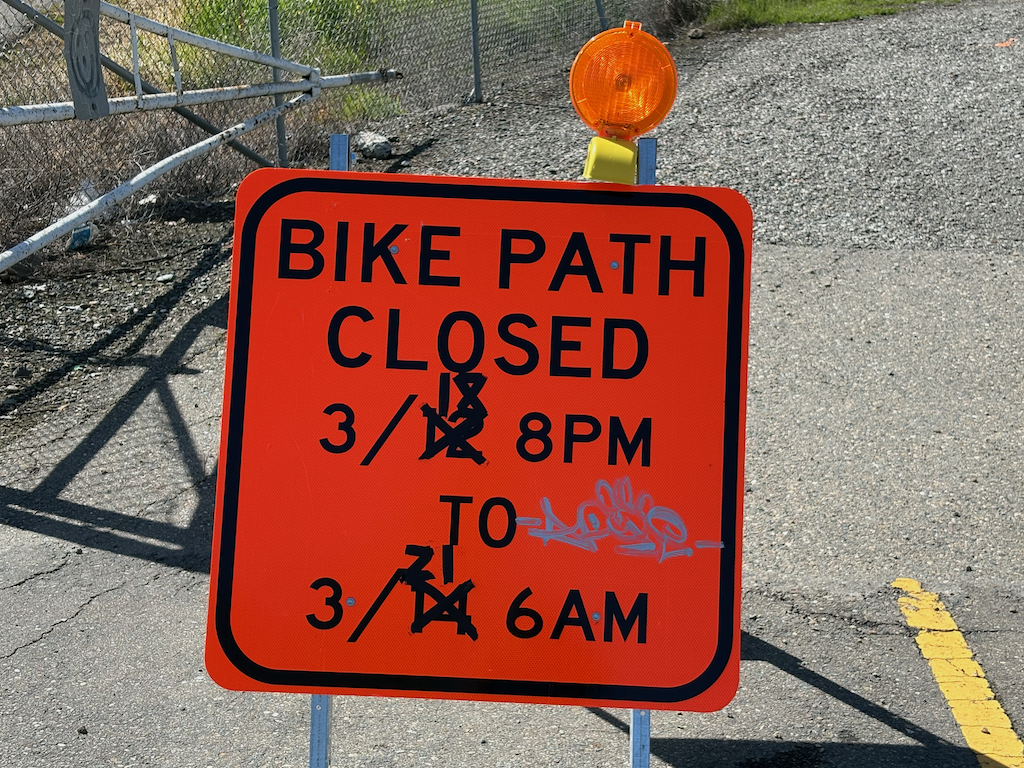
Bike Path Closed sign on east entry to Yolo causeway bike path

Note that this sign indicates that the path will not be closed until 8 PM on Tuesday, March 18.

This is what the Caltrans website says (UPDATE: Extended 79-hour Closure for Eastbound U.S. Highway 50 in Yolo County Postponed due to Weather Forecast, 2025-03-13, retrieved 2025-03-18 3:00 PM):

screen capture from Caltrans D3 website

Note that this press release says that the path will be open again by 6:00 AM on Tuesday, March 18.

And this is the reality is:
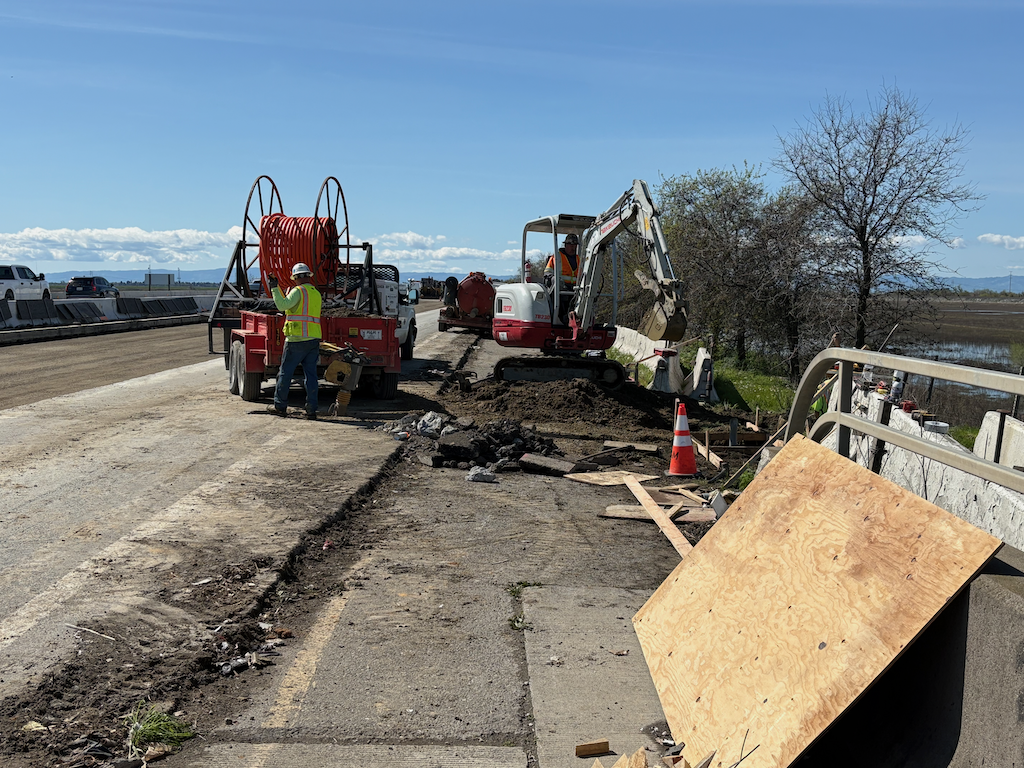
construction on Yolo causeway bike path

Construction is completely blocking the path, at this location and several others. The work to remove the concrete barrier from the freeway is ongoing along the western section of the causeway. Some parts of the freeway are also torn up, awaiting reconstruction.

I talked to the supervisor at this construction location, and he said they are just a subcontractor, not responsible for Caltrans signing, or lack thereof. He called the general contractor, who apparently said it is my problem, not theirs. After exiting at the I-80 off-ramp (the normal entry to the path north to Yolo County 32A is not accessible), I saw a CHP officer, and reported the issue to him. He said he would pass it along. He probably will, but I doubt that either CHP nor Caltrans will do anything about it.

This is an active construction project which was not properly signed for construction. This is a violation of Caltrans procedure, and state law, and federal law.

It is absolutely typical of Caltrans District 3 (which includes Yolo and Sacramento counties) to not care about the travel or safety of bicyclists. What would it take to correct the signing, and to correct the website? Not much, but it is beyond the care and interest of Caltrans D3.

Caltrans has said that as a result of the Yolo 80 project, there would be an improved bike path. I’ve previously written about why that is very likely to be a lie: Yolo causeway bike path. Note that though Caltrans claims the current construction is just bridge rehabilitation and has nothing to do with the Yolo 80 project, that is a lie. It is safe to assume that everything Caltrans D3 says is a lie. Caltrans is a highway department, not a transportation department. They care about motor vehicles. They do not care about walkers or bicyclists or air quality or the state budget. In fact, given the high fatality rate on both under-construction and completed highway projects, they don’t really care about motor vehicle drivers either.

I will also note that the California Transportation Commission (CTC) is complicit in Caltrans D3 malfeasance, as they continue to fund projects no matter what the behavior or violation of the law. And above CTC, California State Transportation Agency, which is intended to oversee both CTC and Caltrans, but does not.

HSIP grants for SACOG region

Caltrans has released a list of $300M in projects under the HSIP (Highway Safety Improvement Program) program of federal funds. See Streetsblog: State Announces Nearly $300 Million in Grants for Safe Streets for more information. The funds are a mix of federal and state, but the awards are selected by the state. Unlike most projects funded by the federal and state, these projects really do have a focus on safety, though the various signals in these grants may be as much motor vehicle focused as walker and bicyclist focused. The City of Sacramento has installed beg buttons, replacing auto-recall pedestrian signals, in an effort to ease traffic flow and only secondarily make it safer for people walking, so there is a concern about how signals will be implemented.

Twenty-three of the projects are in the SACOG region. A pdf of those is available. Presumably descriptions of each project are available somewhere, but I’ve been unable to locate them. If I do find them, I’ll highlight a few of particular interest.

State Rail Plan webinar March 4

Seamless Bay Area and Californians for Electric Rail are hosting a webinar, New State Rail Plan Explained: A vision for an integrated, cohesive California rail network on March 4, 2025, at 12:00 PM. Registration is required, but free.

The Caltrans/California State Transportation Agency 2024 California State Rail Plan (2024-12) is available for review. An earlier draft emphasized hydrogen trains to the exclusion of overhead catenary wire electric trains, but the current version includes catenary, battery electric and hydrogen fuel cell electric.

From the registration page: “The newly released State Rail Plan lays out strategies that can significantly impact how Californians and visitors get around the state – and can make California a place that’s easier for everyone to get around in an affordable, low-carbon, safe, and accessible way. The plan establishes a long-term vision for an integrated, cohesive statewide rail system that offers passenger and freight service and helps achieve California’s mobility, economic, and climate goals. Tune into this webinar to learn about the plan from California State Transportation Agency staff. Researchers and advocates will give their reaction to the updated plan including cost analysis, the political changes needed to implement reforms, and upcoming funding and reform opportunities.”

Whether or not you can attend this webinar, I encourage you to read the 2024 California State Rail Plan, focusing on the routes or concepts that are most important to you.

The Capitol Corridor, Sacramento/Roseville to San Jose, is called out for electrification, but the source power is not defined. Capitol Corridor is not specifically a single project, but part of several projects including Transbay Crossing, Leveraging Mega-Investments, Sea Level Rise, and Sacramento and San Joaquin Valleys. In stages, Capitol Corridor service is planned to reach once per hour in the mid-term, and once per 30 minutes in the long term. Current service is one hour at peak times of day, but two to three hours at other times.

Many transportation advocates strongly support catenary electrification of the Capitol Corridor route between Sacramento and San Jose. I have also advanced the idea of state purchase of the rails in heavy passenger rail corridors, which would include Capitol Corridor, either through willing seller or condemnation if necessary. Freight rolling stock would still be owned and operated by the railroads, but passenger trains would now have priority over freight trains, and the freight railroads could not resist catenary electrification.

I hope to provide more detailed analysis of the state plan in the near future.

timeline for Tier 4 diesel and zero emissions
2050 electrified corridors
long-term service plan

Yolo causeway bike path

Caltrans and Yolo County Transportation District are proposing to widen a section of Interstate 80 from Sacramento to the Yolo/Solano county line, a project called Yolo 80. This is not just a future project, subject to funding shortfalls and lawsuits, but is actually underway, as Caltrans illegally spends funds for highway maintenance on highway widening. I have written a number of posts on Yolo 80 and managed lanes, but today is just about the bike path that parallels Interstate 80 from the west edge of West Sacramento to Davis.

I am not a commuter or regular rider on the causeway path, but I do average riding it about once a week (I like concerts and beer and Mishka’s tea), and have been doing so for about 13 years.

Caltrans, in the Final Environmental Impact Statement (FEIR), Chapter 2, proposes a number of mitigation measures or policies, including the rehabilitation of the existing bike path, and extension of the bike path to county road 105, where a bicyclist can either use an existing though poorly maintained bike path along the freeway, or surface streets into Davis. In selling the project to the public, Caltrans and Yolo TD have promoted the mode shift potential of an improved and extended bike path, and in fact it seems a major part of the project.

However, this and all other mitigation measures are dependent upon excess tolling revenue, income above that necessary to maintain the section of freeway. It is not at all clear that there will be any excess funds, and Caltrans has made no promises that any mitigation measures will be implemented if there is no excess. Freeway maintenance is expensive!

To take Caltrans at their word, that they really want to do the bike path improvements and extension (if you take Caltrans District 3 at their word, you haven’t been reading this blog), it is instructive to look as the existing path and route.

First, the part along county road 32A, from where the path joins the road, to county road 105, where 32A crosses to the north of the railroad tracks, and the path along the freeway to Olive Drive begins. After a patch of gravel on the shoulder that gets worse over time, the bike ‘route’ is on the shoulder of road 32A, with a posted 55 mph speed limit (which means, in a practical sense, 65-75 mph). There is frequently trash on the shoulder, which is the responsibility of the county, but I have never seen trash picked up or the shoulder swept. This is not horrible for experienced bicyclists, I have ridden it a number of times, but replacing the shoulder with with an actual Class 1 bikeway would be an immense improvement. However, if the path is between 32A and the freeway, the noise and auto pollution will still be horrible. Could it be on the other side of the railroad tracks? Perhaps, but having the path pass under the railroad tracks to the north side would raise the issue of blocked access during flooding episodes, which are not uncommon in the Yolo Bypass (that is why it exists).

The second mitigation is rehabilitation of the existing bike path along Yolo causeway. I think it is useful to see how Caltrans is taking care of the existing path to see how they might rehabilitate it, and take care of it in the future. Preview: They don’t give a shit.

Trash coming off vehicles accumulates on the path. I don’t know how often it is cleaned, but I can tell you it is not often. Maybe twice a year. A lot of the trash eventually gets blown off into the Yolo bypass rather than getting picked up. This Wednesday, there were large accumulations of leaves shed from the trees along the path.

The path itself has not been maintained in the 13 years I’ve been riding on it. There are cracks that have been there so long tree sprouts are coming up in them. The asphalt parts of the path, where the path is on fill rather than bridge, are becoming unrideable. Many of these cracks are parallel linear, presenting the danger of wheel capture and falls for narrow-tired bikes.

When it rains, the path has large and persistent puddles. It was not well designed to drain. Note that the photo below was two days after the rain, and there is still standing water.

The path has been narrowed in several places for construction of the widened section of the freeway. This makes everything worse, removing the width that allows bicyclists to navigate around hazards.

There is a fence along the concrete barrier between the freeway and the path. This fence is not only intended to keep people from crossing (though it does have gaps from time to time, presumably to allow people from disabled motor vehicles to exit the freeway), it protects bicyclists on the path from flying debris from cars. Not only the trash they lose, but actual car parts. You can find a variety of car parts along the path, and I’m sure far more is prevented from getting onto the path by the fence. Cars lose a lot of parts! But construction has removed the fencing along a number of sections. In some cases there is wood fencing on top of the K-rail temporary barriers, but it is flimsy and only half the height of the fencing. And in several locations, there is no fencing at all, it has simply been removed. For no reason, so far as I can see.

At the western end of the causeway section, where the path turns north to connect to road 32A, there should be a permanent barrier to make sure that bicyclists don’t continue onto the freeway. But the barrier, created with leftover materials, is frequently damaged, probably by construction crews, and has several times been missing completely. Imagine riding here at night!

What Does It Mean?

It means that Caltrans cannot be trusted to construct, rehabilitate, or maintain a bike path along the route of Interstate 80 through the Yolo Causeway and into Davis. They are lying that they have, they are lying that they will. Do not, under any circumstances, trust Caltrans District 3 to serve or protect bicyclists. This is criminal neglect by Caltrans.

SB 960 complete streets signed

Governor Newsom has signed SB 960, the complete streets bill (SB-960 Transportation: planning: complete streets facilities: transit priority facilities.), authored by Scott Wiener. That’s the good news. It is certain that the Caltrans districts will resist this law, but with oversight by CalBike and the public, things will gradually shift.

CalBike series on Caltrans complete streets failure

CalBike has published the first two of a series of reports on the failure of Caltrans to follow their own complete streets policy when designing and building streets which are also state highways. It is telling that the first of the series is on the failure of Caltrans District 3, which includes Sacramento county, to actually provide complete streets – Incomplete Streets Part 1: How Caltrans Shortchanges Pedestrians. District 3 is perhaps the worst of the Caltrans districts, which operate as independent (or rogue) agencies and regularly subvert Caltrans policy and direction from headquarters. Though they have a lot of competition for the title of worst.

“District 3 is perhaps best known as the district pushing through the Yolo Causeway highway expansion project. The project, which has been approved despite internal and external opposition, led to the firing of Caltrans Deputy Director Jeanie Ward-Waller after she blew the whistle on improper use of funds for freeway widening and insufficient environmental review.”

I encourage you to read these first two, and to follow CalBike investigative reporting. Caltrans must be held to account, as otherwise they will continue to design projects that kill and injure walkers and bicyclists, will continue to resist fixing the design mistakes they have made in the past, and will continue to commit fraud on the people of California by lying about what they are doing with your tax money.

complete streets and intelligent speed assist

This week at the legislature, the Assembly Transportation Committee is hearing SB 960 (Wiener) Transportation: planning: complete streets facilities: transit priority projects, Monday, July 1, 2:00 PM in Room 1100 at 1021 O Street in Sacramento (StreetsblogCA: Complete Streets Bill Hearing Next Week). This bill would force Caltrans to follow its own policy on Complete Streets, which is seldom does, and could have a beneficial impact on all street redesign in California as many transportation agencies look to Caltran for guideance.

The Assembly Privacy and Consumer Protection Committee is hearing SB 961 Vehicles: safety equipment (Wiener), Tuesday, July 2, 1:30 PM, in Room 126, State Capitol. The bill would implement Intelligent Speed Assistance for all vehicles except emergency vehicles. Though considerably weakened from the original version, with passive rather than active control, it is still a valuable step forward, and would encourage NHTSA to speed up their policy process, which they have been slow walking (to preserve fast driving).

If you live in Sacramento and can attend, please do. All you can do at legislative hearings is ‘support’ or ‘oppose’, but since most speakers are paid lobbyists, hearing from actual citizens can be powerful.

CalBike What are complete streets? graphic

lawsuits against Yolo 80

For earlier posts on Yolo 80 and managed lanes, see category ‘managed lanes‘.

Two lawsuits have been filed against Caltrans over the Yolo 80 freeway widening project.

Sierra Club and ECOS: Sierra Club, ECOS file lawsuit against Caltrans over I-80 project; Sierra Club and ECOS Sue Caltrans over Yolo I-80 Freeway Widening Project

“Caltrans’ Environmental Impact Report (EIR) grossly underestimates increased vehicular travel, which would emit far larger quantities of greenhouse gases (GHG) and air pollutants than claimed. The EIR fails to consider viable alternatives, such as increased public transit or alternate tolling strategies. Therefore, the project neither adequately manages demand nor produces adequate revenue to fund needed transit alternatives. Also, Caltrans’ proposed mitigation is woefully inadequate to offset the resulting increased GHG and air pollutant emissions.” – Sierra Club/ECOS Press Release

NRDC (Natural Resources Defense Council)/Planning and Conservation League/Center for Biological Diversity: Environmental Groups File Suit Against I-80 Highway Expansion; Environmental Groups Challenge Highway Expansion Project in Court

“First, Caltrans improperly chopped this project into two pieces to use funding in illegitimate ways and obscure environmental impacts, as documented by a Caltrans whistleblower. The first project, already underway, is using maintenance-only transportation dollars to strengthen the shoulders of the highway so they can accommodate heavy vehicle travel. The second project would restripe the road to accommodate the additional lane of traffic in each direction.” – NRDC

I tend to be cynical about the chances of stopping this widening project. However, the lawsuits can have several beneficial impacts:

  • requiring Caltans to supplement or revise its Environmental Impact Report, because it failed to consider several impacts, and failed to address induced demand
  • requiring Caltrans to allocate more funding to environmental and GHG mitigation; the existing project only partially mitigates impacts, and depends on income from a single tolled lane, which may fall short of projections
  • highlighting the failure of the California Transportation Commission, and in particular Chair Carl Guardino, to provide legally required oversight of Caltrans

I am in favor of tolling freeway lanes in order to recovered construction and maintenance costs, and to fund mitigation measures, not just for GHG but for other environmental impacts. A tolling authority (CARTA) has been set up to administer the added toll lane, but there are great uncertainties about how much will be raised, and the fee structure (vehicles and time of day) has not been developed.

“The EIR does not consider tolling existing lanes, which could be based on income, with funds used to provide clean public transit and bike and pedestrian options along the corridor, facilitating affordable infill development.” – Ralph Propper, ECOS Climate Committee Chair, from the press release

Caltrans widening I-5 north of Sacramento

Yesterday I rode the bus to and from Sacramento International Airport, to see what the ride and buses and ridership were like. I noticed that there is significant construction occurring on I-5 between Arena Blvd and Airport Blvd, the entrance to the airport. The freeway width under overcrossings is being widened by one lane in each direction, and the roadway is being widened in between the overpasses and interchanges. I had not heard or realized that this work was already going on, but then, I rarely travel on I-5. This project is titled “SAC-5 Corridor Improvement Project – Phase 1”, and is being referred to as “Sacramento I-5 Auxiliary Lanes Project”. A fact sheet is available.

Caltrans claimed a categorical exclusion for this project, meaning that they claimed they did not need to do an environmental assessment or environmental impact statement for CEQA or NEPA because the project would not have a significant environmental impact. This is laughable. Capacity expansions ALWAYS have an environmental impact. It amazes me the number of agencies, including SACOG and California Transportation Commission, that sign off on this bullshit. The project number is 03-4H580, which means it is part of the Caltrans District 3 megaproject to increase the capacity of I-5 and I-80 in the Sacramento region. It may be that part of this widening is a separate project to add an auxiliary lane between Metro Airpark and State Route 99, using Trade Corridor Enhancement Program (TCEP). It appears that the main project is funded through Solutions for Congested Corridors Program (SCCP). The project also shows up on lists of State Highway Operation and Protection Program (SHOPP) projects, though it is not clear whether it actually received any SHOPP funding. This type of widening would be illegal as a SHOPP expenditure. There are literally 70 documents that relate to this project, and it is beyond me to figure out what they all mean, or how they relate to each other. Caltrans specifically does not gather these documents onto a project page. That would entail some transparency, which Caltrans District 3 is apparently opposed to.

The photo below shows the widening of I-5 at Airport Blvd, captured from Google StreetView. The freeway is being widened to the west to the Sacramento River crossing, and the widening appears to continue all the way to Arena Blvd. Caltrans calls these auxiliary lanes, meaning they extend only between interchanges but not through, but it appears to me that they will be continuous, and that is why the freeway is being widened beneath the overpasses. These modifications of the overpasses are called tie-backs by Caltrans, meaning the the original slope under the overcrossing bridge to the freeway is being truncated to add width to the freeway.

This is phase 1 of the project. Caltrans intends to add capacity to I-5 all the way from the Yolo County line to US 50, where the earlier project greatly expanded capacity from Elk Grove north.

If readers travel this section of I-5 and have comments about this project, or more knowledge of the project than I have been able to come up with, please comment or contact me.

Senator Wiener introduces road safety bills

California State Senator Scott Wiener has introduced two bills to improve road safety in California.

The more important is SB 961, which requires changes to vehicles directly, including a first-in-the-nation requirement that all new vehicles sold in California install speed governors, smart devices that automatically limit the vehicle’s speed to 10 miles above the legal limit. The old name for these is speed governors, which limited speed with a physical device that disengaged the driver train when a certain speed was reached. They were required on all early motor vehicles before vehicle manufacturers managed to eliminate laws requiring them. Today, speed can be digitally read and limited. Already, almost all new vehicles have built in the ability to limit speeds to the posted speed limit, but it is not implemented. The bill would require it be implemented by 2027.

Speed is a contributing factor in all motor vehicle crashes. Whether it is driving too fast for conditions, or simply driving way over the speed limit, speed is a contributing factor to carnage on our roads. Of course there are other factors such as roadway design which encourages speeding. And speed limiters won’t prevent drivers from running red lights, as has become so common, but at least the resulting crashes will be at a lower speed, less likely to result in fatalities.

Speed limiting of vehicles also would remove law enforcement from most speed enforcement, which increases safety for everyone on the road, including officers.

SB 960 requires Caltrans to implement and report on a complete streets policy. In vetoing a Wiener bill to require complete streets, the governor implemented a executive order that purported to accomplish this, but Caltrans has done almost nothing since then, and has weakened and then delayed release of its complete streets policy directive. The bill also requires Caltrans to develop a transit priority policy with performance targets.

Caltrans headquarters has, to some degree, gotten on board with the idea of designing and re-designing roads for better safety and productivity, but the Caltrans districts, including our District 3, are still full speed ahead (pun intended) on building unsafe highways that kill walkers and bicyclists. They must be reigned in by the legislature.

CalBike is a sponsor of both of these bills, along with other organizations. Yay, CalBike!

Links: