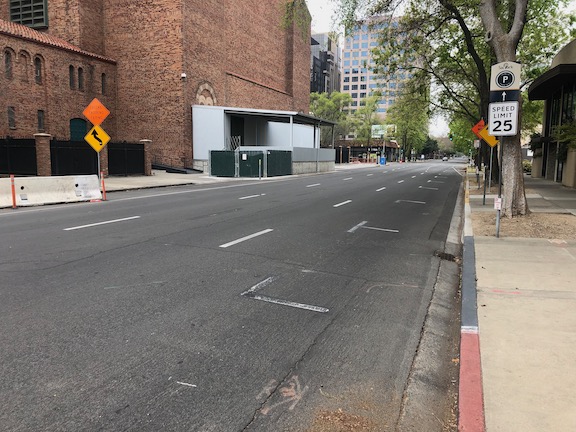
Note: updated 2020-03-28 to correct lane descriptions and add a photo of the lane shift.
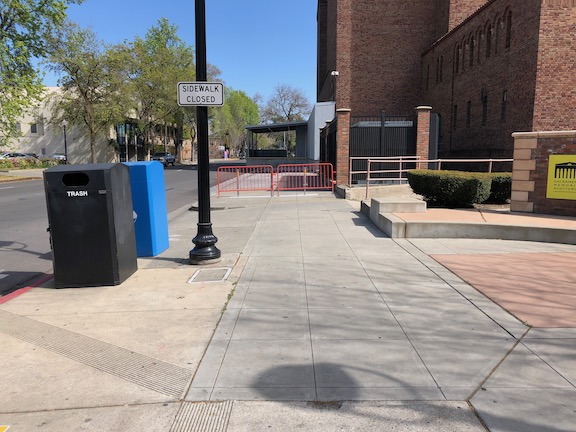
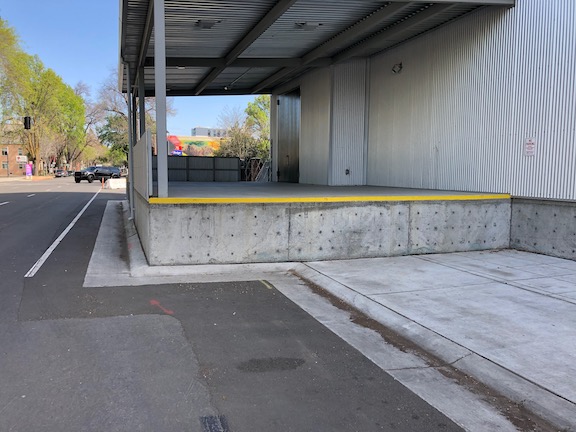
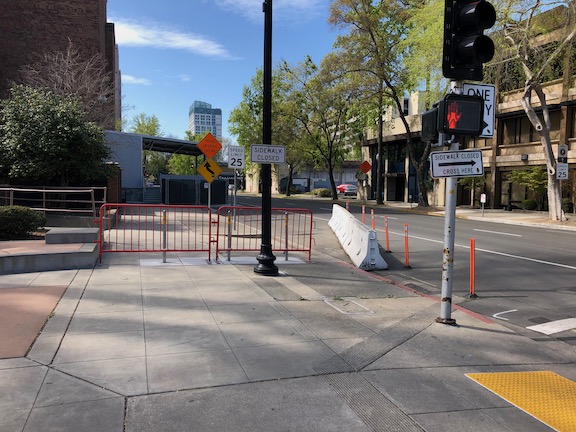
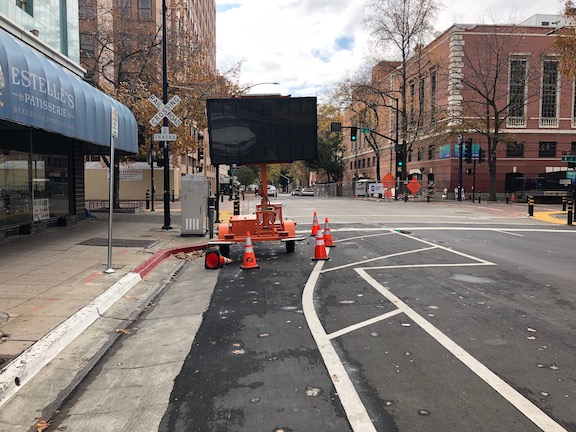
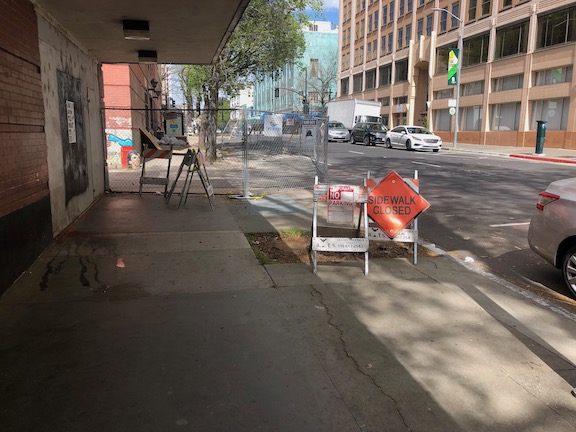
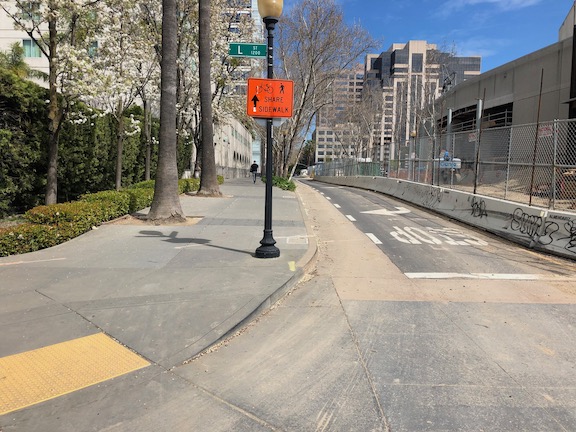
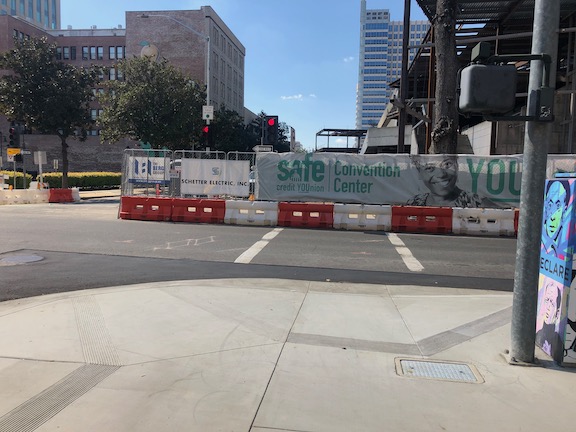
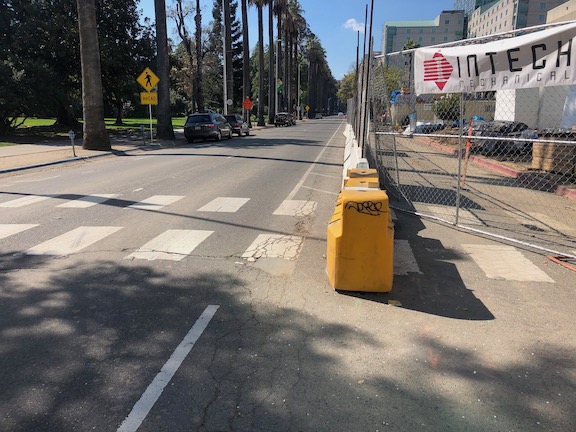
On the south side of I Street, between 15th Street and 16th Street, the city has permanently closed the sidewalk. This was to construct a loading dock for Memorial Auditorium. I had noticed the construction going on there, the first phase of the city’s project for the convention center and community center theater, and just assumed things would be returned to normal when construction was complete. How wrong I was. I was flabbergasted when I saw this. The loading dock sticks quite a ways into what used to be the public right of way, erasing the sidewalk and two parking lanes (the general purpose lanes were shifted to the right). The loading dock is concrete, intended to be there forever. See the photos below.
If the loading area was really than important, and could not be provided anywhere else, the city could have set things up for easy temporary closure of some of the street so as to allow loading when needed. They did not, they made it permanent.
I have walked by here, on the sidewalk, when events were going on at the Memorial Auditorium and there were a lot of walkers using this sidewalk. I imagine for a lot of other uses as well.
Also note that the ‘ bike lane’ stripe does not meet standards for a bike lane because it is immediately adjacent to a hard barrier and fence, so requires shy distance not provided. So that means when there are eventually bike lanes on I Street, this will be a gap, permanently.
What the fuck were you thinking, City of Sacramento?
I Street, south side, east of 15th StreetI Street, south side, east of 15th StreetI Street, south side, west of 16th StreetI Street, south side, west of 16th StreetI Street westbound, lanes shifted right
There is a national movement, 10 Minute Walk, with a goal of every person in cities of all sizes is within a 10-minute walk to a park, by 2050.
In the Sacramento region, the City of Sacramento (Darrell Steinberg), the City of Elk Grove (Steve Ly), and the City of Citrus Heights (Jeannie Bruins) have signed on. None of the other cities have. Looking at the listing for the western United States, all are cities except for Los Angeles County. I am not sure if park districts can sign on, but that might make some sense for Sacramento County which has a large number of separate park districts as well at Sacramento Regional Parks.
Why is this important right now? Many neighborhoods do not have sidewalks, so people out for physical and mental health must walk in the street. Sometimes that is OK, on very low traffic and low speed streets, but as you may have noticed, some drivers are using the empty roads as an opportunity to speed and driver recklessly, unconstrained by congestion. Even on streets that have sidewalks, they are often much too narrow (4 feet, 5 feet, occasionally 6 feet, rarely more; I am talking about neighborhoods were most people live; central business districts often have wide sidewalks but few residents) to share with the 6-foot physical distancing requirement. Parks are a great alternative. I am not talking about gathering in parks, which has been prohibited or strongly discouraged in most places, but just a safe and pleasant place to walk. Though many of us will be working to prevent a return to previous traffic levels and speeds, the mostly empty streets we are seeing now have a limited shelf life, and the need for parks will be even greater.
Though I’ve been aware of this goal for a while, I have not looked into it or gotten involved yet. As I have the chance, I will post more, perhaps a map of the city or county showing ten minute walk buffers around parks, and information about whether this goal is in the existing and updated general plans for the counties and cities in the region.
In the meanwhile, you might want to look at the National Recreation and Parks Association (NRPA) web page on 10 Minute Walk for some background information.
So, now that I’ve spent several posts complaining, on to solutions. The city is working an ordinance for construction zone handling, but I have not seen any draft documents. When something is available, I’ll add it.
The City of Oakland has what is generally considered to be the model guidance (http://www2.oaklandnet.com/oakca1/groups/pwa/documents/memorandum/oak062315.pdf), though Seattle also has something good that I’ve not tracked down yet. Sacramento could do well to simply adopt the Oakland guidance, but it is pretty radical for Sacramento, so I’m expecting something weaker to come out. Let me say what I think is most important.
Let me credit Robert Prinz of Bike East Bay for publicizing the guidance (he may have also had a part in developing it, not sure about that), and for monitoring compliance and publicizing failures. He is an inspiration for me.
Management:
Responsibility for approving traffic control plans should be removed from Construction Services and placed in another division of Public Works that will actually ensure quality traffic control plans and enforcement as needed. Construction Services has demonstrated that they cannot be trusted with this responsibility. They continually bias for motor vehicle traffic and drivers, and against walkers and bicyclists.
Construction sites should be inspected on a regular basis by city personnel, to ensure that they have correctly installed the signing and barriers specified in their approved traffic plan, and that these are maintained until completion of the project.
Fines will be imposed on construction companies that do not correct problems within 12 hours of reporting to the city, by city staff or by citizens. If the construction company fails to correct the issue within 48 hours, the construction project should be shut down.
Sidewalks and bike lanes:
For any roadway with more than one general purpose travel lane in the same direction, it shall be automatic that temporary sidewalks and bicycle lanes will be placed instead one lane.
For any roadway with parking lane on the same side as the construction zone, it shall be automatic that temporary sidewalks and bicycle lanes will be placed in the parking lane.
For any roadway where the bicyclist and/or pedestrian traffic is above a certain level (I’m not sure what the number should be), if no accommodation can be made by using a parking lane or general purpose travel lane, then the road will be closed to motor vehicle traffic in one or both directions for the duration of the project.
Crosswalks:
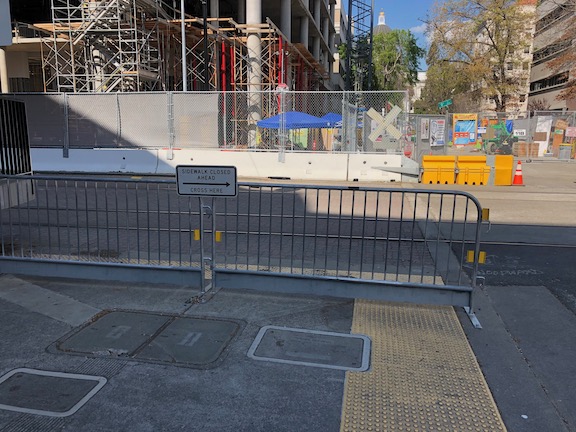
ADA compliant barriers and signing will be used at ALL construction projects which close a crosswalk, no matter what the duration of the project. For any closure of over a week, fixed metal barriers should be used (see photo below). Plastic barricade poles or construction tape will never be used by themselves to mark a closure.
Unless the closest safe crossing is clearly evident from the point of closure, wayfinding signs will be included specifying the shortest distance and safest crossing.
ADA detectable crosswalk closure barrier
Signing off for now with the construction zone topic. I found several more problematic locations on my walk this morning, but I need to take mental break from this, and talk about other things.
As always, I invite your comments and additions. Stay safe walking and bicycling out there, but don’t stay home. Your sanity requires being outside, or at least that is my opinion.
A brief aside before I get to the solutions for construction zones.
I’ve been out walking I don’t do that much talking these days These days These days I seem to think a lot About the things that I forgot to do, for you And all the times I had the chance to
Jackson Browne, “I’ve Been Out Walking” or “These Days” 1967/1973
I’ve realized in the last few days that I could spend a week, and fill up a week with blog posts, about construction zone problems in just the central city, and could probably spend a month on it in the entire city. Prior to the shelter-in-place, I was mostly bike riding for time reasons, but now that I have more time, I’ve been walking a lot more, and I see a lot of construction activity that I failed to notice on bike. When I’m bicycling, I just go around the construction zone, taking the lane, because that is what I mostly do anyway, and don’t think about it that much. However, most people aren’t willing to take the lane in traffic, and therefore are stopped cold by these construction zones that do not carry the bike lane through. My posts will continue to be mostly about issues for walkers because I see walkers as being more vulnerable users of the public right-of-way, as compared to bicyclists, and collision statistics back that up, however, I recognize that there are plenty of issues for bicyclists as well.
I recognize that all the examples of construction zone problems (and a few done right) have been central city Sacramento. This is for two reasons, one is that I live downtown, and when I’m out on my physical distancing walks, these are the places I’m seeing. The second is that a lot of the construction happening in the entire city is happening in downtown, particularly the projects which require extensive closure of sidewalks, and bike lanes. If you have examples from other places, please let me know (allisondan52@gmail.com) and I will try to get there to take photos and analyze the situation. For those of you in the county, well, that is too much to tackle, and in a relative sense the county is economically moribund, so much less construction is going on.
Please don’t take my criticism of construction zones at being a criticism of construction. I love that there is a lot of construction going on. In midtown, most of the construction is housing, and nothing could make me happier. In downtown, there is more office construction than housing construction, and that is not a good thing, as it further exacerbates the jobs/housing imbalance in downtown. Except right around the arena, and in old town, there are few businesses and almost none are open on weekends because there is so little housing as compared to offices.
Below, a few last examples, before I move on to solutions. The first was a temporary issue, but it is illustrative of the problems. A mobile message board was placed in the center of the separated bikeway on 9th Street, even though there was a cross-hatched area immediately adjacent where is could have been placed, without constraining the bikeway or the general purpose lanes. I am not sure whose mistake this was, but anyone with a brain would know that this was the wrong place to put it. The sign was moved within a day of my reporting it to the city, but these are things that should be done right, not relying on citizens to correct mistakes.
9th Street separated bikeway, mobile message board
There is currently a utility project along the north side of L Street between 13th St and 10th Street. The photo belows shows the situation at L Street & 11th Street. The signing is acceptable, though the use of plastic barricade poles is not, but the issue is that the detour doesn’t tell you how far. A block? Several? Where is the nearest safe crossing? As referred to in the What? Cross Where? post, the west side of this intersection has a pedestrian prohibition, but you can see someone crossing here. And why not? What else could they do?
L Street at 11th Street, signing but no information, improper barricade
This next one was a temporary closure on 10th Street. There is signing, but rather than being placed at the point where a walker could either choose to cross to the east side of the street, or to walk through Cesar Chavez Plaza and back to the sidewalk, it was placed where the closure starts. Again, the plastic barricade poles do not meet ADA requirements because they are not detectable for person with vision limitations. While some would say, well this is just temporary, for a day, and standards should be lower, I disagree. It may be perfectly acceptable to not provide an alternative route for a temporary closure, but the signing and sign locations should be the same for all closures, whether they last an hour, a day, a week, a month, a year.
10th Street, west side, temporary closure
And one last example, though I have dozens more. The 3rd Street Sewer project has closed off 3rd Street from S Street to U Street. An attempt has been made to keep the sidewalks open, and I seriously appreciate this effort, as many construction projects would simply close off the sidewalks along with the street, and not think twice. However, construction tape does not a safe route make. The detour signs are clear, but no attempt is made to provide a detectable barrier. And construction tape…
Yet another. There is a construction project, or at least a fencing off for future construction, at 830K, a long abandoned building. Along 9th Street, a fence has been put up where there used to be a bus stop, extending from K Street to and including Kayak Alley.
Southbound at K Street, there is no signing on the fence at all. This is not a major flaw, as it is obvious the sidewalk is closed, but there is no information about how far the closure extends.
9th Street southbound at K Street, west side (830 K)
From the south end, things are much worse. There is no signing at L Street to indicate there is a closure ahead. When you get to the closure, there is a random assortment of barricades, each of which is non-ADA compliant, and not indication which way to go. If Kayak Alley were open, it would at least offer an alternative, but the alley is closed.
9th Street, northbound at Kayak Alley, west side (830 K)
The worst part of this is that, so far as I can tell, nothing is going on here. The sidewalk, and bus stop, was closed off by fencing, but since then, nothing is happening. The point here is that there should be requirements placed on construction projects that if they stall out, the sidewalks must be returned to their previous open condition until such time as construction resumes.
The convention center and community center theater project (3C) project did a very poor job of preserving access for walkers and bicyclists at the beginning. Some issues have been resolved, but some never have, though the project has now been going on for just less than two years.
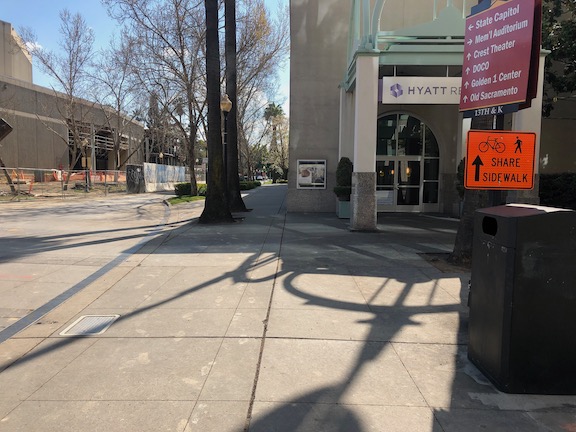
The most significant issue is that there was no provision made for northbound bicyclists on 13th Street, passing the construction between L Street and J Street. 13th is a major bicyclist route of travel, and the city knew this before the construction started. But the original traffic plan did not address this use at all. After public complaints, a sign was installed on the sidewalk for northbound bicyclists, photo below, but not the southbound. The numerous walkers using this sidewalk, adjacent to the Marriott and Sheraton convention facilities, were confused to see bicyclists on the crowded sidewalk. After more public complaints, a sign was added southbound, the second photo, though it is placed in a location where people coming from K Street would not necessarily see it. As you can see in the first photo, the sidewalk is narrow just north of the crosswalk, so bicyclists heading north are brought into immediate conflict with pedestrians heading south, many of whom are headed to the crosswalk over L Street. Of course having an angled ADA ramp here, rather than the two-to-a-corner design that should be used wherever there is significant pedestrian traffic, makes things worse.
Of course the best solution here would have been to just close 13th Street to motor vehicles between K Street and L Street, leaving the narrowed roadway available for two-way bicyclist traffic. There are far more bicyclists using this route than private vehicle drivers. Despite that, the city biased in favor of drivers.
13th Street northbound at L Street13th Street southbound at K Street
One issue on which progress was made was the southeast corner of J Street and 13th Street. Initially this corner was closed, giving walkers only one choice of how to cross, despite this being one of the most heavily used intersection crossings in the city. There was no reason to close the corner off, the area behind the fence was never used for construction. After about a year and a half, the corner was re-opened, photo below, so that walkers have a choice of routes. Note that when the city finally worked on this corner, the work was not done behind the fence, but the fence was moved and then the sidewalk and ramp work done by closing off the corner until it was done.
J Street & 13th Street, southeast corner, finally re-opened
On the east side of the project, issues remain. The sidewalk from J Street south along 15th Street has no signing indicating that it is closed ahead, see photo. When you get half way, there is just a fence blocking access. In daylight, you can see the fence ahead, but a limited vision person and anyone walking at night would not see the fence until they got to it. This is simply unacceptable.
15th Street west side, southbound from J Street, no signage
There are several other less serious issues around the east and south sides. At K Street & 15th Street, there is no signing to indicate how to get to the other side, to go either northbound or southbound. This one is not hard to figure out, at least for sighted people, but it was still not done correctly. This crosswalk ramp should have been barriered off, just like the ADA compliant barriers in the previous post, since it only leads to a closed crosswalk.
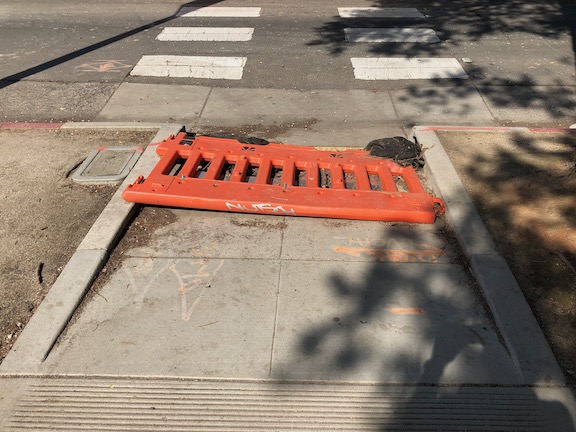
On the south side of the project, there are plastic barriers for the crosswalk over 14th Street at L Street, and for the crosswalk over L Street on the west side of 14th Street. These barriers were knocked over months ago and have not been put up again. There were not sufficient to begin with, but laying down on the ground, are both useless and hazardous.
14th Street at L Street, failed barrierL Street at 14th Street, west side crosswalk, failed barrier
I’m going to call this one a failure on the part of both the construction company and the city: the construction company for failing to monitor and maintain the traffic control devices for which they are legally responsible, and the city for failing to monitor the construction company. Blame all around!
And lastly, the closure of a lane on L Street for the construction was not handled well. As you can see, there is a narrow crosshatched area the length of the block. One might reasonable choose not to go this way, but then again I see people going this way every day, both walking and bicycling. I am not sure how this should have been handled, but there must be a better solution. Of course one solution would have been to continue a temporary pedestrian walkway on the north side of the street, set off by concrete barricade, and requiring only a simple fence to separate the walkway from the construction site. If more street width was required, parking could have been removed from the south side and the general purpose lanes shifted to the left. Note there there never was a bicycle lane present in this block, it is dropped at 15th Street and the traffic sewer 3-lane roadway continues west.
L Street westbound at 14th Street, narrow shoulder
In closing, this construction project is probably the worst in the city (though there is competition). It does not involve a private property owner, it does not involve a state construction project, it is a city project on city land. There is simply no excuse for such poor walker and bicyclist accommodation. It is a big middle finger to those to who don’t drive.
And now, before going on to all the examples of failure to accommodate walkers and bicyclists, some examples of crosswalk/sidewalk barriers that are done right. These barriers are for the state office building being constructed on the north side of O Street between 11th Street and 10th Street. It is also the light rail alignment, and one of the busier light rail borderings is across the street at Archives Plaza.
These barriers are some of the few ADA compliant barriers in the entire city. These are hard barriers, not construction tape or plastic barricade poles that can be walked through without notice be a vision impaired person. They have a base plate which is detectable by canes. They are anchored to the sidewalk, so that they can’t be knocked over intentionally or accidentally. The signing is clear, that the sidewalk/crosswalk is closed, and that the route goes left, crossing O Street.
11th Street at O Street, northeast corner
At the opposite corner of the project, on 10th Street southbound, there is clear signing, even wayfinding signing for the State Museum. Though the sidewalk is open for half the block, the barriers and signing make clear that a crossing of 10th Street is the appropriate action. Again, these are ADA compliant barriers.
10th Street east side, southbound from N Street
On 11th Street northbound, there is ‘share the lane’ signing, which is not ideal but serves acceptably in this situation with narrow street width. On 10th Street northbound, the bicycle lane has been carried through by shifting travel lanes to the left (west) and removing parking (no photo, but I will add one later). This is a good solution to accommodating bicyclists.
11th Street northbound
The remaining photos below show the other barriers and signing for this construction project. I don’t know why this one was done correctly, when most of the others are not. Was it the construction company that insisted on doing it right? Was it the state? Was it the city?
10th Street at O Street, northwest corner, crosswalk barricadeO Street at 10th Street, southeast corner, barricade and signingO Street at 11th Street, southwest corner, barricade and signing
Now onto a construction signing instance that would be laughable if it weren’t dangerous and offensive.
11th Street & J Street, northwest corner
Take a look at the signing, and think about what it means….
The orange detour sign is telling you the detour goes left, to cross J Street, while the permanent pedestrian prohibition signing tells you not to cross J Street here. Leaving along the issue of a stupid place to put a pedestrian prohibition (it is here simply to favor the drivers whipping out of the garage exit on 11th Street and wanting to take the right without stopping), this is nonsensical. This is one of the few issues that I do blame the construction company for. It was eventually corrected, the orange detour sign was turned around to face eastbound walkers, where it should have been, but it was this way for more than 24 hours. Does the construction company care so little about safety that it just puts up signs without thinking about them? Well, yes.
Since there will likely be a long string of posts on construction zones done wrong, I want to point out that they can be done right. This is one from yesterday. Though the crosswalk closure here was less than one day, it was signed properly, and the detour was very short, about 30 feet west to the next crosswalk.
N Street at 12th, clear construction zone signingN Street at 12th, clear detour signing










 Getting Around Sacramento