Walkable Sacramento #3: pedestrian signals

Following on to the previous post on crosswalks, policies are needed for pedestrian signals, which are intended to provide some additional protection for pedestrians crossing at signalized intersections. I am not in favor of creating signalized intersections where they don’t exist (in fact, many should be considered for removal), but where they do exist, the pedestrian signals need to be done right.

It should be noted that the NCUTCD (National Committee on Uniform Traffic Control Devices) just today decided to not recommend that the MUTCD (Manual on Uniform Traffic Control Devices) require that signalized intersections have pedestrian signals. I’m not sure how I feel about this: sometimes I think that we over-sign and over-signalize roadways, causing lack of attention, but at the same time, such a limitation would never be accepted if it had to do with motor vehicle movement.

Pedestrian activation buttons are often called ‘beg buttons’ because the walker must ‘beg’ permission to cross by pressing the button and then waiting an uncertain length of time. Sometimes forever, because some buttons have failed or been disconnected, and no change has been made to the signal logic to address this. Motor vehicle drivers are not required to take any such action, they are detected in various ways, or the signal is set to change automatically without detection.

Some European cities have installed automatic pedestrian detection, which changes the signal based on the presence of a walker. I have heard that some of the detectors can even distinguish people in wheelchairs, with walkers and canes, or elderly, and adjust the cycle to accommodate. I’m not aware of any of these in the United States, but would be happy to hear about them if there are.

The policies are:

  • No crossing will require the pressing of a pedestrian button unless it is a roadway over over 30,000 ADT with a crossing frequency of less than 100 pedestrians per day, or is a mid-block crossing. 
  • All pedestrian buttons will be labeled to clearly indicate whether they have any effect on the signal cycle. Buttons may serve only the purpose of:
    • triggering infrequent crossings, as above, or
    • triggering audible information, or
    • lengthening the crossing time for walkers requiring a longer time, often seniors and the disabled
  • Existing buttons will be removed unless they provide one one of the functions above, and are signed to indicate their function. Removal of others within three years.
  • All pedestrian signals will have a countdown function, unless there is a crossing frequency of less than 50 pedestrians per day, within five years. 
  • Signals will normally have a cycle of 60 seconds or less in order to reduce pedestrian wait times. Revision within two years.
from Dhiru Thadani

unpleasant walking

I used to very much enjoy walking in downtown Sacramento, but I realized today that I don’t really enjoy it anymore. Sacramento downtown and midtown continue to be more interesting places to walk, with more businesses, more people, more destinations. So that is not the reason. Why, then? The behavior of drivers is why.

I just had a driver blow though the crosswalk at high speed while I was crossing L St at 13th St. I was already half way across in the crosswalk, but the driver accelerated into the other lane in front of me and blew through. Minutes before that a driver almost hit me while I was crossing J St at 10th St. When the pedestrian signal went white, I looked right (one way traffic eastbound) and proceeded. A driver almost hit me in the crosswalk. He (yes, it is almost always but not always a he) had run the red light because left turning vehicles in front of him had kept him from making the green light. He was not just a little late. The signal had been red for him for at least 10 seconds. He was so late northbound vehicles on 10th St had to wait for him to get out of the way. Every walk I take these days involves one or more of these instances.

There is a clear message that these drivers are sending to walkers and bicyclists, and that message is: “my convenience is more important than your life.” I believe that almost all of these people are very aware of the law, but choose to break it because to do otherwise would inconvenience them.

What do other pedestrians do? I see them cringing on corners, waiting until all the cars are gone, all the right and left turners have turned, and then crossing. As you probably well know, that means that many times they don’t get to cross at all, or they end up finishing their cross after the pedestrian phase is over. I am not willing to cringe on the corner. I have just as much right to the street as any car driver, and the law says that they must yield to me.

A driver who does not yield to a walker in the crosswalk is not only violating the law, they are creating an atmosphere of intimidation that causes some people to choose not to walk. I suspect many drivers are just fine with this; the fewer pedestrians around, the faster they can drive and the less chance of their distracted driving leading to an inconvenient insurance claim.

When a driver expresses their disdain for me, for all walkers, by not yielding to people in the crosswalk, they are threatening my life. They are largely doing so with impunity. Tickets for failure to yield are rare. And when a driver does kill or seriously injure a pedestrian, they often get away with it. The survivor gets to tell the story and make up some excuse about why hitting the pedestrian was inevitable, an ‘accident’. The number of pedestrians murdered by drivers continues to climb. It is a public health epidemic, it is an epidemic of lawlessness, and it is failure of society to protect vulnerable people.

We can’t just let drivers continue to kill us with impunity. It is time to fight back.

Now, back to the posts about creating a walkable Sacramento. I think this post does explain why the topic is so important to me. I want to live, and I want to be able to enjoy walking. And I want every other citizen who travels on foot to have the same, life and enjoyment.

Walkable Sacramento #2: crosswalks

This is the second in a series of posts on a Walkable Sacramento, starting with crosswalk policies.

Crosswalks

  • All prohibited crossing locations will be evaluated within two years, and every instance that is not clearly justified will be removed. Locations were infrastructure change is required to accomplish safety will be prioritized for funding and resolved within five years.
  • No crosswalk will be removed without approval of the Active Transportation Commission and the city council.
  • All crosswalk locations with more than 200 crossings per day will have marked high visibility crosswalks, within five years.
  • All intersections with more than 2000 crossings per day will receive an exclusive pedestrian phase, within three years.
  • Marked and safe crosswalks will be provided on all roadways at no less than an 1/8 mile interval, within two years. Pending the installation of safety countermeasures, speed limits will be reduced. Modify ‘complete streets’ policies so that they address this interval of safe crossings, and do not construct ‘complete streets’ that fall short. 
  • All marked crosswalks will be daylighted in the upstream direction with red curb markings and removal of marked parking, within five years, with a goal of 20% per year. All unmarked crosswalks will be daylighted within ten years, with a goal of 10% per year. (Daylighting means to remove the parking space closest to the crosswalk, so that walkers may better see vehicles, and drivers better see pedestrians. Sometimes this daylighted area receives a painted or concrete curb extension.)
  • All crosswalks with at least 2000 crossings per day will receive curb extensions where parking lanes are present, within eight years. 
  • Raised crosswalks or raised intersections will be installed at any intersection where serious injury and fatality occurs after other measures have been taken.
  • Roadway crossing distances will be limited to no more than 60 feet. Where wider roadways exist, median refuge islands with pedestrian activation buttons will be installed to reduce distances to 40 feet or less, within five years. 
  • No roads will be constructed that are more than two lanes in each direction, and all roads with more than two lanes will be reallocated within ten years, with the purpose being to reduce crossing distance. Freeways and expressways with strictly limited access may have more lanes.

Walkable Sacramento

With the creation of specific goals and implementation of specific policies, the City of Sacramento can become a walking-first city, in the same sense that San Francisco and Chicago are transit-first cities. 

These goals transcend the built form; they are as applicable to the suburbs as to the central city. Though the policies are in part an attempt to regenerate the suburbs that were built on a cars-first model, they are applicable everywhere in the city. 

Accomplishment of a walkable Sacramento will require that most transportation funding over the next ten years be directed to fixing pedestrian infrastructure that was poorly designed without the needs of walkers in mind. In all policy, investment, and expenditure decisions, the needs of car-free and car-light individuals and families will be considered at least co-equal with those of drivers. Much of current transportation infrastructure was created without considering those too young to drive or too old to drive safely, and who cannot or choose not to drive. A walking-first Sacramento requires that we invert this model, with walkers the top priority. 

Low income communities should receive the first improvements to the walking environment, to counteract previous disinvestment and higher traffic threats in these communities. Neighborhoods with both low-income and high walking rates will be prioritized. However, at the completion of changes in policy and infrastructure, all neighborhoods will be walkable.

Reduction of greenhouse gas emissions, which requires a reduction in vehicle miles traveled, and public health benefits for physical activity, air quality, and protection from traffic hazards, will be the primary motivators of a shift to a walkable Sacramento. These and other benefits will be clearly communicated to the public to create and maintain support for the necessary changes. It is recognized that the changes necessary may make travel by privately owned vehicle somewhat slower and less convenient, but the emphasis will be on the ways in which walking is superior to driving for many trips. 

The goal of our transportation system for walkers will be zero serious injuries and fatalities, and any policy or practice that does not support this goal will be eliminated. 

Goals

  • Everyday destinations such as jobs, groceries, coffee shops and schools will be available within a 30 minute walk of every residence.
  • Walking, bicycling and transit infrastructure will be planned together so that they support each other synergistically.
  • Walking will be an option for most trips in life, and will be the preferred mode for many trips.
  • Pedestrian infrastructure will receive the majority of transportation funding until such time as it is complete and in a state of good repair.

Note: This is part one of a series of posts. I’m breaking it up both for my benefit and in the hopes that it will encourage people to comment on specific categories and issues and not just the concept as a whole. More to come…

Caltrans pedestrian killer

Last week I walked from the Arden Fair Mall area to REI. No, there is no bus that covers that route. There is a sidewalk on the north side of Exposition Blvd, not on the south side. At the I-80 Business onramp to to the freeway south, there is a pedestrian crossing of sorts, as shown in the photo below. There are ADA ramps on both sides of the onramp, but there is no marked crosswalk, there are not signs indicating that it is a pedestrian crossing (at a minimum, there should be a MUTCD W11-2 and W16-7 sign set, shown at bottom. But there is nothing. Drivers are accelerating onto the freeway at this point, not thinking in any way about someone crossing the ramp. Making it worse, the overpass leading to this point is convex, so that sight distances are limited and a driver would not see a pedestrian in time to make a graceful yield or stop. Note in the photo that the ramps are newer than the onramp; they were placed after initial construction, without any attention paid to their actual use. This is typical Caltrans engineering, doing what the law requires without thinking about it at all.

Just barely noticeable in the photo is a sign on the ground just on the other side of the onramp. This sign was knocked over by a vehicle (driver) who either was going to fast or decided at the last moment this was not the ramp wanted, and continued straight, jumping the curb, knocking down the sign, and continuing along the sidewalk before eventually returning to the street.

This location is a pedestrian killer, designed by Caltrans for that purpose.

This interchange needs to be completely redesigned. There should be no free onramps or off-ramps. All traffic should be required to make right-angle turns onto and off the freeway ramps, in order to slow drivers to a safe speed. A safe pedestrian route should be installed to that it is motor vehicles rather than walkers who need to go out of the way. All pedestrian crossings should have marked high-visibility crosswalks, with pedestrian signals that allow an exclusive phase for pedestrians.

I haven’t even mentioned bicyclist facilities here. They are just as bad, just as hazardous at the pedestrian facilities.

Caltrans engineers are directly responsible for any and all crashes involving pedestrians and bicyclists at this interchange. They have designed and promoted something that can and will kill pedestrians and bicyclists.

unacceptable accommodation

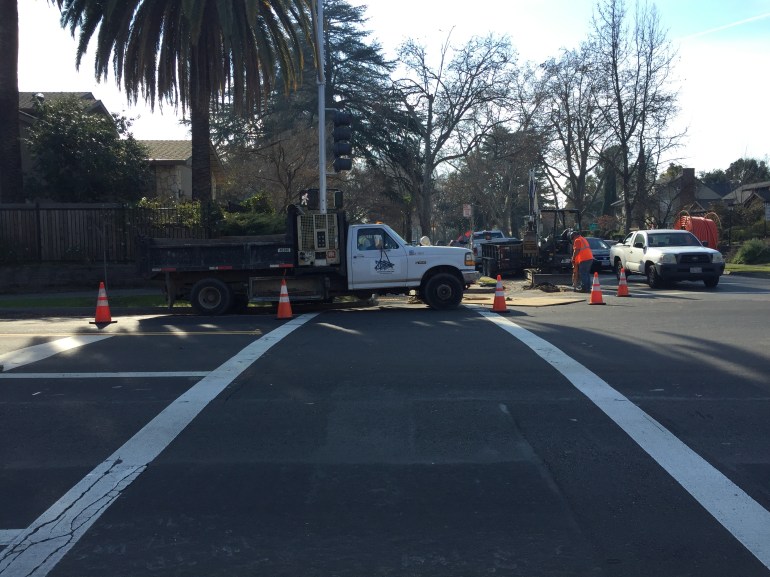
Sacramento City continues its practice of approving construction projects that do not consider the needs of walkers and bicyclists. Here is the latest I ran across, on Folsom Blvd between Santa Ynez Way and 39th St. The construction on the south side appears to be installing cable or fiber. At the west end, there is a sudden ‘sidewalk closed’ sign. There is no prior warning, there is no ramp or marked crosswalk for crossing Folsom to the north side (it requires crossing an offset intersection diagonally to go from one ramp to another, an exceptionally long distance), and there is no indication about how long the detour is.

At the other end, there is the same sort of signing without any prior warning or information provided.

At this location, 39th St, there is a marked crosswalk with traffic signal which could allow people to cross Folsom, but just to make sure the message that pedestrians are unwelcome here is clearly received, a construction truck was parked across the crosswalk. When I asked the construction crew to move the truck, they refused. I reported it to parking enforcement but am not sure of the outcome.

Of course there is a bicycle lane along this section of Folsom Blvd, which is also blocked by the construction. That may be justifiable, but you would think that forcing bicyclists to share the general purpose traffic lane would justify a reduction of the speed limit from 35 mph to 25 mph, but no, that that would inconvenience drivers and in the city, that is not to be considered.

This kind of bias against walkers and bicyclists should be unacceptable in the city. And it would be if the staff of Construction Services were not biased against walkers and bicyclists. Time to replace that staff with people who care about all modes of travel.

21950 and Vision Zero

California Vehicle Code 21950, failure to yield to pedestrians, is in my opinion the most important violation as it applies to implementing Vision Zero in Sacramento. The Vision Zero Sacramento Action Plan (draft) says “Launch high-visibility enforcement campaigns against speeding, failure to yield to pedestrians, distracted driving, and impaired driving. Campaigns will focus on HIN corridors.” The state code says:

21950.
  (a) The driver of a vehicle shall yield the right-of-way to a pedestrian crossing the roadway within any marked crosswalk or within any unmarked crosswalk at an intersection, except as otherwise provided in this chapter.
(b) This section does not relieve a pedestrian from the duty of using due care for his or her safety. No pedestrian may suddenly leave a curb or other place of safety and walk or run into the path of a vehicle that is so close as to constitute an immediate hazard. No pedestrian may unnecessarily stop or delay traffic while in a marked or unmarked crosswalk.
(c) The driver of a vehicle approaching a pedestrian within any marked or unmarked crosswalk shall exercise all due care and shall reduce the speed of the vehicle or take any other action relating to the operation of the vehicle as necessary to safeguard the safety of the pedestrian.
(d) Subdivision (b) does not relieve a driver of a vehicle from the duty of exercising due care for the safety of any pedestrian within any marked crosswalk or within any unmarked crosswalk at an intersection.

VEHICLE CODE – VEH, DIVISION 11. RULES OF THE ROAD,CHAPTER 5. Pedestrians’ Rights and Duties; http://leginfo.legislature.ca.gov/faces/codes_displaySection.xhtml?lawCode=VEH&sectionNum=21950; retrieved 2018-12-15

So, how is the Sacramento Police Department doing on enforcing this code against drivers who fail to yield to pedestrians in the crosswalk? Well, from the ‘Sacramento Police Vehicle Stop Data’ (http://data.cityofsacramento.org/datasets/sacramento-police-vehicle-stop-data) of the last two years, there were 101 violations of 21950 recorded, out of 61,151 violations. This is 0.17 percent, or, other violations were 582 times more common.

Anyone spending more than 10 minutes standing on the corner of any busy pedestrian intersection could count a hundred violations of this law. I know this because I do it. It is part of my job and it is also part of my advocacy. In two years the police only wrote 105 citations? I will also add that I have seen Sacramento Police Department officers in motor vehicles violating this very code hundreds of times, on myself and on others. Even the bicycle mounted officers are frequent violators. I will say that officers have yielded to me in the crosswalk, but it is much more common that they don’t. I’m not saying that they are trying to run me down, rather than they don’t wish to be slowed or inconvenienced, and so will cross through the crosswalk when I’m in it. They are, in this sense, just like other drivers.

So what is this disconnect between what is important and what officers do? I’m going to be blunt here. The police not partners in achieving Vision Zero, in fact they are the main impediment to Vision Zero. If they persist in their windshield perspective that pedestrians are the problems and drivers don’t mean to cause harm, pedestrians will continue to die, and drivers will continue to not face consequences for their violations, for their assaults, for their murders.

If you wish to reply that we all need to work together, and consider perspectives, well, please present evidence that this has worked in the part, or some construct that says it will work in the future. I’m not seeing it. In case you think I am picking on Sac PD, things are actually worse in other jurisdictions, but since this is where I live and observe the issue every day, it is the place I focus on.

By the way, thank you Don Kostelec @KostelecPlan for getting me fired up about all the ways in which our entire system is biased against pedestrians, and that those people whose job it is to consider and act on safety are mostly only concerned about drivers and traffic flow. I encourage you to follow his ‘The Twelve Days of Safety Myths‘ series.

change the signal at J St and 13th St

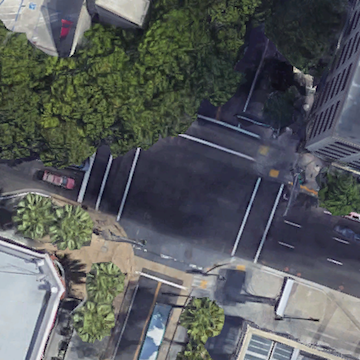
The signal at J Street and 13th Street in downtown Sacramento (shown at right) does not work well for pedestrians. The signal cycle is long, even compared to other signals on J Street, so the wait for pedestrians is quite long. I have seen the signal cycle skip both pedestrian crossings and vehicle crossings a number of times, which means that the wait is doubly long. Most walkers respond to this long wait by simply crossing the street against the pedestrian signal, and I don’t blame them at all.

A second issue is that the signal is set so that the east crosswalk walk mode occurs at the same time as the left turn from 13th Street southbound to J Street eastbound, meaning there is always a conflict between pedestrians and drivers at this point, and this conflict has been created by the signal setup. Many drivers cut directly behind or in front of people walking, as they know if they wait until the crosswalk is clear, as the law requires, they won’t make the signal.

This signal should be reconfigured so that it gives priority to pedestrians, without making them wait an unreasonable period of time, and does not create unnecessary conflict between turning drivers and people walking. The east crosswalk at a minimum needs a longer leading pedestrian interval (LPI).

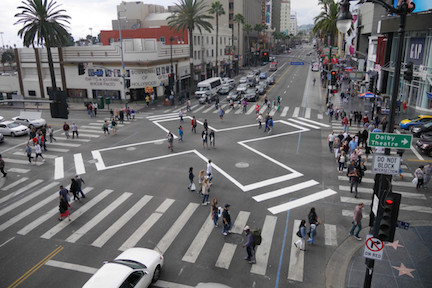
Even better would be to make this a pedestrian scramble intersection, with an all-direction crossing phase during which all vehicle turning movement are prohibited. The intersection can be marked with diagonal crosswalks, and additional diagonal pedestrian signal head added, however, simply changing the signal timing is sufficient as an initial step. This is a busy crosswalk intersection, with the convention center on one corner, the Sheraton Grand on another, and the parking garage for the Sheraton and others on the third corner. It is alway busy, and the people crossing here are commonly tourists, who are likely used to more advanced ‘world class’ cities where pedestrians are not second class citizens after car drivers.

Note: There are a number of busy pedestrian crossing intersection in the Sacramento central city that deserve an upgrade, but this is the one that most irritates me, whether walking or bicycling.

preserving access during construction

Sacramento central city is booming with construction, which I consider to be a wonderful thing. Mixed use buildings, single lot apartments and  homes, state office buildings. But the construction is having a serious impact on walkability, and often bikeability. (Note: this post is not about road construction or about temporary closures, which also need to be addressed, but not today.)

Two examples, both of state developments, but with principles applicable to private developments, will illustrate the issues. For the new California Natural Resources Agency building between O and P, and 8th and 7th, the sidewalk, parking and one travel lane on the south side (P St) were removed from service. These are not being used in any way for the project. Perhaps they will be eventually, but in the meanwhile, presumably for the entire life of the construction project, they are just sitting empty and unused. For the new O Street office building at O and 12th, the sidewalk and parking were removed from the east side of 12th between the N-O alley and the O-P alley. The section to the north, where the building is being constructed, needs closure, as the underground level is being dug and the sidewalk will be replaced. But on the section to the south, which is being used for storing construction materials, do not need to be closed. There is plenty of space on this former parking lot.

12th Street construction closure

For some of the private construction going on, of which there are many examples, some closures are no doubt necessary. But the closures seem to be occurring from the very first day of construction to the very last day of construction, even though it is needed for only part of the time.

Construction companies are doing this because they can, out of convenience or laziness. And the city is allowing them to. Each construction project requires a traffic control plan, and the permit specifies allowable areas and time frames.

When I questioned the closure on the southern section of 12th Street, Matt from Construction Services in Public Works argued that since parking was removed, it was only fair that the sidewalk access be removed. His thinking was that fairness required making everyone lose something, and that the loss of parking was equivalent to the loss of sidewalk access.

This of course is a ridiculous argument. Parking is in no way equivalent to access. And priority must be given on all roadways to the most vulnerable users, which are in order of importance, pedestrians, bicyclists, and motor vehicle drivers.

At the recent Sacramento Active Transportation Commission meeting, Jennifer said that she though there might be guidance on access restrictions, but wasn’t sure, and would look into it.

In the meanwhile, let me propose:

  1. For any roadway with more than one lane in a direction, space will be taken from a general purpose travel lane:
    • If a sidewalk or informal walking path is present, pedestrian access will be preserved by the creation of a temporary sidewalk protected by delineators or barriers.
    • If a bike lane or separated bikeway is present, access will be preserved by the creation of a temporary bike lane protected by delineators or barriers.
  2. For any roadway with a single lane in a direction, space will be taken by closing the general purpose lane in one direction, with appropriate detours for motor vehicles:
    • If a sidewalk or informal walking path is present, pedestrian access will be preserved by the creation of a temporary sidewalk protected by delineators or barriers.
    • If a bike lane or separated bikeway is present, access will be preserved by the creation of a temporary bike lane protected by delineators or barriers.

crosswalks, for now

I hope that you have found the series of posts on crosswalks (category: walkability) useful. I could write about them forever, but for now, that is all. Besides, I’m off to the wilds of southern Utah for spring break, out of Internet range, and no crosswalks except in the small towns.

If you have improvements that you’d like to see that I did not include, or if you have specific locations you’d like to see improved, please comment. Please don’t accept the word of traffic engineers that streets can’t be made safer, or that we can’t afford to make them safer (there are a range of solutions from inexpensive to very expensive), or worst of all, that we can’t slow traffic down. We can slow traffic, we should slow traffic, we must slow traffic. Speed kills.