The section of Elvas Avenue between 62nd Street and Hornet Tunnel which leads to Sac State is very dangerous for bicyclists. Bicyclists have to transition across four lanes of traffic (three travel lanes and a center turn lane), without any protection whatsoever. The pavement quality is low, particularly on the east side where the ‘bike lane’ (not a real bike lane) is. Despite this, it is a high-use bicycle route from Sacramento to Sac State and the American River Parkway trail. M Street, this section of Elvas, and the Hornet Tunnel serve as a bicycle boulevard (though not designated) between the central city, Sac State, and beyond.
Since the day I arrived in Sacramento and rode my bike to work in the eastern suburbs, I have known that this section needs to be fixed. It took me 12 years to get around to writing about it. I hope that it will take the city less to fix it. The solution presented here is not the only solution, so I encourage others to comment, point out flaws, and suggest optimal solutions.
Elvas Avenue is a high-speed, moderately high-volume roadway that acts in many ways as an expressway due primarily to the turns from Elvas Avenue to 65th Street, and from 65th Street to Elvas that encourage high speeds. The roadway is dangerous for motor vehicle drivers and passengers as well as bicyclists. North of 62nd Street, St. Francis High School (about 1100 students) suffers from traffic risk created by Elvas Avenue, so traffic calming to the south will benefit the high school as well as bicyclists. It might be appropriate to extend the separated bikeway north to the signalized crosswalk over Elvas to the school.
It pains me to oppose a grant application that the city is making for transportation improvements, in this case, an application to Active Transportation Program Cycle 7 (ATP7), for Freeport Blvd, to implement the Freeport Blvd Transportation Plan.
When the plan came out, many, many people pointed out the flaws in the plan. To simplify:
the plan did not reflect the desires of the community, both the adjacent community and the larger Sacramento community, for safety and trees
the plan neglected to include space for and planting of trees, a top priority of the community
the plan maintained a roadway of four lanes, two each way, throughout the project, even though only a short stretch, from Sutterville Road to the east to Sutterville Road to the west, has enough traffic to even come close to justifying four lanes
If Freeport were a major bus route, it might make sense to reserve a lane for buses, but it is not a major route and is not a roadway being studied for Bus Rapid Transit (BRT).
The plan was recommended by SacATC to the council, which was a mistake, and then approved by the council. I wasn’t too worried, because I figured the city would take the criticism by myself and many, many others to heart and improve the plan before seeking grant funding for it. I was wrong. There was almost no one outside the city staff who supported the plan. The city now wants to submit a grant application for engineering design and environmental clearance, based on the flawed transportation plan.
The city’s priorities for transportation modes, under the new General Plan 2040, are below. The plan does not meet that criteria.
These posts are included under the category Freeport Blvd. If you have time on your hands, you can read one or more of the posts, but what they do is build a case, and I feel clear about the case. No grant applications until the plan itself is significantly improved.
I hope that you will attend the SacATC meeting this Thursday, March 21, starting at 5:00 PM, in city council chambers, and will speak in opposition to the inclusion of Freeport Blvd in agenda item 6, part (b), for the Freeport Blvd grant application.
I have attended several SACOG board and committee meetings over the last two months, and seen the pushback that smaller cities and more rural areas are providing to the innovations of the 2025 Blueprint, in particular Scenario 3 which promotes infill rather than greenfield development. I will have more to say about this in the future, but for now, want to address the question of why these areas have such a strong voice in SACOG. It is the very structure of the Board of Directors, to give every member one vote, not matter the size of the population they represent. This is called one-member/one-vote.
The SACOG Mission and Governance page provide information about the structure and voting of the board. The table below (pdf, xlsx) shows the 31 voting members, the votes assigned to them, the population of the entity, and the votes that would be allocated if votes were population weighted, rather than one-member/one-vote. Caveats: I have not excluded the population of the Lake Tahoe basin in Placer and El Dorado counties, which are not in the SACOG region, because it is difficult to calculate, and not that significant. County supervisors represent all the citizens of a county, whether they are in unincorporated county or within a city. However, in looking a government bodies, I think it is useful to look at unincorporated population, and have used it in the table. County supervisors often seem to forget that they represent the entire county. All figures are from the 2020 census.
There are dozens of striking insights from this table, but I’ll focus on four.
In Sacramento County, the City of Isleton has 794 citizens, which is less than 0.1% of the county, and 0.1% of the region. That means the member representing Isleton has about 16 times the power of the member representing Elk Grove. Other counties have similar disparate representation.
In the region, Sacramento County has 61.5% of the population, yet only 35.5% of the vote, while Yuba County has 3.2% of the population, yet 9.7% of the vote. Sacramento County has 20 times the population of Yuba County, yet only 3-1/2 times the vote.
If Sacramento County were not assigned three voting members, and City of Sacramento two voting member, the disparity between population and voting would be even more prominent. This higher number of voting members is meant to compensate, in a minor way, for the egregious imbalance in representation that would otherwise result.
The town of Loomis, not a city, has one member, with a population of 6,836. In Sacramento County, the ‘towns’ (CDPs, census designated places) have far larger populations, yet no representation except through the county: Arden-Arcade 94,659, Carmichael 79,793, North Highlands 49,327, Orangevale 35,569, Fair Oaks 32,514, and several smaller CDPs. How did Loomis get this seat?
I am a believer in democracy. I realize that many people consider us a republic rather than a democracy, but other than the US Senate, we make the effort at all levels of government to approach as closely as possible the democratic ideal of one-person/one-vote. Yet we have entities such as SACOG (Sacramento Area Council of Governments) that, by using one-member/one-vote, are as far from representative of the people as can be.
So when you wonder, why do small cities and rural areas have such a large voice in transportation funding and sustainable communities strategies (the SCS part of the Blueprint), and why we continue to promote greenfield development in the region when we know that greenfield equals climate disaster, please refer back to this governance model.
Update: Diagrams were added for agenda item 3 streetcar-related bikeway on 3rd Street and agenda item 5 T Street bikeway improvements with unneeded parking. Update 2: Information added about Envision Broadway in Oak Park, one of the project applications desired for ATP7.
The monthly meeting of the Sacramento Active Transportation Commission (SacATC) will be this Thursday, March 21, 2024, starting at 5:30 PM in the city council chambers. You can comment on these items, or on topics not on the agenda, ahead of time via eComment, or in person at the meeting. I encourage people to attend these commission meetings. There are usually very few members of the public in attendance, which means that your voice is important. Though eComments are valuable, in-person comments carry a lot more weight. The city’s planning staff is usually progressive and innovative, but Public Works in general is not, so it is important the citizens show up to push for progressive and innovative projects and policies. With some new appointments to the commission, and support of the public, the commission itself has been much more progressive than in past years.
Downtown Riverfront Streetcar Project – Active Transportation Elements
Draft Parks Plan 2040 Public Release
T Street Bikeway Gap Closure Rehabilitation Project (R15200030)
Active Transportation Program Cycle 7 Grant Applications
Item 6 is mislabeled as a discussion item since it says: “Pass a Motion to recommend to City Council the approval of applications to the Active Transportation Program Cycle 7 grant applications for the following projects: a) Envision Broadway in Oak Park; b) Freeport Boulevard Safety and Mobility Project; and c) Northgate Boulevard Safety and Mobility Project.”
The Downtown Riverfront Streetcar Project, for a streetcar or light rail extension from Sacramento Valley Station to Sutter Health Park in West Sacramento, with an alignment over Tower Bridge, south on 3rd Street, east on N Street to 7th Street (southbound) and 8th Street (northbound), and along existing tracks to Sacramento Valley Station. Class IV bikeway is proposed on 3rd Street southbound, off or left side, and N Street eastbound, off or left side. There is no detail about what kind of Class IV bikeway, which can be: ““A bikeway for the exclusive use of bicycles and includes a separation required between the separated bikeway and the through vehicular traffic. The separation may include, but is not limited to, grade separation, flexible posts, inflexible posts, inflexible barriers, or on-street parking.” Since the bikeway is not parking protected, a high level of protection and separation is appropriate. Both the map and StreetMix diagram are too fuzzy to determine bikeway and buffer width, but it appears the bikeway buffer is narrow and without vertical delineators. The three general purpose lanes are 11 feet, unnecessarily wide and unsafe, so there is additional space that could be allocated to the bikeway or buffer.
StreetMix diagram of 3rd St, excerpted from agenda item
The Parks Plan 2040 (to align with the General Plan 2040) includes many mentions of trails, particularly in the context of Parkways: “Parkways: There are 14 parkways across the city. All parkways contain multi-use trails; some have artwork, gardens, river/beach access, and picnic areas. A select few offer sports recreation facilities such as basketball, soccer, and volleyball.” Key Direction 6, Foster Nature and Trail Connections includes “Collaborate to Improve Trail Connections: As noted in Appendix D, YPCE will continue to coordinate and collaborate with Public Works, other City departments, Sacramento County, and other agency partners to improve trail connections to parks, parkway use, and recreation via trails. While YPCE is not the primary provider of the City’s shared use paths, the Department brings an important perspective to conversations regarding priorities for shared use paths that support recreation and park access in addition to active transportation. Going forward, YPCE will proceed with the development of planned future parkways, especially where these provide access to rivers, connect missing trail links, and provide access to new parks and neighborhoods.” The Community Voices section (04) indicates strong community support for trails.
The T Street bikeway improvement project is needed, from 34th Street to Stockton Blvd. I bicycle this section regularly, on my way to Trader Joe’s and other destinations. The bike lane comes and goes, and drivers often refuse to yield to bicycles taking the lane, trying to force them to the side, and then right-hooking them at Stockton Blvd. The included diagrams seem to indicate there will be parking along the north side of T Street between 35th Street and 34th Street, which is completely unnecessary since the north side is entirely a Caltrans corporation yard with no need for parking. About two-thirds of the south side is also Caltrans property under the freeway, again with no need for parking. T Street is reduced from four travel lanes to two travel lanes from 34th Street to 36th Street, which is a great traffic calming improvement over the overly wide street that exists (or did, before the Hwy 50 construction narrowed it). The right hand lane approaching Stockton Blvd should be right turn only, so that T Street drops to one lane east of Stockton, without the need for a merge which endangers bicyclists. My observation is that at least half the eastbound traffic on T Street turns right onto Stockton, rather than continuing straight onto T Street or turning left onto Stockton. There are also bike lane improvements on the section of 34th Street approaching T Street.
T St between 34th and 35th streets, showing unneeded parking
The city is proposing to submit three applications to the Active Transportation Program Cycle 7: a) Envision Broadway in Oak Park; b) Freeport Boulevard Safety and Mobility Project; and c) Northgate Boulevard Safety and Mobility Project.
I have not looked in any detail at the Envision Broadway in Oak Park project, which lies to the east of the current Broadway Complete Streets project. If the same street cross-section and neglect of sidewalks is continued east, it will be a bad project, but perhaps this is an opportunity to correct the design mistakes built into Broadway Complete Streets.
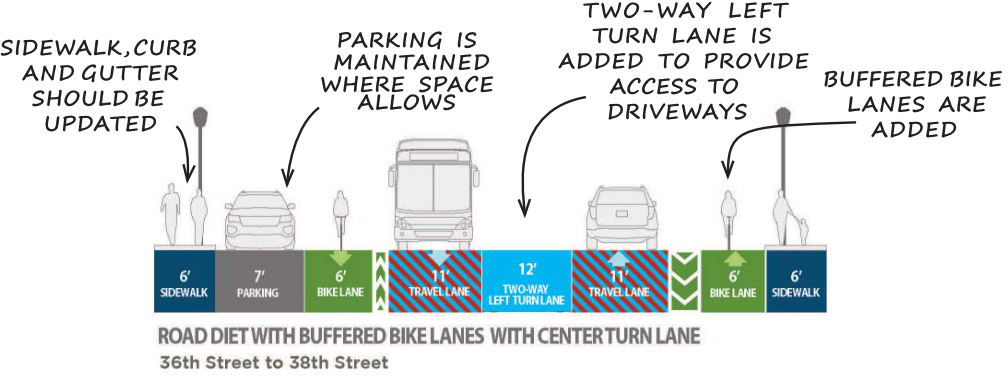
Added information on Envision Broadway. Overall, the plan looks good. Of concern is the section from 36th Street to 38th Street, where the right-of-way is narrower, and existing sidewalks are mostly 5 feet, which is unacceptably narrow for this corridor. The plan says “South of 36th St the rolled curb and gutter and attached sidewalks should be replaced with vertical curbs and wider sidewalks where feasible”. The phrase ‘where feasible’ is concerning. Would we say that general purpose lanes would be installed ‘where feasible’? Of course not. Sidewalks must be a minimum of 6 feet throughout this section, even if other modes are reduced. The sidewalks will not have sidewalk buffers for planting trees, so this section will be unshaded, except for a very short area between 36th Street and 4th Street, where there is a buffer, and a few trees on private property.
The project should still be recommended by SacATC, but with recognition that the plan falls short in facilities for walkers.
The initial Freeport Blvd Transportation Plan was deeply flawed, but perhaps this preliminary engineering and environmental clearance phase can correct some of those flaws. If not, then Freeport will stand as an example of how the city still prioritizes motor vehicles over all other users, and over trees. If the the city does not make a commitment to significantly improving the plan during this phase, then I believe the community should oppose this grant application, at SacATC, and California Transportation Commission, and at SACOG.
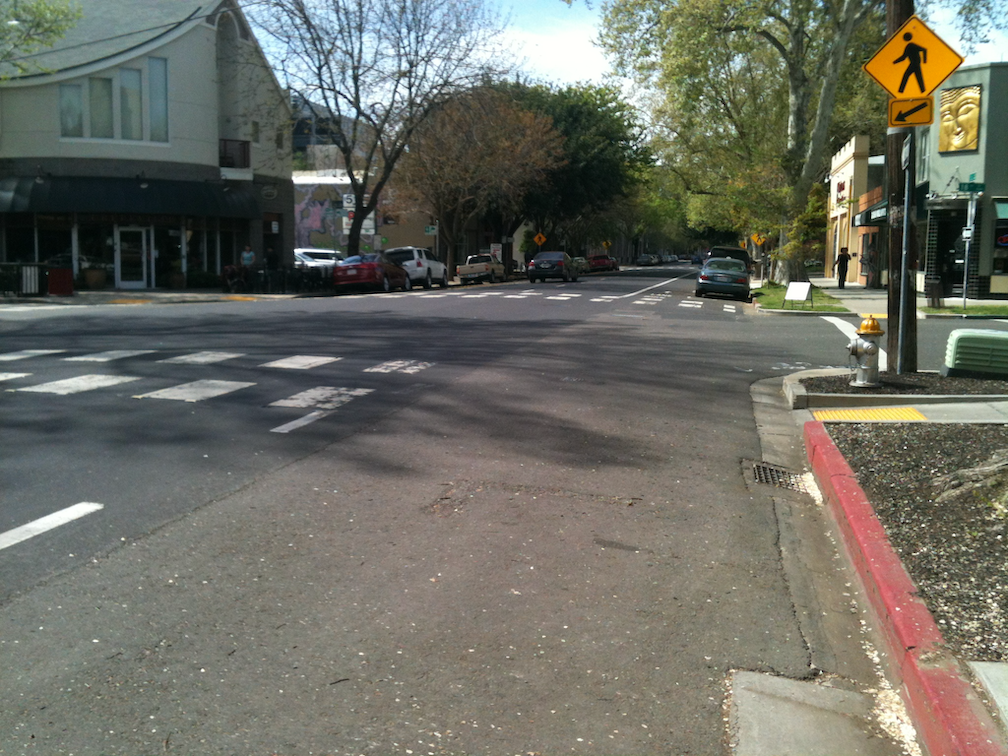
AB 413 (2023, Lee), the Daylighting Saves Lives bill, became law last year. It prohibits stopping, standing or parking a vehicle within 20 feet of any crosswalk, whether marked or unmarked. CalBike: Intersection Daylighting Becomes California Law. The law also details that it applies to the approach side (upstream), and is 15 feet if a curb extension is present. Until January 2025, only warnings can be issued. Either red paint or a sign is required. It does allow a ‘local authority’ (city or county) to establish a different distance with justification and by painting or signing a different distance. Another exception is for commercial vehicle loading and unloading, where the specific crosswalks are identified in ordinance and they are marked by paint or signing. Bicycle and scooter parking can be placed within the 20 feet, which is great since much of the city lacks sufficient parking for these devices.
red curb offset for daylighting, L St at 18th St
I fully support this law, though I would have modified it in some ways. I don’t think the 15 foot distance where a curb extension is present is necessary. The daylighting here can be ‘enforced’ by design. I would have made an exception for passenger loading and unloading (white curb), not for commercial vehicle loading and unloading (yellow curb). Commercial vehicles usually don’t stay long, but they are almost always large and effectively block visibility, whereas private vehicles are usually smaller and block visibility to a lesser degree. Of course we need commercial loading and unloading zones, many more than exist, so that bike lanes and travel lanes are not blocked, but approaching crosswalks is not the right place. Most drivers don’t understand what curb colors mean anyway, but that is a matter for education, not for not using them. Green, by the way, signifies limited time parking, which is posted on signs or stenciled on green curbs.
So, how will the City of Sacramento respond to this? The city has over 700 signalized intersections. It is unknown how many total intersections there are, but it is likely in excess of 15,000, and for most intersections there are four crosswalks, so in excess of 60,000 crosswalk approaches. There isn’t and likely won’t ever be funds to mark or sign all these. So how should the city select locations? One criteria that should not be used is how much demand there is for parking on a particular street. This is about safety, not parking. So possible criteria, similar to that presented for ‘no turn on red’ (no turn on red for Sacramento?):
locations of crashes: This is a no-brainer. Red curbs or signs should be installed at any intersection where there is a history of crashes involved walkers and bicyclists. This should be city policy, to install signs at any location where SWITRS indicates there is an issue, or immediately after any crash.
crosswalks with a high walker count: This is probably the most beneficial for safety. The problem is that the city does not collect data on the number of walkers using crosswalks (marked or unmarked), so it would not know where to start. The lack of data collection is a failure on the part of the city, but it is nevertheless a fact.
There are other possible criteria. The city’s Vision Zero Action Plan (2018) identified ‘Parking Restrictions Near Intersections’ as a countermeasure specifically for drivers making left or right turns impacting walkers and bicyclists, with a high efficacy, low cost and low complexity. The Top Five Corridor Study identified Marysville, El Camino, Broadway/Stockton, South Stockton and Florin segments as dangerous roadways for safety improvements. Unfortunately the Vision Zero effort was limited to corridors, and not high injury intersections. It should have also identified the top five, or ten, intersections. Nevertheless, the city does have data on these intersections that could be used to identify high priority fixes.
The separated bikeways with turn wedges on P Street, Q Street, 9th Street, 10th Street, 19th Street, 21st Street, and I Street largely address the issue without needing additional marking or signing, on the side on which the bikeway is installed, but the other side would still need marking or signing. The separated bikeway on J Street has daylighting at some but not all crosswalks.
The highest safety benefit accrues to curb extensions, temporary at first and permanent in the long run. Temporary extensions are inexpensive and can be installed quickly (Strong SacTown quick-build street safety), while permanent extensions are more expensive and require planning. Sometimes curb extensions require relocation of drain inlets, which increases their cost.
Update: I was incorrect that a ban citywide would not require signing. See below for more information. Thank you, Matt, for the heads up.
Many places throughout the United States are considering banning turns on red signals. Permitting turns on red was a fuel-saving practice implemented in the 1970s, though there is little evidence it actually saved fuel. There is considerable evidence that it decreases safety for walkers and bicyclists, and perhaps motor vehicle drivers and passengers. Though turns on red signals are not the greatest danger walkers and bicyclists face, banning the practice would have safety benefits. It is a partial protection against oversized SUVs and trucks, which have large blind zones that contribute to striking walkers and bicyclists. Though people think of this as no-right-turn-on-red, in Sacramento central city with its overabundance of one-way streets, it may also be no-left-turn-on red.
San Francisco is considering an expansion of its no-turn-on red zones from the Tenderloin, where it has increased safety and calming traffic, to more of the downtown area. Washington DC has banned turn-on-red, though it doesn’t take effect until next year. Chicago and Seattle have considered bans.
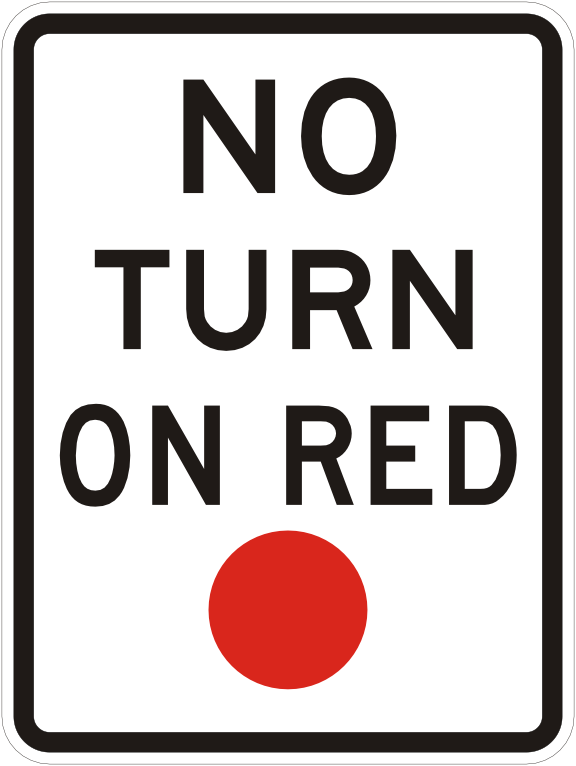
The signs used to indicate no turn on red are:
MUTCD R10-11a No Turn on RedMUTCD R10-11 No Turn on RedNo Right Turn on Red blank-out sign
How should the City of Sacramento, and the rest of the counties and cities in the region respond? The options are:
ban citywide: Turns on red would be illegal throughout the city (or county). The advantage is that no signing would be needed since it would apply to all signalized intersections. However, this may not have as great a safety benefit as a more targeted approach.
ban at locations of crashes involving turning vehicles: This is a no-brainer. Turn on red should be banned at any intersection where there is a history of crashes caused by vehicles turning on red. This should be city policy, to install signs at any location where SWITRS indicates there is an issue, or immediately after any crash.
ban at intersections with a high walker count: This is probably the most beneficial for safety. The problem is that the city does not collect data on the number of walkers using crosswalks (marked or unmarked), so it would not know where to start. The lack of data collection is a failure on the part of the city, but it is nevertheless a fact.
ban at separated bikeway locations: A ban at the intersections with separated bikeways (also called protected bike lanes, parking-protected bikeways, or cycletracks) would protect bicyclists and give them a head start over motor vehicles. Leading pedestrian intervals (LPIs), which bicyclists can also use, can offer even better protection.
I have resisted turn-on-red bans in the past because I thought they had a lower safety benefit than many other measures that could be taken, but traffic violence has become such an issue that any action to reduce death and injury for walkers and bicyclists may be worth taking, and taking now.
As an alternative to bans, yield-to-pedestrians (and bicyclists) signs can also be installed. Two versions are shown below, on the left, the approved MUTCD R10-15R sign, and on the right, the bicyclist and pedestrian version with interim approval in California, and in use in many locations. My observation is that these signs are widely ignored by drivers, but of course, they do help those drivers who are willing to follow the law.
MUTCD R10-15RMUTCD R10-15b (California interim)
California Vehicle Code (CVC) 21453
CVC 21453: (a) A driver facing a steady circular red signal alone shall stop at a marked limit line, but if none, before entering the crosswalk on the near side of the intersection or, if none, then before entering the intersection, and shall remain stopped until an indication to proceed is shown, except as provided in subdivision (b). (b) Except when a sign is in place prohibiting a turn, a driver, after stopping as required by subdivision (a), facing a steady circular red signal, may turn right, or turn left from a one-way street onto a one-way street. A driver making that turn shall yield the right-of-way to pedestrians lawfully within an adjacent crosswalk and to any vehicle that has approached or is approaching so closely as to constitute an immediate hazard to the driver, and shall continue to yield the right-of-way to that vehicle until the driver can proceed with reasonable safety. (c) A driver facing a steady red arrow signal shall not enter the intersection to make the movement indicated by the arrow and, unless entering the intersection to make a movement permitted by another signal, shall stop at a clearly marked limit line, but if none, before entering the crosswalk on the near side of the intersection, or if none, then before entering the intersection, and shall remain stopped until an indication permitting movement is shown.
Under section (b), signs are required, even if the ban is citywide. Section (c) does allow use of red arrows, but the red arrow signal would be more expensive than a sign, so only used in a few situations. The blank-out sign, shown above in the set of three, is probably the most effective, but again, more expensive that a regular sign.
Strong SacTown has created a great visual introduction to quick-build fixes for street safety, posted to Instagram. I encourage you to take a look. The series includes curb extensions and modal filters (traffic diverters), both quick build with temporary materials, and permanent installations. Of course temporary materials should eventually be replaced with permanence, but it is better to get something on the ground now rather than waiting for the planning and money it takes for permanent installations. We are experiencing an epidemic of traffic violence, and even small actions can reduce fatalities and injuries. These installations are also called tactical urbanism, though the definition of quick-build and tactical urbanism is not identical.
Some additional ideas that are not always thought of as traffic calming.
Street Design
We can design better streets to begin with so that the need for traffic calming is reduced. Example one is the wide medians in Boulevard Park, which reduces turning movements to the intersections while providing a pleasant environment. Example two is wide sidewalk buffers in the Poverty Ridge area, where narrow streets reduce vehicle speeds, and the sidewalk buffers provide a pleasant environment. I have watched motor vehicle drivers passing each other on these narrow streets in the Poverty Ridge area. They are slowing to about 5 mph to pass. This is a traffic violence reduction design in action!
wide street median, 22nd St at C St in Boulevard Parknarrow street with wide sidewalk buffers, V St at 21st St in Poverty RidgeRead More »
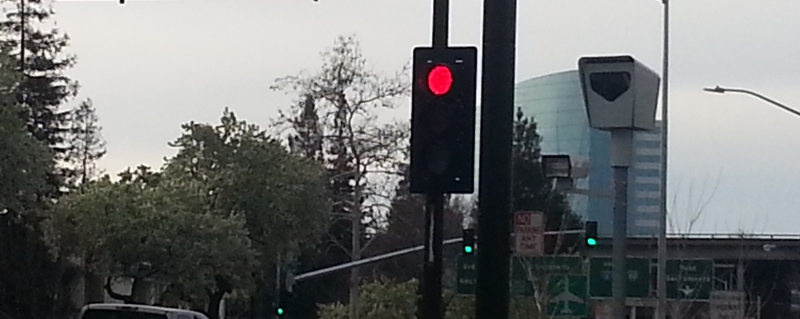
A SacBee article today notes the end of the red light camera program in City of Sacramento, which was part of Sacramento County’s program: Sacramento’s red light camera program has been shut down by the Sheriff’s Office. Here’s why. (sorry about the firewall)
A quote from the Sacramento County Sheriff’s Office is particularly galling: “Gandhi said the Sheriff’s Office wants to focus on its mission of suppressing violent crime and other criminal activity.” Apparently, in the view of law enforcement, traffic violence is not a violent crime. Apparently, the fact that red-light runners kill and injure walkers, bicyclists, passengers, and other drivers is of little concern. Sadly, this is a very common law enforcement attitude.
If cost-cutting were an appropriate response to criminal activity, it would be reasonable to just eliminate law enforcement. Law enforcement responds to criminal activity; it does little to nothing to prevent criminal activity. Automated red light enforcement is an effective response to criminal activity, and it does reduce future criminal activity. Why is the Sheriff’s Office and the City of Sacramento not interested?
If you think that direct law enforcement of red light running is a good replacement, you would be wrong, for two reasons. One, almost no enforcement of motor vehicle violations occurs anymore, other than some enforcement of speeding. Two, the law enforcement practice of pretextual stops, stopping people of color for traffic violations to search for other violations, and to intimidate people of color, results in law enforcement violence against drivers of color.
One of the useful things the city was doing to reduce traffic violence is no longer. Don’t you feel safer now? You can visit the city’s Red Light Running Program page, in case you wish to leave condolences, remembrances, or flowers.
Update: I have decided that, for now, I’m only going to follow back transportation organizations and agencies. My concern is that if I start following individuals, my feed will become overwhelming for the limited time I have for Instagram.
As an experiment, I have created an Instagram account for Getting Around Sacramento. I started using Instagram for the Week Without Driving Sacramento campaign last year, on the encouragement of one of the program partners, SABA, which has an active Instagram. I maintain the WWD Sac website on behalf of Sacramento Transit Advocates and Riders (which does not so far have Instagram). We gained some engagement, but not much participation in Week Without Driving. It was definitely a learning curve for me.
The main reason for my interest in using Instagram for Getting Around Sacramento is not promoting my posts, but linking to events sponsored by other organizations and agencies, which are important but not necessarily worth a separate blog post.
I stopped using Facebook years ago because there was little of import there, and stopped using Twitter/X two years ago because it had become toxic under the regime of Elon Musk. I’ve looked at Mastodon, but the most logical server is a bay area server, and haven’t found one relevant to the geography and mission of Getting Around Sac.
A media icon for Instagram has been added to the top of the sidebar.




 Getting Around Sacramento