I attended the Work Zone and Event Detour Policy Roundtable on January 9, with city staff and various stakeholders. All present agreed that current practice was unacceptable. Two companies that provide construction signing for projects talked about the challenges, including signs and barricades being placed and then moved by the public. I pointed to the two most important issues not addressed in the draft policy: 1) the policy must be explicit about requirements in PROWAG, and 2) the policy is meaningless if there is no monitoring. A number of people had anecdotes about projects that failed to offer accommodation for walkers and bicyclists, in addition to the hundreds of 311 reports that I have filed.
Posts related to the work zone guidelines are linked via category ‘Work Zones‘ within City of Sacramento category. Posts about construction project issues, previous to and after the release of the draft guidelines, of which there are a huge number, are linked via tag ‘construction zone‘ within Active Transportation category.
I woke up this morning with thoughts about how Governor Newsom could largely solve the budget deficit. And shortly thereafter ran across the CalBike-led letter, co-signed by 25 organizations, to the governor about shifting budget priorities: Stop Fueling Climate Change: Coalition Challenges Governor to Shift Transportation Spending. In the Governor’s initial budget proposal, there is no reduction in highway building whatsoever. It is as though this is the sacred mission of the state, to fund and build highways at the level desired by Caltrans, and the asphalt lobby, no matter what else is going on in the state, with budget or climate. This is called the ‘Infrastructure Cult’ by Strong Towns.
The letter’s four asks are:
Consider any proposed reductions in General Fund spending on transportation infrastructure in the context of our climate and equity goals
Backfill any General Fund cuts by leveraging the existing statutory flexibility of federal highway formula funds as well as funding from the State Highway Account.
Suspend California state investment in new highway capacity
Develop a multi-year funding commitment that ensures at least 50% of the State Highway Account (SHA) funds go to VMT-reducing projects while prioritizing investments in California’s most burdened communities.
I support all of these ideas, but of course would go further:
Suspend SHOPP funding, the funding which is supposed to maintain and improve (but not expand) our highway system until an audit of the SHOPP program is complete. This would take at least a year, maybe more. SHOPP is the biggest part of the Caltrans budget, so the savings for this year would be considerable.
Suspend all STIP funding, the funding which is used to build new infrastructure, indefinitely, except for the TIRCP (rail and transit) and ATP (walking and bicycling) programs. This is much the same as the letter’s third action.
Propose to the legislature a bill that would convert all HOV (high occupancy vehicle) lanes (which are worthless in practice because so routinely violated), to tolled lanes, statewide, within five years. This effort would include state funding to accelerate creation of tolling authorities where they don’t exist, and to study merging of tolling authorities into regional entities.
Propose to the legislature a bill that would not only allow but encourage and/or require the conversion of general purpose lanes to toll lanes. For the time being, this would preserve two general purpose lanes on highways with more than two lanes per direction, but ultimately, all lanes would be tolled. Highways are incredibly expensive to build and maintain, and general funds should never be spent on highways because they are not used by a significant portion of the population. And if all users are tolled in all lanes, the tolls would be reasonable and equitable.
Propose a bill to the legislature that assigns CalSTA (California State Transportation Agency) a study of the charter and organization of Caltrans. Caltrans is an outmoded legacy agency which should be reoriented towards meeting the needs of citizen access and climate action, and most specifically maintaining what we have and not continuing to build new.
Support governance options with one Caltrans voting member, but not two
Support inclusion of Sacramento Transportation Authority as the Sac county agency
Tolling advances user pays concept, which transportation advocates support
If the JPA had been in place, Fix50 project would have had toll lanes rather than HOV: HOV lanes don’t work for management because they are routinely violated
Support does not indicate that I support adding lanes in Yolo, but if lanes are added, they should be tolled
Questions about JPA membership, board members and voting are probably best answered by proportional representation based on tolled lane miles rather than county representation, which is more consistent with citizen representation; this would also entice counties to add or convert tolled lanes so they could be part of the process and benefits
Conversion of HOV lanes and general purpose lanes to tolled lanes will be required in the future to maintain our very expensive highway system, so this is a start
Brian Abbanat of YoloTD also spoke.
Several board members spoke, and to summarize and paraphrase their comments:
Rich Desmond and Eric Guerra supported a lanes miles voting idea
Karina Talamantes expressed concern but seemed satisfied by the answers
Bret Daniels expressed the standard ‘I don’t want to pay anything’ and tolling is for rich Tesla people
Phil Serna asked about safety of adjacent lanes, SACOG responded that safety can be part of the infrastructure and/or tolling design; I don’t think the idea of separation on the causeway has come up before; also asked about detection and enforcement
Eric Guerra said benefit or presentation is raising awareness
Patrick Hume actually said that eventually we will need to toll not just lanes but entire facilities
Overall, the concerns of the board were mainly that Sacramento County be treated equitably in terms of tolled projects, design of tolls, and distribution of toll revenue; several people also commented that the focus on excess revenue may be premature since it isn’t clear that there will be excess revenue, and some of it is already dedicated to mitigation measures.
Kevin Bewsey presented on SacTA’s role in the JPA, including how votes would be handled.
Though no motion was made on the issue, nor any vote taken, the consensus of the board seems to be:
Support for creation of the JPA
Support for creating tolled lanes in Sacramento County
Yes to SacTA being the agency for Sacramento County
Yes to appointing members of the SacTA board to the JPA board, probably with one county representative and one city representative (under the staff recommended governance structure, SACOG would appoint another from its own board, and from Sacramento County or a city within)
Concern about the governance model treatment of Sacramento County, and concern about a voting methodology that is equitable for Sacramento County, but willingness to allow some uncertainty here for the time being (the voting document created by SACOG was not presented, but was discussed since several SacTA board members are also SACOG board members)
map of potential tolled lanes in the SACOG region
Note: I am unsure of the source of this map. It was referred to as being in the 2020 SCS, but I don’t find it there. Apologies for the low resolution, it was extracted from the SACOG presentation today, not from an original source.
For additional posts on managed lanes in general, this regional tolling authority, and the Yolo 80 project, see category ‘managed lanes‘.
The proposal for a tolling authority JPA for the Sacramento region came before a special meeting the SACOG Transportation Committee yesterday. Agenda item 2 was to recommend to the SACOG Board that the JPA effort move forward, and that was passed after a whole lot of information and even more discussion. The reason for it coming back is that several options for governance membership are now included, which were not available in December. The tolling authority would be called Capital Area Regional Tolling Authority (CARTA). The meeting can be viewed on YouTube, and the supporting documents are available from SACOG.
presentation page on tolling JPA governance options
For reasons that were not clear to me, SACOG staff added an addendum to the item at the last minute, Evaluation of Voting Options, about how votes might be allocated on use of excess revenue. At least one-third of the meeting time was taken up by discussing this issue, though it was not to be voted on, and is not even relevant in the near future. It will be years before there is any excess revenue to be spent, there will not likely be a large amount of excess revenue, and there is already a long list of mitigations to be funded by excess revenue that are part of the Yolo 80 project. Just when the committee was ready to move on from this topic, SACOG staff brought it up again. Argh!
It is typical of government councils or boards, when composed of more than one government agency, to spend an absurd amount of time haggling over membership. The situation is created when these boards adopt a one-member/one-vote policy, where the vote of each member weighs equally with each other. This sounds like representative government, analogous to one-person/one-vote that our democracy is founded on (with the exception of the US Senate, of course). But it is NOT analogous, and it is NOT representative. Smaller agencies have an outsized affect on the outcome, which is the case of transportation related boards means that smaller cities and rural areas have a much larger voice than they would have if voting were population weighted. We recognize this in creating city council districts, supervisor district, legislative districts, and US House of Representative districts, where each district has an approximately equal number of people. And it is why we do redistricting, so that this balance is maintained over time as population shifts. But for some reason, when it comes to transportation, the usual solution is to give each entity the same voice. I believe this is wrong. In most cases, voting should be population weighted.
In the case of the tolling authority, however, I believe that membership and voting should be weighted by tolled lane miles. This means that initially, only Yolo County, through YoloTD, would have that voice, and other counties would gain that voice over time as they added tolled lane miles. It would make sense to add membership and voting rights at the beginning of construction, not at opening of the toll facility, since decisions about tolling amounts, discounts or exceptions, and hours would start to be made at that point. Since Sacramento County has the largest number of freeways likely to be eventually tolled, it would end up with the highest membership and weighted voting, but not at this time.
Caltrans spend an inordinate amount of time in the meeting defending their right to one or two voting memberships. They had a long list of expertise they could provide, though when challenged to put a dollar value on in-kind or contracted work, was flummoxed. Though both Caltrans District 3 denied it, it was pretty clear to me that they had their eye on excess revenue for future capacity expansion projects. Caltrans has never really had to justify its work or existence to anyone, and when challenged to do so, is quite inept at it.
I spoke at the meeting, the only member of the public to do so. My points were:
Support creation of regional tolling JPA
Support governance options with one Caltrans voting member, not two
Support inclusion of Sacramento Transportation Authority as Sac county agency
Voting options for excess revenue can be deferred because there likely won’t be any for a while
Tolling advances user pays concept, which transportation advocates support
HOV lanes don’t work for management because they are routinely violated
Support does not indicate that I support adding lanes in Yolo, but if lanes are added, they should be tolled
For additional posts on managed lanes in general, this regional tolling authority, and the Yolo 80 project, see category ‘managed lanes‘.
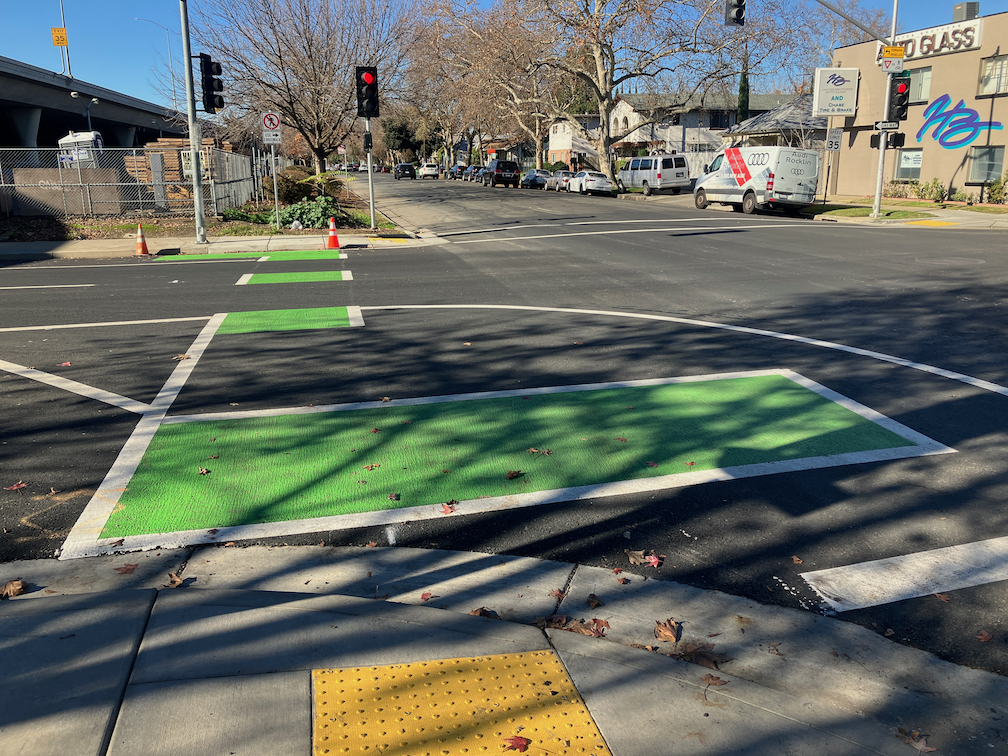
The 19th Street bikeway has been completed from W Street to Broadway. Only a half block of the two blocks is separated bikeway, and it is on the right side rather than left side as it is to the north. At W Street there is a bike box in line with the bikeway to the north, and a green dashed bikeway to carry the bikeway from the left or east side to the right or west side. The curved area shown in the photo does not have any sort of protection to reduce turn speeds, as is present on most turn wedges in the rest of the Central City Mobility Project.
The turn intersection involves a two stage turn for bicyclists, once to cross W Street to the south side, and then to cross 19th Street to the west side. There is no separate bicycle phase or bicycle signal face here. The pedestrian crossing phohibition here and lack of crosswalk indicates two things: there is no sidewalk on the south or freeway side of W Street, and that high speed turns from W Street to 19th Street are expected and encouraged. This project would have been a great time to add a crosswalk and pedestrian signaling here, and remove the prohibition, as both sides of 19th Street under the freeway have sidewalks, so a crosswalk would speed travel for walkers by offering two routes of travel. Bicyclists using the green dashed crossing of 19th Street have turning traffic at their back, which is somewhat unsafe but could have been made safer with an exclusive bicyclist phase or even a bicyclist signal phase. Since the signal timing favors W Street over 19th Street, it could have been possible to allow both a brief bicyclist phase and a turning phase.
19th St bikeway transition to right side
Crossing under the freeway, the bikeway is partly green painted and next to a travel lane, and partly parking protected bikeway to X Street. From X Street to Broadway, it is a regular door-zone bike lane. At Broadway, there a green bike box the full width of the street, allowing bicyclists to continue straight or turn left onto Broadway.
To summarize, the design is OK but could have been better.
A previous post about new beg buttons on Alhambra Blvd noted that there are now beg buttons where there used to be auto-recall pedestrian crossings. I walked Alhambra this week, and noted that there are eight intersections with these new beg buttons (technically called pedestrian actuators or Accessible Pedestrian Signals APS). At auto-recall crosswalks, the pedestrian signal comes on at every signal cycle. At beg button crosswalks, the signal comes on only if requested by the pedestrian. The city has many of both types of crosswalks, but these particular locations are new. The intersections are Alhambra and: J Street, K Street, L Street, Capitol Avenue/Folsom Blvd, N Street, P Street/Stockton Blvd, Q Street, S Street. At each intersection there are eight of these new beg buttons on new posts, for a total of 64 new beg buttons.
No one seems to know who authorized this project, nor what funds were used to pay for it. I have confirmed that the project never came before the Active Transportation Commission (SacATC). All significant pedestrian projects are supposed to come before SacATC, and the fact that this one did not probably indicates that the staff in Public Works knows that this is a motor vehicle project, and not a pedestrian project. Though it is a good bet that pedestrian safety funds were used to pay for it.
Though these beg buttons are not signed with the ‘wave at’ sign R10-3j(CA) that the new ones at 21st Street and I Street, they do seem to have the same function, that they detect people, waving or not, up to about 18 inches. It seems odd that the city would have purchased these infrared detector actuators, which must be more expensive than plain touch buttons, but then did not indicate them as such. Installation of new accessible pedestrian signals is about $70K per intersection, though replacement of buttons at existing locations is only about $14K per intersection. I have been unable to find costs for passive detection systems (they all seem to require a quote process).
A reminder, if one is needed, that beg buttons have no safety benefit for people walking. They are a motor vehicle device, meant to reduce the length of signal cycles so that more cars can go faster.
The solution to this is to prohibit the use of pedestrian beg buttons throughout the city. Existing locations can be converted to the audible crossing signals that are now required by PROWAG. The relevant sections of PROWAG are R307 Pedestrian Push Buttons and Passive Pedestrian Detection and R308 Accessible Pedestrian Signal Walk Indications. Unfortunately PROWAG does not have a definition for ‘passive detection’ to specify what the detection radius or functionality is. It might be presumed this is the same at automated pedestrian detection, but not certain. Under PROWAG, new or changed locations require audible signals, but this can be met by audible/tactile push buttons or passive detection.
San Francisco is replacing the signing on their pedestrian actuator locations with the signing below.
The bike signals and related signaling is now installed at the intersection of 21st Street and I Street, where the northbound 21st Street separated bikeway ends, and the westbound I Street separated bikeway begins. East of this intersection, I Street is two-way. The I Street bikeway is on the north side, right side, so bicyclists must transition from the southwest corner to the northwest corner. Bicyclists continuing north on 21st Street must also transition from the left side bikeway to the right side general purpose lane.
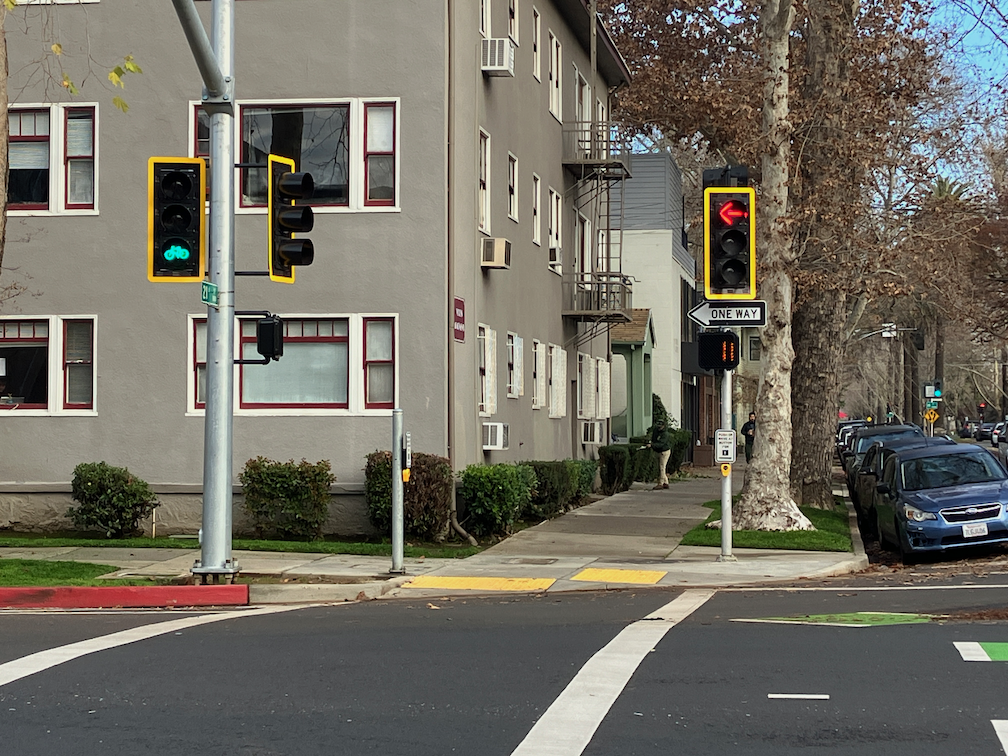
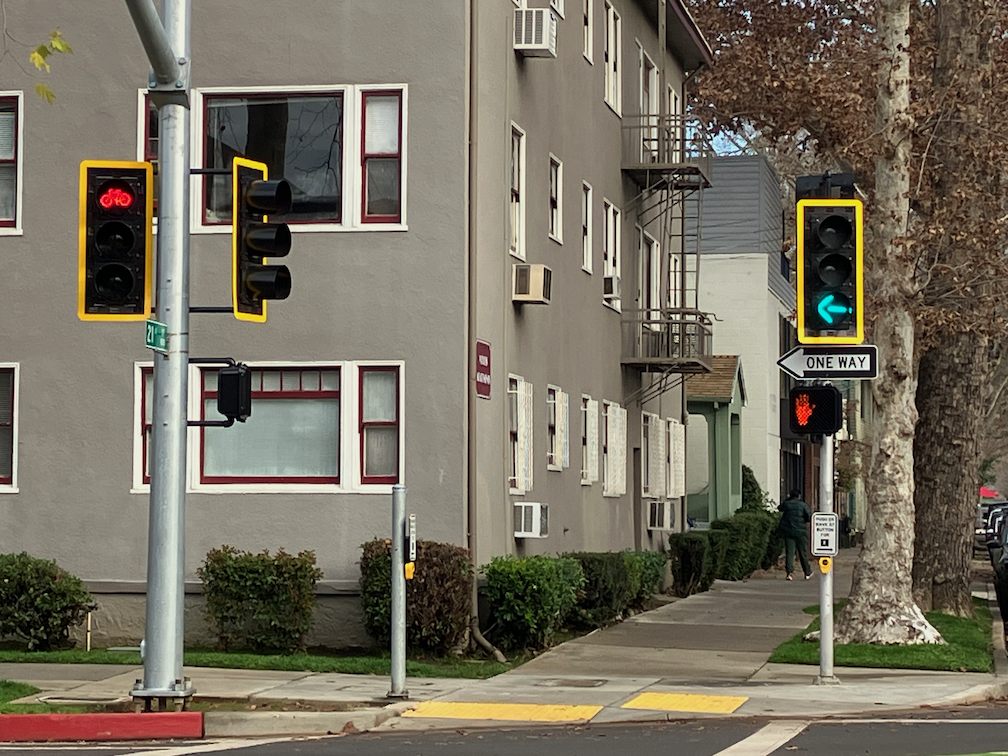
The city has attempted to solve this problem by installing bicycle signal faces on the northwest corner, for bicyclists turning left on I Street, and the northeast corner, for bicyclists going straight on 21st Street. The photos below show the northwest corner bicycle signal green and turn arrow red, bicycle signal red and turn arrow green, and the bike signal on the northeast corner.
21st & I St, bicycle signal green and turn arrow red21st St & I St, bicycle signal red and turn arrow green21st & I St, bike signal on the northeast corner
The signals are set up so that bicyclists, and walkers on the west leg of the intersection, have an exclusive phase, meaning that no cars are supposed to be moving when the pedestrian signal shows walk, or the bike signal is green. Actually, triggering the bike signal also triggers the pedestrian signal, and vice versa, they are ganged together.
The problem is that drivers are turning left from 21st Street to I Street against the red arrow, endangering bicyclists going west and north, and walkers in the crosswalk. In about 30 minutes of observation over the last few days, I saw drivers turning left against the red about half of all signal cycles. Once the front driver decides to turn, all other drivers follow. I did not see any drivers turning from the right hand left-turn-straight lane.
California Vehicle Code (CVC) 21453 says: (c) A driver facing a steady red arrow signal shall not enter the intersection to make the movement indicated by the arrow and, unless entering the intersection to make a movement permitted by another signal, shall stop at a clearly marked limit line, but if none, before entering the crosswalk on the near side of the intersection, or if none, then before entering the intersection, and shall remain stopped until an indication permitting movement is shown.
So, every single one of the drivers who turned left on the red arrow was breaking the law. Sadly, the city has designed an intersection that assumes drivers will not break the law, but as every bicyclist and walker knows, drivers do so pretty much continuously. I do not know what the solution is for this intersection. It is difficult to control driver behavior. In any other situation than roadways, the behavior of routinely breaking the law is called lawlessness.
Signal actuation (beg buttons)
In addition to the new signals, there are signal actuators, generally called beg buttons. Nothing here is on auto-recall, meaning there is not a bicyclist and pedestrian phase on every signal cycle, but only when requested.
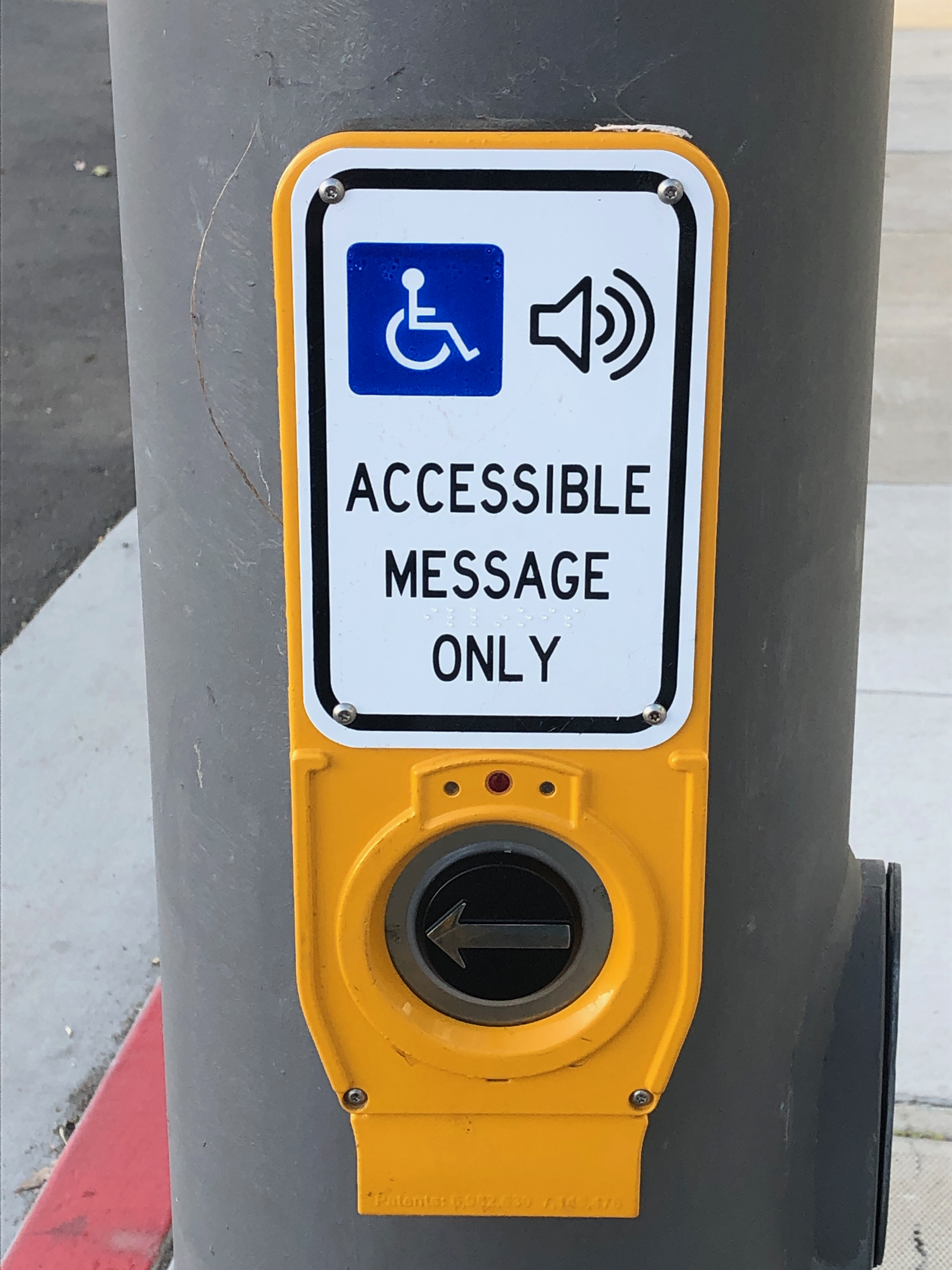
The actuator for the pedestrian signal is shown below. This is first placement of this technology in the city, so far as I know. The sign is CA-MUTCD R10-3j (CA). The ‘wave at’ function is an infrared proximity detector, that works for up to about 15 inches, and also works for standing as well as waving. An example commercial product is WiAPPS Wave, though I don’t know what vendor the city used. It is not automated pedestrian detection, which would cover the full width of the sidewalk.
pedestrian actuator (beg button), 21st St & I St
Strangely, the bicyclist actuator (beg button) does not have this technology; the bicyclist must actually touch the button.
The Broadway Complete Streets project, to reallocate the street from 3rd Street to 24th Street, is underway. I have been walking this section recently, and I see several things that greatly concern me. To be honest, I was not paying much attention when this project went through public review, and attended only one meeting. I had not looked closely at the project documents. The page linked above confuses me. There are no final design documents, yet I have several documents more recent, including one that says final. Did the city unlink these newer documents? Lose them?
It appears from the work I see being done currently, that parking will be preserved along the entire length of the project. While this makes complete sense where there are small businesses, there are also several blocks where there are large buildings that provide off-street parking, or fast food chain restaurants that that have ample off-street parking. Parking can be a good thing, but not when it takes the place of wider sidewalks and sidewalk buffers.
One positive is that vertical curbs are being installed, replacing the rolled curbs that exist along much of the street at this time. But a negative is that apparently curb lines are not being moved as part of the project, meaning that under-width sidewalks and under-width sidewalk buffers will remain so. A diagram from the planning process shows eight foot sidewalks.
diagram of proposed roadway allocation
Here is an actual constructed section, north side between 18th and 19th Streets. The sidewalk is six feet, and a completely useless sidewalk buffer of about 18 inches is included. A sidewalk buffer this narrow cannot provide planting space, and does not provide any physical or visual separation from the street. The street width could have been reallocated to a wider sidewalk, and a sidewalk buffer wide enough to host trees, but it was not.
Broadway narrow sidewalk and narrow buffer new constructionRead More »
Posts related to the work zone guidelines are linked via category ‘Work Zones‘ within City of Sacramento category. Posts about construction project issues, previous to and after the release of the draft guidelines, of which there are a huge number, are linked via tag ‘construction zone‘ within Active Transportation category.
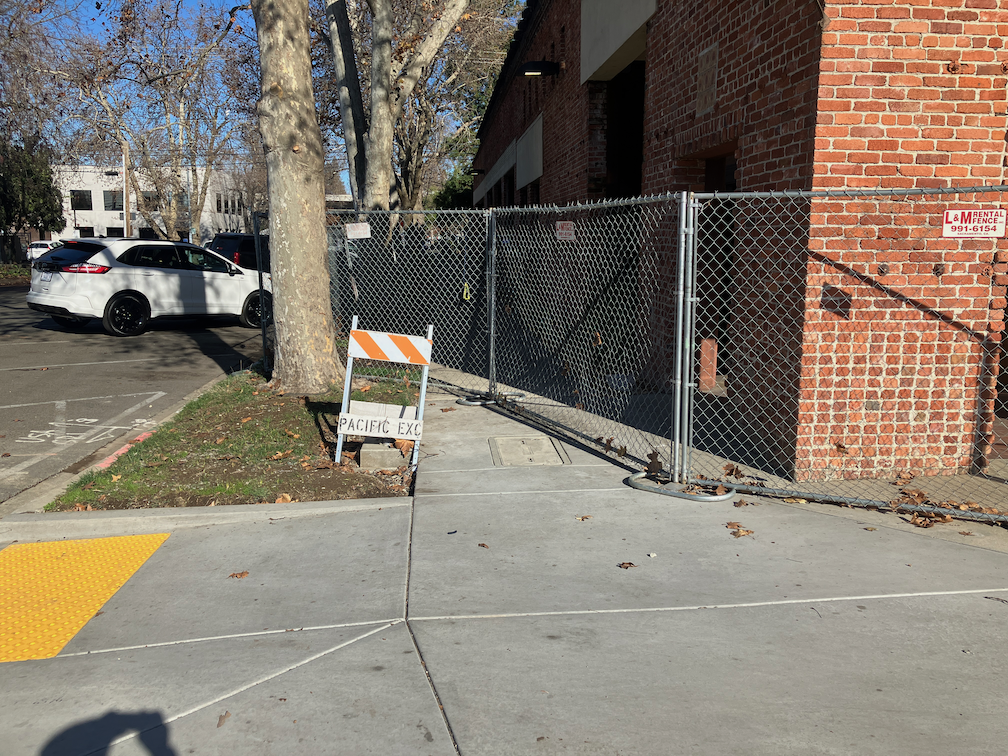
I walked a long section of Broadway today, and came across two construction projects that close sidewalks without proper and safe signing and barricades.
‘Dental Clinic Remodel’
I put this one in quotes because it is a building that has been abandoned for years, but is apparently now under construction. Construction for this half-block building on the north side of Broadway between 23rd and 22nd Streets has closed sidewalks on both 23rd and 22nd. For 23rd, there is some signing, but also a non-detectable chainlink fence and trips hazard folding barricade. As with many other construction projects, a sign on hand, the bicycle/pedestrian detour sign (MUTCD M4-9a), was used though it is not required or appropriate. The sidewalk closed ahead cross here (MUTCD R9-11) is a valid sign, but the wrong location. The sidewalk is closed HERE, not ahead, so the correct sign is sidewalk closed cross here (MUTCD R9-11a).
work zone violation at Broadway and 23rd St, wrong sign, non-detectable barricade
At the corner of Broadway and 22nd Street, there is no sign at all, and the same non-detectable chainlink fence used as a barricade.
work zone violation at Broadway and 22nd St, no sign, non-detectable barricade
I did not check on the north side of these sidewalk closures, but I would assume the signing and detectability is the same or worse.
There is a new development occurring on the southwest corner of 16th Street and E Street, 30 affordable apartments, apparently called Studio 30. This is something that I always support, more housing, more affordable housing.
apartment construction at 16th St & E St, southwest, called Studio 30Read More »








 Getting Around Sacramento