SacBee: sidewalk repair

The SacBee published an article in January entitled ‘$20k? Homeowners in some Sacramento neighborhoods are billed more for sidewalk repair‘. The article is about the charges the City of Sacramento has made to homeowners, primarily in low income areas.

City code specifies that property owners are completely responsible for repair of sidewalks adjacent to their property. State streets and highways code seems to allow the city to claim this. The two relevant sections within Chapter 22: Maintenance of Sidewalks are: Article 2. Repairs and Article 3. Collection of Cost of Repair. I have previously made the claim that both state code and city code are unconstitutional, because they make persons responsible for maintenance of property that belongs to the city, not the person. In almost all cases, sidewalks and the land on which they lie is city property, not private property. This is particularly egregious when the sidewalk damage is due to city-owned trees in the sidewalk buffer (which the city calls planting strips).

Therefore, I believe that it is illegal for the city to charge property owners for sidewalk repair.

The major focus of the article is that low income communities are being unfairly targeted for sidewalk repair, with a graph that indicates that. That is one interpretation of the data, and it would not be surprising. The city has always and continues to treat lower income communities and people of color with bias. There is another explanation however. Sidewalks in lower income communities were very likely built to lower standards than in others, and it is likely that the city has never maintained any of them, except in some locations placing ADA ramps at corners. I notice in the central city that many sidewalk cracks are covered with asphalt patches, which were placed by the city. I have not noticed these patches in lower income neighborhoods. It is likely that the city is doing work in moderate and high income areas that they are not doing in lower income areas. The central city has more construction projects than other areas, which often result in the sidewalks being repaired or replaced. The central city has also seen a lot more installation of new corners with ADA ramps that other areas of the city. This makes some sense because much of the central city has higher pedestrian (walker) levels, but this fact does not overcome the fact that there are walkers in disinvested neighborhoods, and in particular, children walking to and from school deserve good sidewalks more than anyone else.

I have been in the habit of reporting sidewalk issues through the city’s 311 app. This article has made me rethink reporting. Am I causing unaffordable repair bills for people who can’t afford it? Is the sidewalk flaw really that bad? I’ve decided to stop reporting sidewalk locations, until these issues are resolved.

My next steps are to make a suggestion for how the city can mitigate these repair costs, and for the city to inventory its sidewalks so that it knows what the situation is throughout the city, rather than a complaint-driven system that is almost certain to have bias. Coming up!

photo of broken sidewalk, V St, Sacramento
broken sidewalk, V St, Sacramento
photo of sidewalk repaired due to damage by a city owned tree in a city owner sidewalk buffer, P St
sidewalk repaired due to damage by a city owned tree in a city owner sidewalk buffer, P St

CalBike People-First Mobility Budget

I had mentioned CalBike’s initial response to the governor’s budget, in the a modest proposal to fix the budget deficit post, referring to Stop Fueling Climate Change: Coalition Challenges Governor to Shift Transportation Spending. CalBike now has a more specific proposal, which they are calling the 2024 People-First Mobility Budget for California. This is part of CalBike’s Invest/Divest program. You can sign a petition on both the program and the budget pages, and I encourage you to do so. I did, and I also contributed to the program.

The CalBike People-First Mobility Budget shifts significant funds from the standard Caltrans budget, which is focused on build more, but don’t maintain what we have, to a state of good repair. The typical Caltrans budget, which the governor’s proposed budget continues, is what has gotten us into our horrible transportation mess. Time for a new paradigm! Thank you, CalBike.

CalBike People-First Mobility Budget graphic

I, of course, would go further. I’d spend 100% of Federal Trust Fund and the California State Highway Account (SHA) on VMT reduction, and I’d fund Active Transportation Program at $1B. I completely support the 50% to historically marginalized areas. These are the places that have been intentionally isolated, divided, and polluted by our current highway system. Nevertheless, I recognize the CalBike proposal as a very practical one, and hope that legislators will integrate all these ideas into the state budget.

CalBike Invest/Divest logo

SacBee: city response to crashes

The SacBee published an article yesterday: After a deadly crash, Sacramento fixed a dangerous road. Why isn’t this the norm? Apologies for linking to a firewalled article; if you have a subscription or access to a printed newspaper, it is well worth reading.The article is quite in-depth, more like the investigative reporting that the SacBee used to do, but rarely does any more. The author is Ariane Lange.

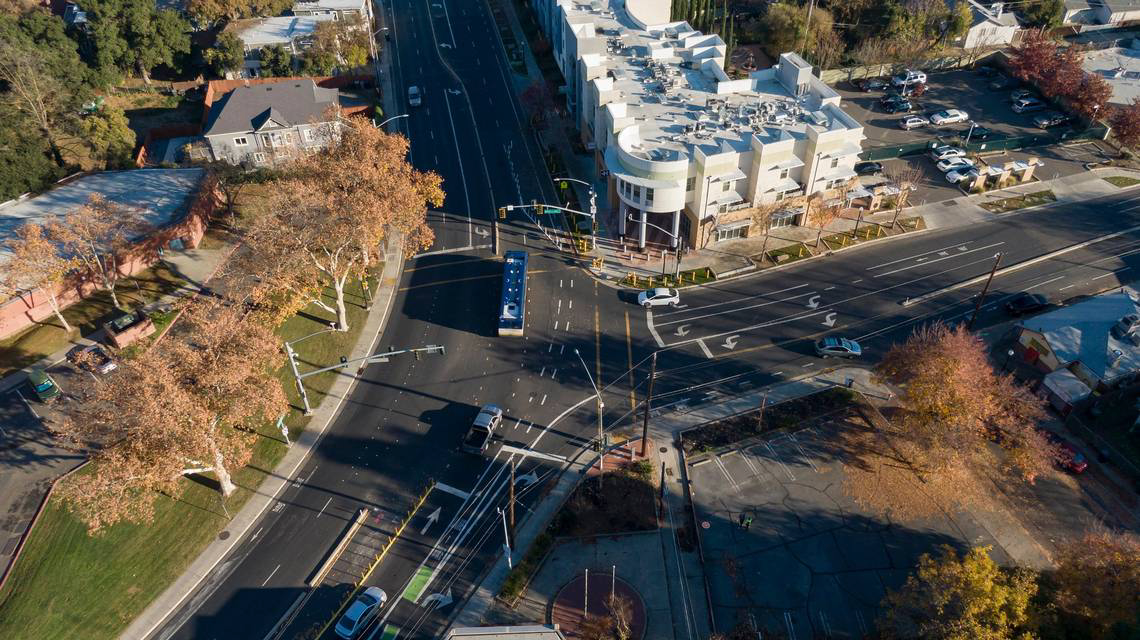
The article highlights changes made to the intersection of Broadway and Martin Luther King, Jr. Blvd (MLK) after a fatal crash single-vehicle crash in 2021. Though the article did not make clear, the driver was likely eastbound on Broadway and continued straight into the building. Google maps, below, does not show the changes, but a photo from the article does (second).

Broadway & MLK intersection, Google Maps (not up to date)
Broadway & MLK, SacBee photo (more recent)
Read More »

SacBee firewall

I’m soon to create two posts that refer to articles in the SacBee, so it seems like a good time to express my frustration with the SacBee firewall. The Bee does make a few articles available to the public, but most require a subscription to view. When I link to a SacBee article, I know that many of my readers will not be able to access that article, because they don’t have a subscription to the Bee. That is frustrating to me, and frustrating to my readers.

The SacBee app works reasonably well, but SacBee links don’t open in the app, you have to go to the app and search for what you want. The search engine is weak. Articles that have been posted recently are often not in Latest News or More latest news. Though it isn’t clear how long articles are retained in the app, a search for an older article may (or may not) bring up the print edition facsimile, and the article of interest may or may not be in that issue.

The web version of the SacBee is quite problematic. You can log into your account, but it will make you log in again within a few day. If you do have a subscription, it will often claim you don’t, and make you go though the whole log in process again. I had a subscription for a while, and tried to use the web interface. I quickly gave up and dropped my subscription. Which was another problem. It took me a deep dive into account management, and several tries, to drop my subscription.

Of course the Bee offers incentives pretty regularly. Free for a period of time, of a price far below subscription for a period of time, but trying to drop the subscription after these incentive periods is quite frustrating. I just tried to load the subscription page in the web interface, and after 15 minutes, the page is still loading. It loads in the app, however. Month subscriptions are $15.99 per month. That seems like a whole lot of money for a newspaper that most repeats national new sources, which I can get many other places, or rewrites articles from CalMatters, and has little real local journalism outside sports. But then, just when I’m about to give up completely, a useful article pops up.

What I want from the Bee is an option to buy an article. For personal, non-commercial use, to read or excerpt a small portion of the article, maybe 50 cents per article. If I want to share the entire article on my non-commercial blog, maybe $2. The Bee knows that its readers want this sort of payment by article, but it has resisted offering this. I don’t know why. It is a chance to make more money off of its journalism. Talking to my friends about the Bee, very few of them subscribe, so the Bee is missing all of the income from these people, and additional income it might make from me.

These are modern times. Why can’t the SacBee offer per article payments? Why can’t the Bee make a website that works?

convert HOV lanes to Express Lanes

With the establishment of the regional tolling authority, Capitol Area Regional Tolling Authority (CARTA), a joint powers authority (JPA), the opportunity exists for existing HOV (high occupancy vehicle) lanes to tolled lanes, specifically Express Lanes. HOV lanes had their time, but that time is past. HOV lanes are routinely violated. If you stand on an overpass and look down at vehicles in the HOV lane, you will see that many of them are single occupant vehicles, not high occupancy. You could also do the same while driving, but I’d rather you kept your eye on the road. The HOV 2+, used in the Sacramento region, which requires two occupants, is a pretty low bar, but even that is not achieved by many drivers. HOV lanes, being free, also generate no funds to maintain the lanes.

The SACOG region current has about 144 lane-miles of HOV lanes. It has no HOT (high occupancy toll) lanes, and no Express Lanes (all vehicles tolled, though toll may vary with occupancy or time of day). The map below (pdf) shows the existing HOV lanes (blue), and the HOV lane now being constructed as part of the Fix50 project. I have seen a SACOG map of the intended Managed Lane Network, but am unable to find it at the moment.

While the Yolo 80 project initiated the current tolling effort, SACOG in the 2020 MTP/SCS, identified managed lanes as a key component of both managing traffic and paying for maintenance of the system.

Read More »

meetings

The Sacramento Active Transportation Commission (SacATC) on Thursday, January 18, was just posted. It is not possible for me to post something on every meeting, and I usually do so only if there is something of particular importance to me. For tomorrow’s SacATC, it is the work zone policy. It may be useful to others to see a schedule of meetings that I often or sometimes attend. For all of these meetings, they may be cancelled or rescheduled, so it is alway best to check before attending. Though most meetings are viewable online, either during or after, fewer and fewer offer public comment, except ahead of time or in person, at the meeting.

Government

Advocacy

Sacramento Transit Advocates and Riders (STAR) maintains a calendar of events of interest to transit advocates, at https://sacramentotransitadvocates.groups.io/g/main/calendar, and you can subscribe to that calendar if you wish.

You are welcome to add meetings that you think would be of interest to transportation and housing advocates, in comments. Certainly no one needs more meetings to attend, but my experience is that if you attend a meeting regularly, people get to know you and your interests, and you can really make a difference.

SacATC meeting January 18

The Sacramento Active Transportation Commission (SacATC) will meet on Thursday, January 18, at 5:30PM. This meeting will be at Historic City Hall, hearing room 2nd floor, though it usually meets in council chambers in new city hall. You can watch in person or online via https://meetings.cityofsacramento.org. You can comment via the eComment function on the meetings page, and in person. eComments are placed in the meeting record, but if you want to be heard, you must attend. Apparently Zoom is no longer available.

Agenda

Commission Staff Report (Oral Report)

Consent Calendar

  1. Approval of Active Transportation Commission Meeting Minutes
  2. Active Transportation Commission Log

Discussion Calendar

  1. Selection of Chair and Vice Chair for Calendar Year 2024
  2. Draft Work Zone and Event Detour Policy
  3. Log Item Report Back: Sacramento’s Alleys

Commissioner Comments – Ideas and Questions

Public Comments-Matters Not on the Agenda

Work Zone

The most important agenda item is 4, Draft Work Zone and Event Detour Policy. I have several prior posts on this. Please read if you want to make comments. Though there could be a number of improvements to the policy, it is overall very good, and far, far better than anything that exists today. The two critical improvements are that the policy must address PROWAG (Public Right of Way Accessibility Guidelines), which are now the law of the land (though not yet enforceable until adopted by US DOT and US DOJ), and that there must be monitoring of all projects that are more than one day duration. The city has claimed that they have contractors (not the construction companies, but separate compliance contractors) monitoring at least once, but clearly that is not happening, as there are violations of ADA on nearly every construction project, and corrections are either slow to occur or never occur.

A report on alleys is also on the agenda.

Truxel Bridge on STAR

STAR, Sacramento Transit Advocates and Riders, has created several posts on Truxel Bridge, the City of Sacramento effort to add a motor vehicle, transit, walking and bicycling bridge over the American River in alignment with Truxel Road. The STAR interest is that the original bridge proposal, approved by Sacramento County under the American River Parkway Plan and by SacRT, was for a bridge that carried light rail, walking and bicycling, not motor vehicles.

View these posts, and likely more to come in the future, on STAR at category ‘Truxel Bridge‘.

the long awaited death of ‘share the road’

The ‘share the road’ sign, which has been very popular with traffic engineers, is NOT in the 2023 MUTCD. So this sign is dead, and a well deserved death. The ‘share the road’ sign was often interpreted by drivers to mean, bicyclists must share the road with motor vehicles, or in less polite terms, “get out of my way, the sign says so”. The share the road diamond shaped sign was never a legal MUTCD sign, though they were and are quite common.

W16-1P sign, which used to say ‘share the road’ now says ‘in road’, as in, bicycles in roadway. The left sign is common, the middle sign can be used, and the right sign is for temporary traffic control (TTC). Since this new sign content replaces the old with the same sign designation, I take it to mean that the old sign may no longer be used at all, and must be replaced by the new sign.

The plaque is not used by itself, but with the W11-1 bicycle sign, below. Though the yellow version of the W11-1/W16-1P assembly is permitted, this sign would more likely be used at TTC in a construction zone.

MUTCD W11-1/W16-1P assembly sign 'bicycles in road'
MUTCD W11-1/W16-1P assembly sign ‘bicycles in road’

Outside of construction zones, the preferable sign would be MUTCD R9-20 ‘bikes allowed use of full lane’, below, and this sign can also be used in construction zones. This sign is similar to the old MUTCD R4-11 sign, which is no longer in the MUTCD.

MUTCD R9-20 'bicycles allowed use of full lane'
MUTCD R9-20 ‘bicycles allowed use of full lane’

Only in a few cases does the MUTCD require replacement of existing signs, but does require that the current sign be used in any new installation.

The new MUTCD recognizes the green painted bicycle lanes and green dotted bicycle lanes (often called skip marking) through conflict areas such as merges and intersections. Unfortunately, it did not drop recognition of the ‘sharrow’ shared lane marking. Though the sharrow can be legitimately used to show a bicyclist path in confusing locations, it has generally been used to bias roadways against bicyclists and to encourage motorists to fail to yield to bicyclists in the roadway. Maybe next time!

The MUTCD now has an entire chapter devoted to bicycles, Part 9: Traffic Control for Bicycle Facilities. This is progress, even if less than desired.

MUTCD released

The 11th edition of the Manual for Uniform Traffic Control Devices (MUTCD) was released in December by FHWA (Federal Highway Administration), so is the 2023 version. The update included solicited comments from the public for the first time, as previously it had been solely the work of traffic engineer insiders. As a result, it is better than the previous version, but still has many unsafe practices included. Though it is supposed to be only about signs and pavement markings, it grades into roadway design, with an emphasis on high speed freeways. Much of it should be limited to highways, but it is regularly applied, or mis-applied, to local streets.

I have been focused on Part 6: Temporary Traffic Control, because it relates to the City of Sacramento work zone policy update. The diagrams are much easier to digest than the text, but the text is also critical. Most of the text and diagrams relate to freeways and expressways, where sidewalks and bike facilities are absent, but it does have some information that affects walking and bicycling. The document uses the phrase ‘shall’ to indicate that a practice must be followed, however, the entire document is prefaced with allowance and encouragement to use engineering judgement. Other terms such as guidance and support are used, for ‘good ideas’ but not requirements. It is very unlikely that I will ever read the entire document; it is 1,150 pages!

NACTO (National Association of City Traffic Officials, a much more progressive organization than FHWA) has done a preliminary review of the new MUTCD: NACTO Statement on the Release of the 11th Edition of the MUTCD, Which Governs How Nearly Every Street in the U.S. Is Designed. NACTO has promised a more though review.

California has in the past adopted its own version of the federal MUTCD, the CA-MUTCD. The current California version is 2014, and it took the state five years to develop this version and get it approved. Hopefully it will take far less time this go-round. The California version deletes some text and diagrams from the federal, adds some diagrams, and adds quite a bit of text. In most case, the California version specifies clearer or safer information, but not always. In some cases the California version has been included in the new federal version, so does not need to vary. I have not seen any announcement from Caltrans about a state update.