Caltrans widening I-5 north of Sacramento

Yesterday I rode the bus to and from Sacramento International Airport, to see what the ride and buses and ridership were like. I noticed that there is significant construction occurring on I-5 between Arena Blvd and Airport Blvd, the entrance to the airport. The freeway width under overcrossings is being widened by one lane in each direction, and the roadway is being widened in between the overpasses and interchanges. I had not heard or realized that this work was already going on, but then, I rarely travel on I-5. This project is titled “SAC-5 Corridor Improvement Project – Phase 1”, and is being referred to as “Sacramento I-5 Auxiliary Lanes Project”. A fact sheet is available.

Caltrans claimed a categorical exclusion for this project, meaning that they claimed they did not need to do an environmental assessment or environmental impact statement for CEQA or NEPA because the project would not have a significant environmental impact. This is laughable. Capacity expansions ALWAYS have an environmental impact. It amazes me the number of agencies, including SACOG and California Transportation Commission, that sign off on this bullshit. The project number is 03-4H580, which means it is part of the Caltrans District 3 megaproject to increase the capacity of I-5 and I-80 in the Sacramento region. It may be that part of this widening is a separate project to add an auxiliary lane between Metro Airpark and State Route 99, using Trade Corridor Enhancement Program (TCEP). It appears that the main project is funded through Solutions for Congested Corridors Program (SCCP). The project also shows up on lists of State Highway Operation and Protection Program (SHOPP) projects, though it is not clear whether it actually received any SHOPP funding. This type of widening would be illegal as a SHOPP expenditure. There are literally 70 documents that relate to this project, and it is beyond me to figure out what they all mean, or how they relate to each other. Caltrans specifically does not gather these documents onto a project page. That would entail some transparency, which Caltrans District 3 is apparently opposed to.

The photo below shows the widening of I-5 at Airport Blvd, captured from Google StreetView. The freeway is being widened to the west to the Sacramento River crossing, and the widening appears to continue all the way to Arena Blvd. Caltrans calls these auxiliary lanes, meaning they extend only between interchanges but not through, but it appears to me that they will be continuous, and that is why the freeway is being widened beneath the overpasses. These modifications of the overpasses are called tie-backs by Caltrans, meaning the the original slope under the overcrossing bridge to the freeway is being truncated to add width to the freeway.

This is phase 1 of the project. Caltrans intends to add capacity to I-5 all the way from the Yolo County line to US 50, where the earlier project greatly expanded capacity from Elk Grove north.

If readers travel this section of I-5 and have comments about this project, or more knowledge of the project than I have been able to come up with, please comment or contact me.

Senator Wiener introduces road safety bills

California State Senator Scott Wiener has introduced two bills to improve road safety in California.

The more important is SB 961, which requires changes to vehicles directly, including a first-in-the-nation requirement that all new vehicles sold in California install speed governors, smart devices that automatically limit the vehicle’s speed to 10 miles above the legal limit. The old name for these is speed governors, which limited speed with a physical device that disengaged the driver train when a certain speed was reached. They were required on all early motor vehicles before vehicle manufacturers managed to eliminate laws requiring them. Today, speed can be digitally read and limited. Already, almost all new vehicles have built in the ability to limit speeds to the posted speed limit, but it is not implemented. The bill would require it be implemented by 2027.

Speed is a contributing factor in all motor vehicle crashes. Whether it is driving too fast for conditions, or simply driving way over the speed limit, speed is a contributing factor to carnage on our roads. Of course there are other factors such as roadway design which encourages speeding. And speed limiters won’t prevent drivers from running red lights, as has become so common, but at least the resulting crashes will be at a lower speed, less likely to result in fatalities.

Speed limiting of vehicles also would remove law enforcement from most speed enforcement, which increases safety for everyone on the road, including officers.

SB 960 requires Caltrans to implement and report on a complete streets policy. In vetoing a Wiener bill to require complete streets, the governor implemented a executive order that purported to accomplish this, but Caltrans has done almost nothing since then, and has weakened and then delayed release of its complete streets policy directive. The bill also requires Caltrans to develop a transit priority policy with performance targets.

Caltrans headquarters has, to some degree, gotten on board with the idea of designing and re-designing roads for better safety and productivity, but the Caltrans districts, including our District 3, are still full speed ahead (pun intended) on building unsafe highways that kill walkers and bicyclists. They must be reigned in by the legislature.

CalBike is a sponsor of both of these bills, along with other organizations. Yay, CalBike!

Links:

SacATC review of work zone policy

Please see previous posts in category ‘Work Zones‘.

The City of Sacramento is hosting a webinar on the draft Work Zone and Event Detour Policy Update, today, January 24, 6:00PM. You can register for the Zoom webinar here(registration is not available on the Work Zone webpage).

I have neglected to post on the SacATC (Sacramento Active Transportation Commission) review of the Work Zone and Event Detour Policy. Commission members had several good ideas and questions, which are worth capturing. You can view the meeting video at https://sacramento.granicus.com/player/clip/5786. Note that the sound quality is very poor, with many dropouts. Since I was at the meeting, I have filled in some details on the comments.

Comments/questions from commissioners:

  • Houpt: advocates should have a chance for input, is that part of the noticing process?
  • Hodel: Old Sac boardwalk (promenade) has been completely closed to bicycles for events; should be consequences for blocking access; supports rerouting motor vehicles is necessary; hefty fines for non-compliance
  • Moore: Class 2 bike lanes are already dangerous so reproducing them as diversions or detours is still dangerous; provide physical safety; rely on automated enforcement, not police presence
  • Gonzalez: is there a definition for ‘short pinch point’?; concerned about monitoring, suggested QRcode at location for immediate report of dangerous situation
  • Gibson: asked for details on enforcement at events; should be separate for short term events versus long-term construction project
  • Banks: how will the city get word out about events and construction that impact access; suggested more photos, particularly for events
  • Erasmus: assistance for event sponsors who may not have the resources to post events
  • Doerr Westbrook: could longer term projects be reflected in Google maps?; there may be some more recent Caltrans info on bicyclist detours; is there a database for locations and TCP documents? Can the document refer to federal guidelines on bicycle facilities for ADT levels, rather than city? (Reply was that the Streets for People Active Transportation Plan will update that guidance, and replace old Bicycle Master Plan at that time)

The Community Development AgencyCounter map (https://sacramento.agencycounter.com/) could be one location to store TCP locations. It does not appear to have document links, but would at least allow people to find locations and request documents.

Central City Mobility: new beg buttons on 5th Street

This is Central City Mobility Project update #33. Note that 5th Street has not yet been converted from one-way to two-way.

When looking at 5th Street, part of the Central City Mobility Project to convert this from a one-way street to a two-way street, I was focused on the looking at the new signals and the mast arms. I failed to notice all the new beg buttons that have been installed. These are the ‘wave at’ variety. Installations are at Q Street, P Street, N Street and Capitol Mall. At Q, P, and N Streets, there are 8 new buttons per intersection. At Capitol Mall there are six, all on the east side of the intersection, because there is a pedestrian crossing prohibition on the west side. I don’t have documentation of what was here before these were installed, but I’m pretty sure that these intersections were on auto-recall, meaning that the button did not need to be pressed, or waved at. I have to admit I have been fooled again by City of Sacramento Public Works. I had been assuming that either things would remain the same, or things would get better. They have proved me wrong by making things worse.

photo of 5th St & Q St SE new wave beg button
5th St & Q St SE new wave beg button

There are beg button posts installed at R Street as well, but since this crossing of 5th St has not been activated, I don’t know how the beg buttons will be labeled.

Read More »

construction violation on 6th St

You may be getting tired of these posts on construction zone failures to accommodate walkers and bicyclists, to to comply with ADA regulations. Well, I’m getting tired of the City of Sacramento Public Works Department completely failing at its responsibility to protect people walking and bicycling. I wonder why it falls to the public to report these issues, rather than to city employees whose job it is to take care of these things. Maybe they should not have their jobs.

This most recently noticed problem is on the east side of 6th Street between I Street and Improv Alley. The building is Riverview Plaza Apartments, a Sacramento Housing and Redevelopment Agency (SHRA) housing, and the project is apparently Riverview Plaza Rehabilitation Project. This construction is not on the city’s AgencyCounter website, perhaps because SHRA is a city/county partnership and assumes it does not need to inform the public.

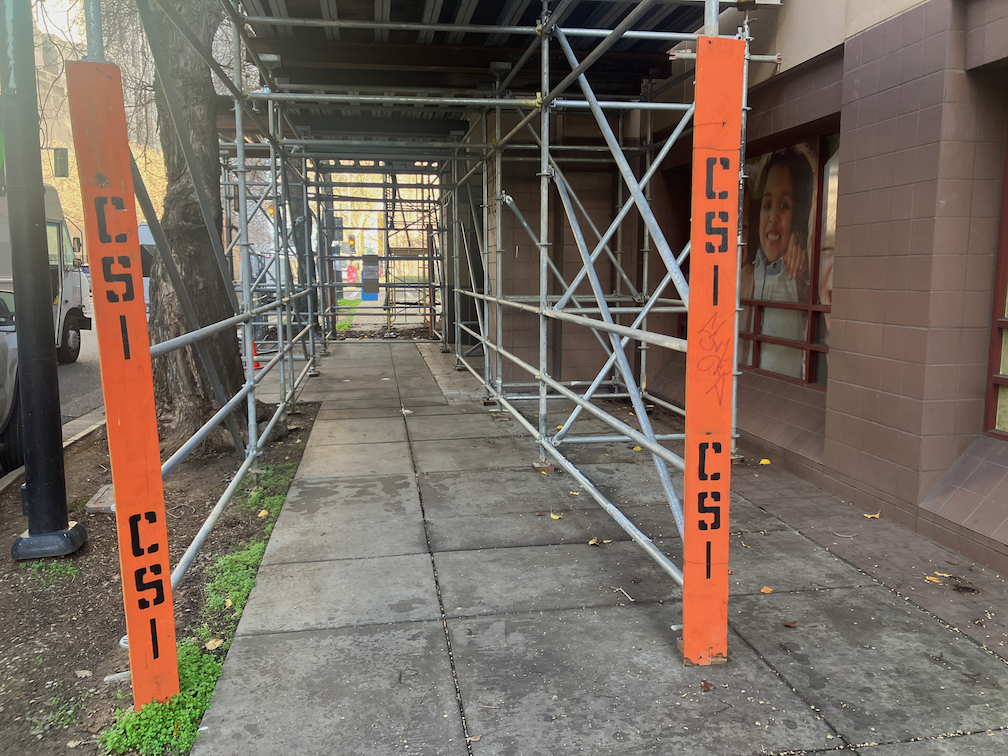
The sidewalk on the east side of 6th Street is completely blocked by construction. At I Street, there is no advance warning of the sidewalk being closed ahead. At the closure, southbound, there is a chainlink fence, which is not a detectable barrier, and no sidewalk closed sign. The construction extends to the curb, including the sidewalk buffer. From the south, there is no advance warning of the sidewalk being closed ahead, either at Improv Alley or at J Street. At the closure, there is a scaffolding, which is not a detectable barrier, and a small paper sidewalk closed sign, not compliant with CA-MUTCD or PROWAG. At the time I walked past, there were two delivery vehicles double-parked on the street, so even if a person wanted to walk around the closure, they would be forced out into traffic on 6th Street. This situation is a complete failure on the part of the construction company, and the city.

photo of SHRA construction on 6th St, no advance warning, no sign on chainlink fence
SHRA construction on 6th St, no advance warning, no sign on chainlink fence
photo of SHRA construction on 6th St, scaffolding as barrier, non-compliant paper sidewalk closed sign
SHRA construction on 6th St, scaffolding as barrier
photo of SHRA construction on 6th St, scaffolding as barrier, non-compliant paper sidewalk closed sign

SHRA construction on 6th St, scaffolding as barrier, non-compliant paper sidewalk closed sign

Work Zone webinar January 24

The City of Sacramento is hosting a webinar on the draft Work Zone and Event Detour Policy Update, tomorrow, January 24, 6:00PM. You can register for the Zoom webinar here (registration is not available on the Work Zone webpage).

With two posts today on construction zone violations, and hundreds of reports to 311, and a series of posts on the work zone policy, I hope that you will agree with me that this is a critical issue for everyone who walks or bicycles in the city (or drives, for that matter), and will attend this webinar. This will probably be the last chance for public education and input before the policy goes to city council, perhaps in February.

The two most important steps to improve the draft policy are:

  • acknowledge PROWAG (Public Right-of-Way Accessibility Guidelines) as the overriding legal requirement for alternate pedestrian access routes
  • establish a monitoring program which requires city staff (or contracted services) to monitor construction projects of more than one day with a visit at the beginning of the project, and at reasonable intervals thereafter

For other improvements to the policy that could be made, please see previous posts in category ‘Work Zones‘.

Work Zone and Event Detour Policy banner

reason #937 against diagonal ramps

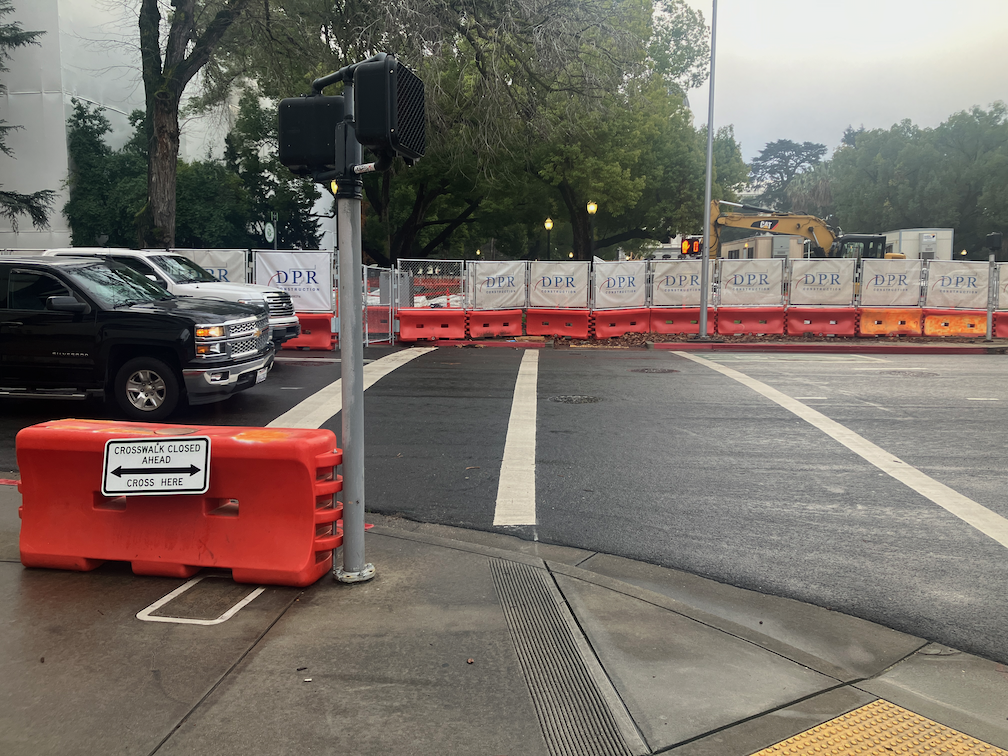
On the northwest corner of 9th Street and Capitol Mall, the construction project on the east side, Jesse Unruh State Office Building Renovation, has closed the sidewalk on the northeast corner, and therefore the crosswalk over 9th Street north side. In general, the construction project has done a good job of signing and barriers to comply with ADA. State projects, though not perfect, are more likely to be compliant with ADA than any of the city or private projects.

photo of 9th St & Capitol Mall NW difficult corner
9th St & Capitol Mall NW difficult corner

There should be a barrier across the crosswalk at this location, to indicate that the crosswalk is closed and the opposite side inaccessible. There is a barrier, and the correct sign, but the barrier is not blocking the crosswalk. But it can’t! If the barrier were placed to block this crosswalk, it would also block the crosswalk over Capitol Mall, which is not a closed crosswalk. That is just one of the things wrong with diagonal ramps. They make it impossible to correctly place barriers and signing for closed crosswalks and sidewalks.

Two actions could make this better. One, cover the pedestrian countdown signal so that it is not visible, and therefore subject to misunderstanding by limited vision walkers. But this would only be safe if, two, the crosswalk were completely blocked by barriers, and a temporary ramp to the Capitol Mall crosswalk placed, to the right of the barriers.

Diagonal ramps are now illegal everywhere via PROWAG, but of course existing diagonal ramps do not need to be corrected unless the corner is subject to modification for other reasons. The city has known for years that diagonal ramps are poor practice, but has continued to build them, or allow them to be built. And sadly, has even allowed illegal ramps to be built: serious concerns about Broadway.

Posts related to the work zone guidelines are linked via category ‘Work Zones‘ within City of Sacramento category. Posts about construction project issues, previous to and after the release of the draft guidelines, of which there are a huge number, are linked via tag ‘construction zone‘ within Active Transportation category.

16th & E construction uncorrected

The construction project at 16th Street & E Street, southwest corner, 500 16th Street, apparently called Studio 30, an affordable apartment complex, still has not corrected its significant flaws in ADA signing and barriers. An earlier post covered the difficulty in properly signing and routing due to the city’s mistake in prohibiting crossing on the north side of the 16th Street and F Street intersection: SacCity bad work zone and bad street design converge.

I reported the ADA violations on January 3, 2024. I checked the project today, 20 days later. Nothing has been corrected. Every violation of ADA standards, which is basically every one, is the same as it was. Apparently the city has decided not to follow up on my 311 report, or the construction company has decided not to correct anything. This is sad.

One thing I noticed today that I had not noticed last time is detour signs on the northeast corner of E Street & 15th Street. The sign directions are nonsensical. The signs may have once been set correctly, but if so, they have been moved, and now communicate incorrect information. This is what happens when signs are placed and then not monitored, by the city and by the construction company.

photo of E St 15th St NE confusing detour signs
E St 15th St NE confusing detour signs

The folding barricades used around this project (which are trip hazards) are labeled with JVB, for JVB Construction Management. I have more recently been paying more attention to who places the construction signs and barriers. This is the first project I’ve noticed by this company, not surprising since it is a southern California company. From now on when I blog about work zone failures, I will do my best to identify who is responsible. Of course it is not just the construction company that is responsible, the city is also responsible.

N Street & 14th Street construction

At a recent meeting, people asked me about the crossing of N Street at 14th Street, what I thought of the pedestrian prohibition, and why I hadn’t reported it as I do most other construction related issues.

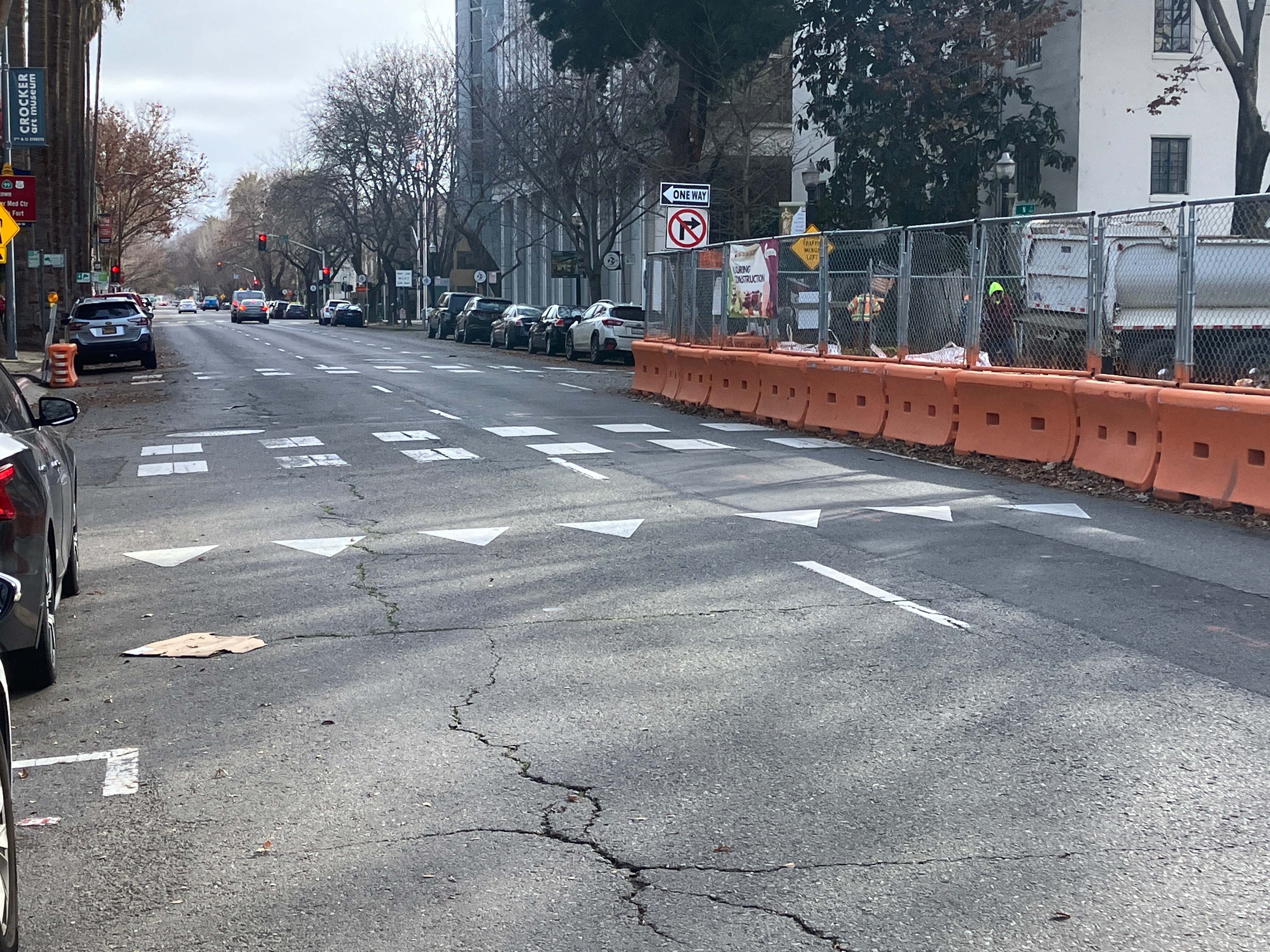
N Street is a three lane one-way street, reduced to two lanes by construction at the state capitol, and the CADA construction project on the southwest corner of N Street and 14th Street. At this construction project, the parking lane and rightmost lane are closed, with a barrier and fence along N Street. The barrier and fence block driver view of the crosswalk on the east side of the N Street/14th Street crosswalk, until just before the crosswalk. This is a situation not addressed by CA-MUTCD, nor the proposed city Draft Criteria and Guidance to Accommodate Active Transportation in Work Zones and at Events, or work zone guide for short.

There are probably ways of safely handling this limited visibility situation, but it is not immediately obvious to me how. So I have not reported the closure of this crosswalk. It is a low volume crosswalk, I believe. Any detour for walkers is an issue, and this one requires a detour of a block to the east or west, because both the east crosswalk and the west crosswalk are closed.

While it is true that this crosswalk closure is no absolutely necessary, it is also true that it would take some sort of traffic control at this location to make it safe for walkers.

photo of N St approaching 14th St, poor visibility
N St approaching 14th St, poor visibility
photo of closed crosswalk over N St at 14th St, east
closed crosswalk over N St at 14th St, east leg, northeast corner
photo of crosswalk closed over N St at 14th St, east, southeast corner
crosswalk closed over N St at 14th St, east leg, southeast corner

healing over-wide streets

I participated in a Strong Towns Crash Analysis Studio on Thursday. I highly recommend these sessions, and will have much more to say about them in the future. One of the presenters shared the diagram below to illustrate what could be done with an over-wide street in Carlsbad, California, the scene of a bicyclist fatality.

diagram of Residential Neighborhood Collector Parallel Parking One Side
Residential Neighborhood Collector Parallel Parking One Side

The diagram is from Better Town Toolkit, and I am quite pleased to find this website. It has design guidance for a variety of places, best practices, and case studies. “Our goal is to help you improve the prosperity, sustainability and quality of life in your community by providing you with the best practices for design and development in your area.” It is sponsored by Regional Plan Association in New York. I am unable to find this exact diagram on their website, but a similar one is L56.

Sacramento is full of over-wide streets. Of course pulling in the curb line and permanently narrowing the vehicle portion of the roadway is the best solution, but very expensive for moving drain inlets an re-pouring curbs. I’ve suggested using diagonal parking to narrow the travel way on slow, low-traffic streets: diagonal parking. The diagram shows another good solution for streets with attached sidewalks, no sidewalk buffer or planting strip. Plant trees in the parking lanes to narrow the roadway, retain parking on one side only, and make a two-way street with narrow lanes (9 foot?). The curb line does not necessarily need to be moved at all, and drain inlets may not need to be moved, so the project would be much less expensive than a street redesign.

There are many streets on which parking utilization is low, in fact, streets empty of parking have none of the traffic calming effect that parking can have. One lane of parking would be sufficient on many streets, and would disourage excess car ownership and long-term storage of cars on the street. Parking has benefits, but only if there is high utilization and turnover. Streets are not a place for long-term storage of private property.

Take a look at the website and let me know what your favorite diagram or page is.