Broadway Complete Streets update

Additional posts on Broadway Complete Streets are available at category ‘Broadway Complete Streets‘.

The section of Broadway from just west of 3rd Street to 19th Street has been repaved, and marked for striping, but no striping has been done yet. The section from 21st St to 24th Street has been ground down in preparation for paving, but no paving has occurred.

There are construction vertical delineators scattered all over the street, along with delineator bases without the vertical. Most of the delineators were placed in what will be the bike lane, not in what will be the bike lane buffer. Presumably the construction company wishes to keep them further away from motor vehicles, which is sort of understandable since more than one-third of the delineators have been hit by drivers.

I’ll post again when there is actual striping installed.

cycletrack in West Sacramento Bridge District

Note: I’ve added text and a photo of the approach from the north.

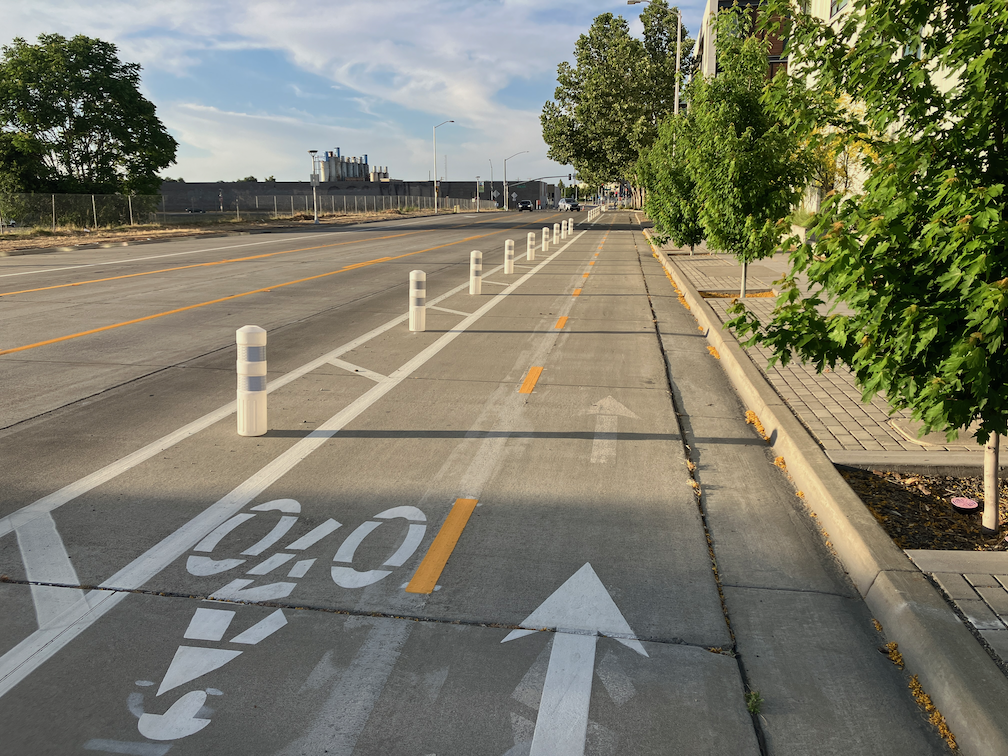
The City of West Sacramento has installed a section of cycletrack (a two-way Class 4 separated bikeway) on South River Road and 5th Street in the Bridge District. Apparently completed late 2023 (shows how long since I’ve ridden that way), it is part of the Riverfront Street Extension and 5th Street Widening Project.

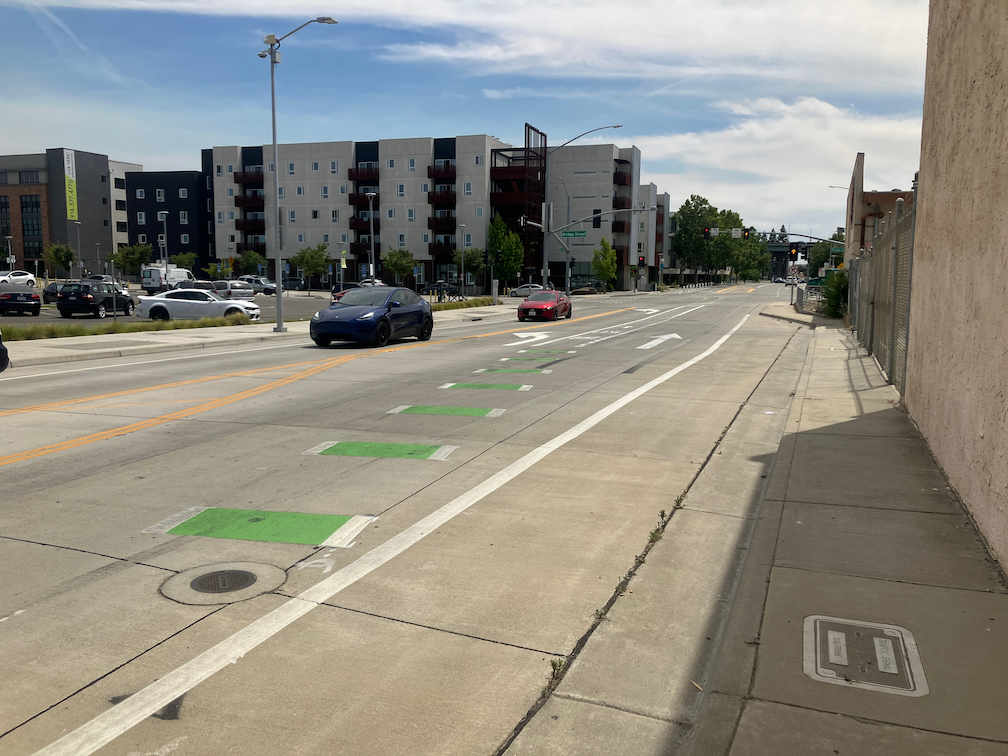
From 15th Street (the connection to Jefferson Blvd) north to almost Mill Street, the bikeway is separated from motor vehicles by a hard curb divider. The on-street bike lane southbound still exists, but this bikeway provides a much safer alternative. The onramp to Hwy 50 east (or Business 80 as it is designated), was an extreme hazard for bicyclists due to drivers turning at high speeds. See two photos below.

South River Rd cycletrack / separated bikeway at 15th St
South River Rd cycletrack / separated bikeway

From Mill Street north to Bridge Street, the cycletrack is separated by a buffer and vertical delineators (K-71). At Bridge Street and north, the roadways returns to traditional Class 2 unprotected bike lanes. Though it would have been great to extend the curb-protected cycletrack all the way north to West Capitol Avenue, at least the truly dangerous section at the freeway onramp was fixed.

To the south of 15th Street, South River Road has more traditional bike lanes, with buffers in a few locations, as it crosses the ship channel and goes through two roundabouts.

The transitions to and from the bikeway seem a little awkward as they swoop through the intersection, but are probably not unsafe. I observed several bicyclists heading westbound to 15th Street who were not following the skip green bicycle markings, but the maneuver was not unsafe. I did not observe any bicyclists at the Bridge Street intersection.

Approaching the cycletrack from the north, the southbound traditional bike lane on the west side of 5th Street transitions to the cycletrack on the east side of 5th Street at Bridge St. Though the transition does not feel safe, I think it actually is, with signals preventing inappropriate motor vehicle movements.

5th St bike lane transitioning to cycletrack approaching Bridge St
signs and signals for bicyclist on 5th St at Bridge St

Folsom Blvd alternative

The city has proposed a Folsom Blvd Safety Project.  See previous post on that project. I would like to present an alternative to the bicycle facilities aspect of this project, improvement of the M Street corridor. M Street, and related streets including Elvas Ave, provide an alternative route. This route is already used by hundreds of bicyclists per day, students at Sacramento State, other commuters, and recreational bicyclists accessing the American River Parkway. Folsom, on the other hand, sees very little bicycle use. This is because it feels dangerous for most bicyclists, and because it is not the most direct route for many destinations.

The lack of bicyclists does not indicate that the street does not deserve bicycle facilities. Folsom has no bicycle facilities in the section to be revised, does not feel safe for bicyclists, and is not safe for bicyclists. The classic saying is that you can’t judge the need for a bridge by the number of people swimming the river. Bicyclists deserve safety on every street.

However, since bicycle facilities are a primary feature of the project, so it is worth asking: ‘Is this the best investment of limited funds?’ I’d suggest that upgrades to the M Street corridor might be a better investment.

Neither route actually offers safe access to and through Sacramento State. M Street is a low volume, mostly low speed street, from Alhambra Blvd to Elvas Blvd, However, the section along Elvas to the Hornet Tunnel that goes under the railroad tracks, is hazardous and intimidating for bicyclists. Folsom Blvd, with this project, would provide basic bicyclist facilities from Alhambra to 65th Street. However, access to and through Sacramento State beyond 65th Street is poor. The ‘safer’ crossing of Folsom at 69th Street and Elvas Avenue is awkward, was designed for walkers and not bicyclists, and not really safe. I have observed a number of drivers blowing the red light at this crossing. After crossing Folsom, a bicyclist can jog west to Elvas Avenue, and ride that to Hornet Tunnel, though the street is very deteriorated, of widely variable width, and the entrance to the tunnel is awkward.

The map below shows both routes, M Street from Alhambra Blvd to Elvas Avenue, in orange, and Folsom Blvd from Alhambra Blvd to 65th Street. Both are of equal length. Folsom Blvd has bike lanes from Alhambra to 47th Street, and discontinuously from 49th Street to 57th Street, with nothing to the east. M Street does not have bike lanes, but is is a low volume, low speed roadway along which most bicyclists feel comfortable riding. It is a ‘low stress bikeway’. Some of the route is marked with bike sharrows. Though improvements could certainly be made to M Street, it is functional as is, as a bicycle route.

Folsom Blvd has a posted speed limit of 35 mph, and much higher speeds are routinely observed. The fatal crash was in fact due in part to egregious speed violation by a driver. The proposed project would reduce speeds somewhat due to prudent drivers, but will probably encourage passing in the center turn lane. The project would leave the posted speed limit unchanged. M Street has a posted speed limit of 25 mph throughout, and speeds above 30 mph are rare. Would bicyclists rather ride on a non-bicyclist facilities roadway with 30 mph traffic, or on a buffered and un-buffered bike lane with 50 mph traffic?

Both of these routes are unacceptable because they don’t create a safe corridor all the way to Sacramento State. However, I feel that an investment in improving the M Street corridor section along Elvas would be a better investment than bicycle facilities along Folsom Blvd which end at 65th Street.

I wrote about improving the section of the M Street corridor between 62nd Street and Hornet Tunnel earlier this year: Elvas Ave and Hornet Tunnel. I don’t have a cost estimate for this project.

I am not saying the the Folsom Blvd Safety Project is a bad idea, just raising the question of where funds can be best invested to improve safety and comfort for bicyclists.

Folsom Blvd safety improvements

I said in my post about the Sacramento Active Transportation Commission meeting of May 16, and in an eComment, that I was generally in support of the Folsom Boulevard Safety Improvements Project, agenda item 3. I am still in support of the project, but conversations with a number of people since them have pointed out weaknesses in the project that I will comment on.

  • Speed limit: The city does not propose to reduce the posted speed limit on the revised sections of roadway. The posted speed limit is 35 mph, and of course the design speed and typical speed is much higher. The reduction of general purpose (motor vehicle) lanes from four to two will result in lower speeds under some conditions, where a prudent driver sets the pace, but where there isn’t a prudent driver, other drivers will continue to travel well over the speed limit, creating the threat of traffic violence for all roadway users. Though not common, some drivers will use the center turn lane to pass slower drivers, increasing the danger for everyone. The city must reduce actual speeds with a safer design that enforces the desired speed.
  • Gutter pan bike lane: For several segments, the project proposes to keep the existing wide gutter pans and use them as part of the bike lane. This is probably illegal under state law, but even if not, it is poor practice. The gutter pans are acceptable in some locations, but in many cases are quite deteriorated and not rideable. Either the gutter pan must not be counted as part of the bike lane, or it must be replaced.
  • Lane widths: The projects indicates lane widths of 11 feet for the center turn lane and the two general purpose (motor vehicle) lanes, or 33 feet of the available roadway width. This is unnecessarily wide and will encourage drivers to travel at a higher speed than is safe. It is worth remembering that the fatality which initiated this project was due in part of excessive speed.
  • Bike lane design: The bike lanes are indicated as five feet. This is the minimum required by law, but is insufficient. It does not allow for safe passing of one bicyclist by another, and limits use by wider bicycles such as cargo bikes and three-wheeled bikes. The bike lane buffer is as narrow as 1.2 feet in some segments. This does not provide any real sense of security for less confident bicyclists. In some sections, the bicycle buffer has vertical delineators (shown as K-71 green delineators), but in other sections has no delineators. The narrow buffers and lack of delineators will not encourage bicyclists to use Folsom Blvd as a travel route. It might be better to improve bicycle facilities on M Street and Elvas Avenue, which is a parallel route commonly used by bicyclists, students and others, from east Sacramento to Sacramento State via the Hornet Tunnel.
  • Sidewalks: At no location in this entire project are sidewalk improvements shown. The sidewalks, where present, meet minimum standards, but do not have sidewalk buffers (planting strips), and there are several short sections with no sidewalk at all. Sidewalks without sidewalk buffers do not encourage people to walk. This is yet another city project with claimed safety benefits in which sidewalks are ignored as though they are not a critically important part of the transportation network. New ADA-compliant curb ramps are indicated in a few locations, but safer crossings are irrelevant if travel along the corridor is discouraged.
  • Slip lanes: The slip lane for 51st Street southbound at Folsom is retained. The small pedestrian island between the two travel lanes is not comfortable for walkers. The project also retains slip lanes for Folsom Blvd eastbound to 65th Street south, and 65th Street eastbound to Folsom Blvd east. Slip lanes are hazardous for all roadway users, and should be removed whenever a street in reconfigured.
  • Center turn lane: As with almost every project the city has proposed, there is a center turn lane along the entire length. I consider these to be a waste of roadway space except where the frequency of turning movements, to or from the major roadway, justify a center turn lane. Otherwise, they are just empty, seldom used space that could be better allocated to other uses.
  • Driveway closures: Driveways are the single feature that creates the most difficulty for people rolliing, and people walking. Commercial properties should be limited to one driveway in/out, of 20 feet, or two driveways, one in, one out, or 20 feet each. Twenty feet is required for commercial driveways by fire regulations. Where driveways are available on side streets for commercial properties, they should be used and driveways on the main roadway closed or greatly narrowed.
  • 48th Street flared intersection: The intersection of 48th Street to the south has a flared design, with extremely wide turning radii, leading to a crossing distance curb to curb of 140 feet! This is a crossing that intimidates walkers, yet the project makes no effort to correct this, or even acknowledge it.

In summary, this project presented as a safety improvement project has major weaknesses that reduce its effectiveness for safety. Remember that the fatality was on a sidewalk, and the result in part of a speeding driver. It was not a bicyclist. Of course I am in favor of higher quality and safer bicyclist facilities, but it seems to be the view of the city that if things are improved for bicyclists, walkers can be ignored. I strongly disagree.

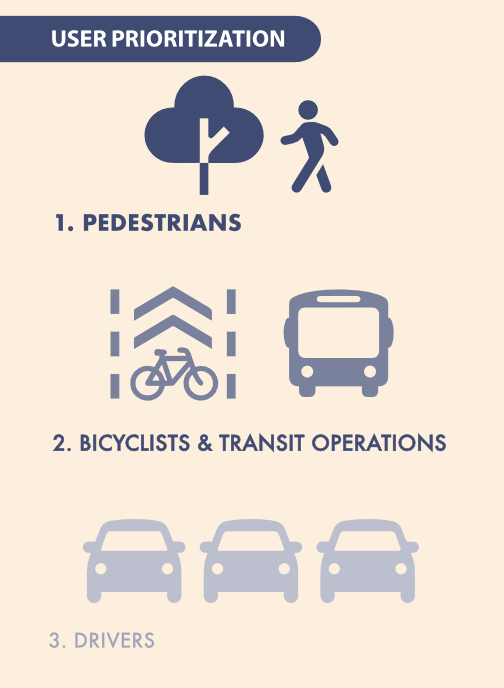
This is another city project that could be transformative, but falls short. The city is unwilling to make our streets significantly safer by prioritizing walkers over others. The General Plan has this diagram. Worth repeating again and again, until the city finally takes it seriously.

I have to admit that I missed a number of these issues when I quickly scanned the project document. If readers see additional issues that I have missed, please comment.

The cross-sections below are from the project document. Each is option two, which has more visual separation of bicyclists from motor vehicles by using buffers and/or vertical delineators. Option one does not provide any separation. But the buffers reduce the bike lane widths to five feet. Whether narrower bike lanes with visual protection, or wider bike lanes with no separation except a white stipe, are better, is a question I do not have a clear answer for. But modern bikeway designs provide both visual, or actual, protection, and wider bike lanes. These bicycle facilities are the minimum acceptable.

Folsom Blvd cross-section, 47th to 53rd, option 2
Folsom Blvd cross-section, 53rd to 63rd, option 2
Folsom Blvd cross-section, 63rd to 65th, option 2

Broadway complete streets update

Additional posts on Broadway Complete Streets are available at category ‘Broadway Complete Streets‘.

I walked part of Broadway today. Not too much has happened. The street west of 11th St/Riverside has been ground down in preparation for overlay, but no overlay has occurred. All of the motor vehicle traffic signals have been installed and turned on. However, NONE of the pedestrian crossing signals have been installed. One of the claimed benefits of the project, to make it safer for people walking to cross Broadway, has been neglected, put at the bottom of the list. It solidifies my opinion that this is really a motor vehicle project, not a safety project. So it goes with City of Sacramento projects.

SacATC 2024-05-16

The City of Sacramento Active Transportation Commission (SacATC) will meet today, May 16, 2024, 5:30PM in city council chambers, 915 I Street.

The main agenda items are:

  1. Folsom Boulevard Safety Improvements Project
  2. Envision Broadway in Oak Park Project
  3. Broadway Vision Zero Project
  4. Draft Sacramento Urban Forest Plan Public Release

These are all discussion and feedback items, not for decisions.

The first item looks like a good project. For each segment, option 2, with buffered bike lanes, is the best option. Wider bike lanes have an advantage in that they accommodate more kinds of bicycles, but most bicyclists appreciate the visual if not actual protection of buffers and vertical delineators.

This project is the result of community pressure on the city to respond to the fatality that occurred at Phoebe Hearst Elementary, and the generally hazardous and hostile environment for walkers and bicyclists.

Folsom Blvd cross-section, 53rd St to 63rd St, option two buffered bike lanes

For all three complete street projects, I feel that center turn lanes are given way too much prominence, while in many segments they are unneeded because there are few driveways and few turning movements too/from cross streets. As always, the problem with with planning streets from the inside out, whereby motor vehicle space is set aside before anything else. Planning from outside in ensures that sidewalks and bicycle facilities are taken care of and of high quality, and then driving and parking needs are taken care of secondarily.

You can comment via eComment at the city’s meeting page, http://sacramento.granicus.com/ViewPublisher.php?view_id=21, before the meeting starts, or in person. Of course in-person is more powerful, but eComments are valuable and the only method many people can use.

SacATC funding recommendations on budget

The funding recommendations of the Sacramento Active Transportation Commission (SacATC) will be on the Budget and Audit Committee agenda tomorrow, May 7, 11:00AM, agenda item 5.

The item offers five action options. The best one is: ‘2) Pass a Motion directing the appropriate council appointive officer to commence work on the proposal with committee members and forwarding the item to the city council for consideration
without further review by the committee.’ Council has already accepted and discussed the annual report, so the decision about how to prioritize the recommendations, and how much budget to allocate, is council’s. The other actions would just slow the process and make implementation less likely.

This request was generated by councilmembers Mai Vang and Katie Valenzuela.

eComment will likely be available at https://meetings.cityofsacramento.org, but is not yet.

Broadway Community Workshop notes

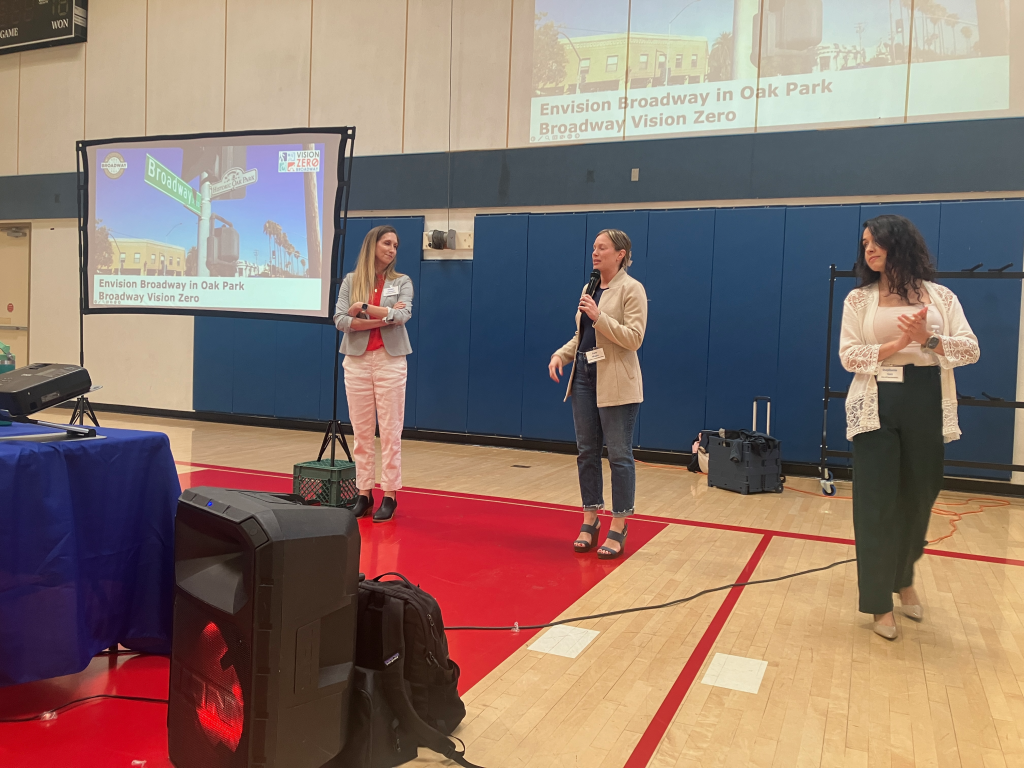
I attended the Broadway Community Workshop on April 23. Stephanie Saiz, the project Engineer, presented on the two projects, Envision Broadway in Oak Park and Broadway Vision Zero. Several consultants also spoke on aspect of the project, and councilmember Caity Maple. Envision is documented by the city’s Envision Broadway in Oak Park, 2020. No document was available ahead of time on Broadway Vision Zero.

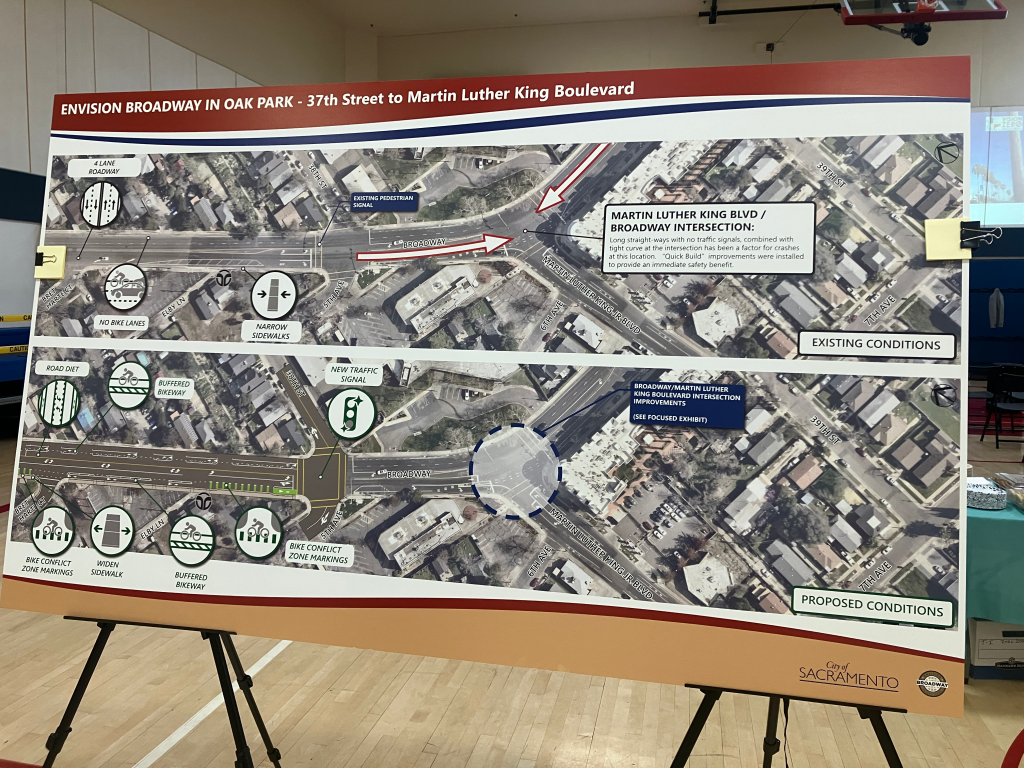
Several options of the intersection of Broadway and MLK Blvd, including an enhancement of the quick build that was previously installed, and a roundabout.

No mention was made of speed reduction, so it is assumed that the posted speed limit will continue to be 30 mph Alhambra to MLK, and 35 mph MLK to Stockton. Design speeds are always about 10 mph above the posted speed, theoretically but falsely to provide a buffer of safety for drivers. And if you have observed traffic on this stretch, you know actual speeds are often above that.

Cross-section and map diagrams were on poster boards. The same design as used on Broadway Complete Streets (5th St to Alhambra) is used on both these sections. It starts with a center turn lane, then general purpose (car) lanes, then a buffered (but NOT protected) bike lane, then parking, and finally sidewalk. This is the way the city designs streets, from the inside out rather than the outside in. By the time the sidewalk is reached, there is no extra space for sidewalks, and no extra money for infrastructure. The presence of a center turn lane throughout the entire Broadway section is ridiculous. There are cross streets with almost no traffic, meaning very few turning movements. But the center turn lane is there, needed or not. The city could have designed so that a center turn lane was present where it was really needed, but it did not. It could have used the width of the center turn lane for more important uses such as protected bikeways, or wider sidewalks, or wider sidewalk buffers, but it did not.

“A foolish consistency is the hobgoblin of little minds.” – Ralph Waldo Emerson

Megan Johnson, engineer for the city, presented on why it was not possible to provide separated or protected bikeways. The answer was because there was insufficient roadway width available for the two buffers needed for a separated bikeway, as opposed to a regular bike lane. It was hard to follow, and I failed to capture that diagram. Of course, when you plan from the inside out, there is often not enough space on the roadway to install proper bicycle infrastructure.

The slideshow below has photos of the display boards. I have not downsampled these, as I usually do, since it requires higher resolution to see all the details. These board are more complete than the diagrams in the Envision document, and the first time Broadway Vision Zero was shown. The boards were captured before people added post-it notes, but the post-it notes were abundant.

There is no question that Broadway will be better with these projects than it is now. But I’m disappointed. Given the opportunity to transform, they instead decided to take the safe route.

I had extensive discussions with transit experts about the bus stops along the Envision section. There will be a post about that on the STAR blog.

SacATC April 18 notes

These are my notes from the April 18 meeting of the Sacramento Active Transportation Commission (SacATC). The official minutes are not available until the agenda for the next meeting is released, about three days before the meeting.

City staff announced that due to hiring a consultant and the project timeline, the updated Vision Zero Action Plan would not be available until sometime in 2025, not this year.

Agenda 4: Kastanis Shared Use Path. This is a wonderful project, connecting two ends of a dead-end street for walkers and bicyclists. It received my support and the full commission. Commissioners asked about lighting and trees, but as a sidewalk infill project from a very limited program, those could not be included.

Agenda 5: Grand Avenue Sidewalk Infill. Another wonderful project, adding sidewalks on Grand Aveue adjacent to the Sacramento Northern Trail for better neighborhood access included ADA ramps on all corners. A SacRT bus stop location will also be improved. Again, my support and the full commission. Commissioner Harris, who represents District 2, spoke about the lack of sidewalks throughout much of the district, and the benefit of any infill projects.

I spoke on items ‘not on the agenda’, asking that the slide presentations be made available before the commission meeting whenever possible. There is often information in the presentations not available in the staff report, which can make a project look better, or worse. I also suggested that the commission ask for a presentation on how the city views its responsibility for bus stops, since this came up many times in discussion of the Grand Avenue project.

I hope that more people will attend the SacATC meetings and comment on projects (on online via eComment). This is the only real chance for public input on projects, other than going to your council member. Most Public Works projects are a black box without public input, so when there is the chance, it is time to speak up for safer and innovative solutions.

And now on to the more complex project, which took up the majority of the meeting time.

Agenda 3: Traffic Signal Safety Program. There was a staff presentation with a slide deck that was not available to the public (this is an ongoing problem, see below). Though the diagrams in the presentation were much more detailed than the ones in the staff report, they still left out a lot about the context of the intersection. What is it close to? Are there already a lot of walkers? How far is it to the next safe crossing? Is a traffic signal the best solution? It was clear from answers to commissioner questions that a lot of information was missing. Apparently this project is the result of a SACOG grant made to the city in 2017. Presumably there was a resulting document on the project, but that was not made available. The staff person said site selection was based on traffic warrants, but then exhibited a lack of knowledge about warrants. The question came up about whether the city could install a signal of any type that didn’t meet designs in the CA-MUTCD (California version of the federal Manual for Uniform Traffic Control Devices). The initial answer was no, but this was revised to yes, however a grant would be unlikely to be obtained that included non-MUTCD designs.

Overall, the entire traffic signal project is disappointing. The traffic engineering section of Public Works seems to have a very simple view of the world, to wit, a street with an unsafe design > a traffic signal. Changing the street design? Nah. Calming traffic to make the crossing safer? Nah. Shortening the crossing distance? Nah.

Traffic signals are expensive! Though no budget detail was provided, it is reasonable to assume from the overall $7.9M budget, which includes four full traffic signals, three pedestrian signals, and two RRFB (rectangular rapid flashing beacon) that full traffic signals cost about $1M each. That kind of money could fund a lot of traffic calming with lane reductions and curb extensions. Please take a look at my agenda post, and a comment from Sean Rogers that provides a much lower cost alternative for the Monroe Street and Latham Drive intersection.

Traffic signals do not necessarily create safer streets. Certainly, they don’t promote safety in between signals, as drivers accelerate to previous, often egregious, speeds as soon as the light turns green. With rampant red-light running, stop signs are probably much safer than signals. Though drivers also run stop signs, they do so at much slower speeds, whereas drivers running red lights often accelerate into the red light, ensuring the death of anyone in their path. If there are no gaps in traffic on a roadway, then it is necessary to create gaps with some sort of control, but a traffic signal is often the dumbest and most expensive way of doing that.

California has two years from the adoption of the federal MUTCD, which was December 2023, to either submit its own version, or the federal version will be the version for California.

The federal MUTCD (2023) has some interesting text (Section 4B.03 Alternatives to Traffic Control Signals): “Since road user delay and the frequency of some types of crashes are sometimes higher under traffic signal control than under STOP sign control, consideration should be given to providing alternatives to traffic control signals even if one or more of the signal warrants (see Chapter 4C) has been satisfied”, followed by 14 alternatives to traffic signals.

Section 4C.01 Studies and Factors for Justifying Traffic Control Signals provides a list of nine possible warrants to justify a traffic signal:

Warrant 1, Eight-Hour Vehicular Volume
Warrant 2, Four-Hour Vehicular Volume
Warrant 3, Peak Hour
Warrant 4, Pedestrian Volume
Warrant 5, School Crossing
Warrant 6, Coordinated Signal System
Warrant 7, Crash Experience
Warrant 8, Roadway Network
Warrant 9, Intersection Near a Grade Crossing

It is unknown which of, or any of, these were used to justify the signal locations. There are very detailed (and hard to understand) explanations of each of these warrant types.

My comments on the project, which I did not quite finish (two minutes is a short time), included:

  • Signals are not necessarily a safety feature for people walking, unless there are no gaps in traffic, the more important issue is to calm traffic on the approaching streets
  • We already have a lot of unneeded signals, where the traffic volume and context of the intersection does not justify a full traffic signal, perhaps 60 of them just in the central city
  • 16th & D: traffic on 16th St needs to be calmed, signal will probably not shorten wait time for crossing
  • Rio Linda at Roanoke: lacks a connection to Sacramento Northern Trail, which would make it a great deal more useful, posted speed 40 mph is too high for an RRFB
  • Monroe and Latham: traffic calming through lane reduction and curb extensions would be as effective as a signal (Sean Rogers comment)
  • At about $1M for a full traffic signal, there are much less expensive alternatives, and much better ways of spending limited funds

Broadway Community Workshop

The City of Sacramento is hosting a workshop on Tuesday, April 23, on the Envision Broadway in Oak Park plan, and Vision Zero Broadway. The workshop will start 5:30PM at the Salvation Army Ray Richardson Community Center, 2540 Alhambra Boulevard, Sacramento, CA 95817.

The 2020 document Envision Broadway in Oak Park exists on the city website but is not findable as it transitions the website. There is no document, so far as I know on Vision Zero Broadway, other than that the section of Broadway east from 38th Street to Stockton Blvd is identified as a high injury corridor in the Vision Zero Action Plan.

The plan for the Alhambra Blvd to 38th Street section is very similar to that underway to the west under the Broadway Complete Streets project, and as such, has the same benefits and weaknesses. The diagram from the Envision document shows wide 15 foot sidewalks between Alhambra and 36th, but the sidewalks are mostly not wide, and what is shown is the entire sidewalk and sidewalk buffer.

The plan, as with the complete streets plan, ranks transportation modes:

  1. motor vehicles
  2. bicycles
  3. walking
  4. transit

The city’s General Plan 2040 has a different vision:

See a post on the Sacramento Transit Advocates and Riders (STAR) blog for more information: Envision Broadway in Oak Park.