Author: Dan Allison
Dan Allison is a transportation advocate in Sacramento, CA. Dan dances and backpacks, as much as possible.
what’s going on? (other)
There are so many actions and possibilities for improving the efficient, equity, and safety of our transportation system that I can’t keep up with it all, and even nonprofits that have staff are unable to keep up. So, what’s going on? The list below is not in any priority order, but may give you ideas about what you would like to get involved in. It takes a village!
Items specific to City of Sacramento were in a previous post, while these items are about other locations, and/or applicable to all the cities and counties in the region.
Transportation funding in Sacramento County: Transportation sales tax measures in 2016 and 2022 failed, and a 2020 measure was withdrawn. Each measure was weak on active transportation and transit (and the sprawl developer sponsored ‘citizens initiative’ in 2022 was horrible), and also suffered from anti-tax sentiment in the county. There are three efforts to place a funding measure on the 2026 ballot, Sacramento Transit Authority (SacTA) new Measure A, SMART/Steinberg citizen measure for housing, active transportation, and roadway maintenance, and SacRT transit measure for City of Sacramento and Elk Grove. All of these are in early stages, not yet formalized. Sales taxes are regressive, making low-income people pay a much higher percentage of their income on these taxes, so efforts to identify other mechanisms are critically important.
City of Rancho Cordova Active Transportation Plan: The city is starting the process of community engagement towards developing a plan for walking, rolling and bicycling.
Other active transportation plans: Sacramento County updated its plan in 2022. Folsom updated its plan in 2022. It isn’t clear what the status of Elk Grove’s Bicycle, Pedestrian, And Trails Master Plan is. West Sacramento’s Bicycle, Pedestrian, and Trails Master Plan, from 2018, received minor updates in 2024. Roseville is undertaking a Transportation 360 effort to include walking, bicycling and transit. Davis does not seem to have an active transportation plan.
Sacramento County Climate Action Plan: The county has delayed a climate action plan by years, going through a series of revisions that aren’t much better than the previous. Sacramento Climate Coalition and 350Sacramento have been the most active on this issue. It will take citizen pressure on staff and on the Board of Supervisors to ensure an effective plan.
Other climate action plans: Every city and county is required to come up with a climate action plan. I don’t know the status of plans other than City of Sacramento and Sacramento County.
SACOG 2025 Blueprint: SACOG is developing a new version of the MTP/SCS called Blueprint ‘Linking land use and transportation in the Sacramento region’. There is a constant tension between the desires of cities, in particular Sacramento, West Sacramento, and Davis, and the smaller cities and rural counties of the six county SACOG region, over what kinds of transportation investment to make. SACOG is required to come up with a plan that would reduce greenhouse gas emissions (GHG) by 19%, and the transportation policies and projects selected will make all the difference in whether the region has a chance for achieving that goal. Citizen pressure for infill and livable communities is required to counteract the small city and rural voices that just want money to continue doing what they’ve always done, which is encourage low density sprawl development with a motor-vehicle focused transportation network.
Caltrans District 3: While other entities are beginning to meet the public demand and legal requirements to reduce greenhouse gas emissions (GHG) by reducing vehicle miles traveled (VMT), and improve roadway safety, Caltrans District 3 is continuing to expand highway capacity, inducing travel demand and increasing GHG/VMT, and making it very hard for cities and counties to make their roadways that are state highways or that cross state highways (underpasses and overpasses) to improve safety. Caltrans headquarters has been unable to rein in District 3.
This list no doubt misses some important topics. Please suggest them in the comments.

what’s going on? (SacCity version)
In compiling this list, I realized that it was becoming very long, so I’m splitting it into two lists, the second on non-City of Sacramento to be posted shortly.
There are so many actions and possibilities for improving the efficient, equity, and safety of our transportation system that I can’t keep up with it all, and even nonprofits that have staff are unable to keep up. So, what’s going on? The list below is not in any priority order, but may give you ideas about what you would like to get involved in. It takes a village!
City of Sacramento
- Street Design Standards Amendment: This is ongoing. The organization most involved is Strong SacTown, and of course, Getting Around Sacramento
- Streets for All Active Transportation Plan: This is ongoing. The neighborhood connections part of the plan, perhaps the most important element, will open a public input process in November, with two online workshops.
- Work Zone and Event Detour Policy: This is ongoing, however, opposition in Public Works has delayed this policy by many months, and it will take public pressure to free it up.
- Active Transportation Commission (SacATC): Though it has been pretty ineffective since founding in 2018, the addition of strong leaders to the commission and the notice of supportive city council members has opened the opportunity for real progress.
- Vision Zero: Though the city committed to Vision Zero in 2017, the rate of traffic fatalities and severe injuries has increased every year since, because of the city’s unwillingness to take dramatic action, and the very very slow process of depending on grant funding to improve streets. The focus on corridors and inattention to intersections is also a flaw. The Vision Zero plan is being updated, but so far there has been no public involvement.
- Speed limits: The city reduced speed limits in many school zones several years ago, on a few streets recently, and is working towards additional reductions under AB 43.
- Emergency Declaration on Roadway Safety: Vice Mayor Caity Maple, Mayor Darrell Steinberg, and council member Karina Talamantes are sponsoring an emergency declaration on roadway safety, to address the epidemic (pandemic?) of traffic violence in the city. The initial proposal focused on ineffective traditional responses, but they seem open to more innovative and effective approaches.
- Climate Action and Adaptation Plan: This plan, now part of the 2040 General Plan, set targets for walking, bicycling, and transit mode share, that were less ambitious than proposed in the Mayors Climate Action Plan, but nevertheless significant. Reaching these targets will require proactive changes to transportation funding allocation, street redesign, and implementation of quick-build projects.
- Transportation Priorities Plan (TPP): This plan was adopted in 2022, to guide city investment and grant seeking based on objective criteria, rather than the whims of traffic engineers. Though the priorities could have been better weighted towards equity, active transportation, and climate action, it is nevertheless an immense improvement. Citizens will have to monitor the city’s decisions to ensure that the plan is followed, and improved over time.
- Shared Mobility/Shared Rideables: The city has a shared rideables program which has resulted in a plethora of electric scooters in some parts of the city, and almost none in others, and almost no bike share at all, though we once had the second most successful bike share in the US. The city has chosen to let the market decide, the commercial companies, and has refused to consider city subsidy or a city program to ensure more widespread and equitable availability.
- Quick-build: The active transportation community has requested that the city implement a quick-build program, with funding, that can respond quickly to crashes and traffic safety issues. Leadership has primarily been by Slow Down Sacramento. Though the city has discussed a program, they have so far refused to implement or fund a program.
- Red light camera enforcement (no link because the city removed its page): The city participated in the county’s red light camera program, but when the county dropped the program, the city did as well, and so far as is known, has no plans to develop their own program. Red light running is epidemic (pandemic?) in Sacramento, and elsewhere, and there must be an automated enforcement program, with equity guardrails, to address this traffic violence issue.
- Daylighting: State law (AB 413) prohibits parking with 20 feet of intersections, in order to increase visibility between drivers and people walking. The city has not said whether it will enforce this law, nor whether it will add signing or red curbs to communicate it to drivers. So of the benefits of daylighting can also be achieved through temporary (quick-build) or permanent curb extensions.
- Speed camera enforcement: The city is not part of the speed camera enforcement pilot program (though to its credit, it asked to be). The city should continue to ask to be part of the pilot program, and to fully participate when the program becomes permanent.
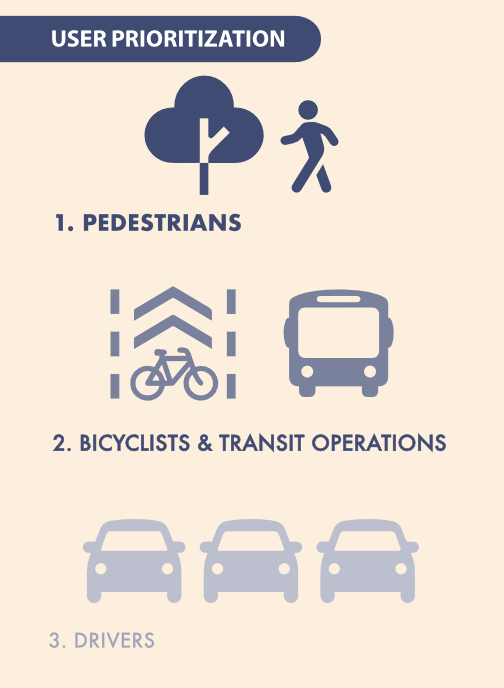
- The 2040 General Plan: The plan sets a new vision for mode priority in the city (graphic below). This is a seismic shift in priorities, and will be resisted by many city staff, so it will take citizen pressure to ensure that it is followed.
This list no doubt misses some important topics. Please suggest them in the comments. The next post will include some actions that are applicable to City of Sacramento, but also to other cities, the county, and the region.
EVs? Meh.
I have long looked askance at the emphasis on electric vehicles (EVs) for solving our climate change challenge and other issues. As has been said, they are necessary but insufficient. Reducing vehicle miles traveled (VMT) is as important, or more important. Now comes a report, highlighted in the Streetsblog USA article EVs — What Are They Good For? that indicates just how insufficient they are. (The Effects of ‘Buy American’: Electric Vehicles and the Inflation Reduction Act)
If EVs were competing in the marketplace, they would be gradually replacing fossil fueled vehicles (also called ICE – internal combustion engines), but in an effort to accelerate adoption, the federal government and California are subsidizing the conversion to the tune of billions of dollars. Is this a good investment, compared to other investments that would reduce greenhouse gas emissions (GHG) and increase roadway safety? I doubt it. EVs will kill and severely injure more people than ICE vehicles. EVs will generate more tire and brake pollution. Most importantly, EVs support the faux environmentalist attitude that I can keep on driving my private vehicle while ignoring the damage to the livability and financial stability of cities, and the mis-allocation of transportation investments towards motor vehicles and away from walking, bicycling and transit.
For those who might miss the cultural reference of the Streetsblog headline, it is from the Motown ‘War‘ – “War, what is it good for, absolutely nothing”.
SacATC 2024-10-17
The City of Sacramento Active Transportation Commission (SacATC) will meet this Thursday, October 17, 2024, starting at 5:30 PM. The meeting is held at city council chambers, 915 I Street, and can be viewed online via the link available when the meeting starts, on the city’s Upcoming Meetings page. People may comment in person (preferred) or make an eComment on the city’s Upcoming Meetings page. Though all eComments become part of the public record, only those submitted before noon of the meeting date will be seen by the commissioners. The agenda includes three discussion items, below, and is available as pdf.
- Fiscal Year (FY) 2025/26 Caltrans Sustainable Transportation Planning Grant
- Assembly Bill (AB) 43 Project (speed limits)
- Active Transportation Commission 2024 Draft Annual Report
At the last meeting, the commission decided to reduce the list of recommendations to those directly impacting street safety. In the updated draft annual report, these six are:
- Increase Funding for Active Transportation Infrastructure Projects
- Expand Speed Management Programs
- Create a Sacramento Quick- Build Bikeways Program
- Re-Establish Slow & Active Streets
- Develop a Citywide Safe Routes to School Program
- Finalize the Construction Detour Policy
They are listed in inverse order of funding. with #1 requesting the highest level of funding, $3M per year.
It is important for the community to support the annual report with its focus on priority safety actions, to support the report when it goes to city council, and to support the city prioritizing these funds in the mid-year budget revision and in next year’s budget.
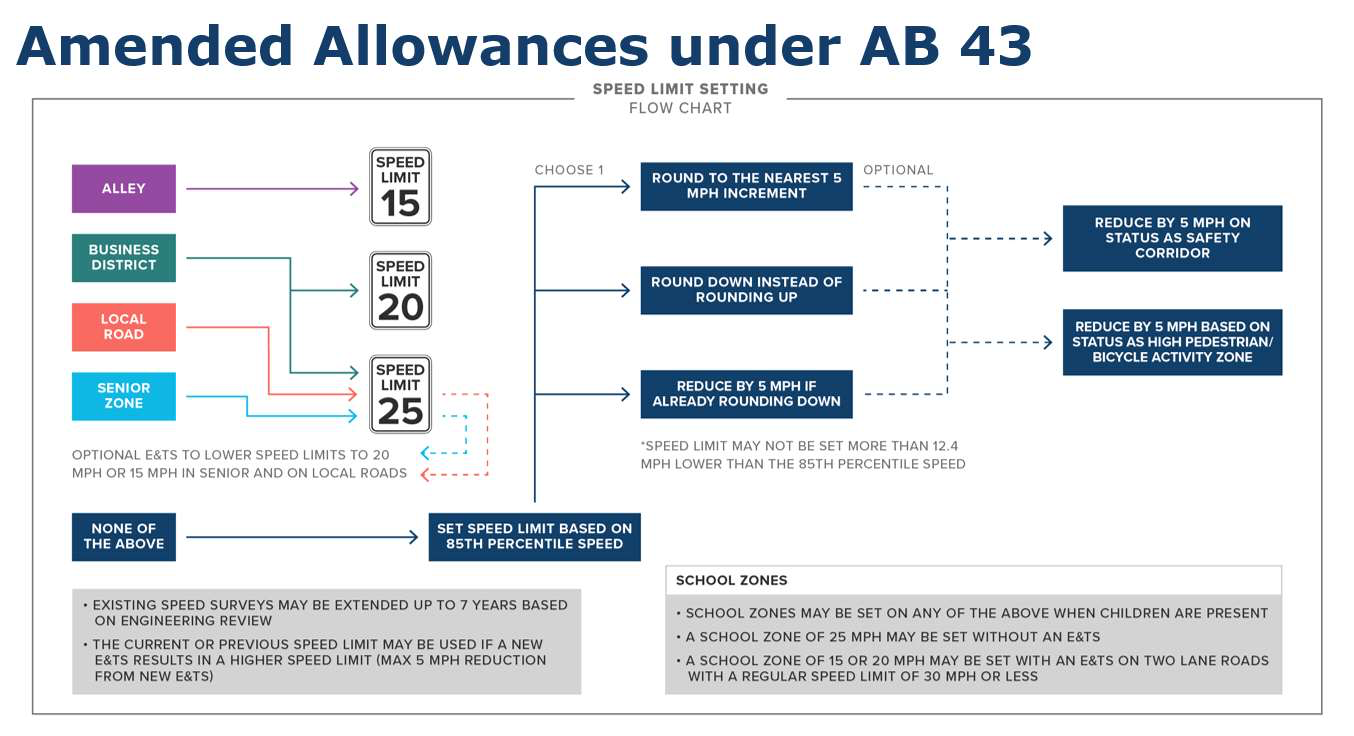
The city reduced speed limits in many school zones several years ago, and recently reduced speed limits on a few streets, and is gradually working to reduce speed limits on more streets, including alleys, business districts, local roads, and senior zones. The graphic below shows the approach. The presentation will bring the commission up to date on the project.
City staff is asking the commission to recommend two grant applications under Caltran’s Sustainable Communities Planning Grants for Transit Needs in Sacramento to meet Climate, Equity and Mobility Goals; and the Walking, Bicycling and Transit Access Wayfinding Project.
The city’s Department of Public Works Transportation Planning Newsletter has more information on these topics and others. I recommend you sign up if you aren’t already getting the email newsletter, which comes out once a month.
SacRT Board considers Smart Ride today!
Strong Towns approach to roadway safety
Strong Towns, an organization which provides leadership and thinking through five priority campaigns: End Highway Expansion, Transparent Local Accounting, Incremental Housing, Safe and Productive Streets, and End Parking Mandates and Subsidies. Safe and Productive Streets are the focus this week, with a podcast Prioritizing Safety in Street Design: A Conversation with Melany Alliston, posted today, and tomorrow, Beyond Blame Press Conference: How Cities Can Learn From Crashes To Create Safer Streets Today, and release of a report Beyond Blame: How Cities Can Learn from Crashes to Create Safer Streets Today.
Strong SacTown, the ‘local conversation’ or affiliate of Strong Towns is an active participant in the City of Sacramento Street Design Standards Update. Please join Strong SacTown. Slow Down Sacramento (Isaac Gonzalez) is also playing a major role in bringing awareness of roadways safety to the public, and his emails inform this post. Please join Slow Down Sacramento. Civic Thread and SABA, along with many other organizations, are providing both leadership and technical expertise on roadway safety. Please support them!
Strong Towns has offered the Crash Analysis Studio for two years now, with 19 studios. I have participated in several of these, and I think they are great, though only a part of the necessary response.

this week 2024-10-14
Monday 14
- SacRT Board Meeting (special), 4:00 PM, includes presentation and discussion of revised Smart Ride program
Tuesday 15
- Strong Towns Beyond Blame Press Conference: How Cities Can Learn From Crashes To Create Safer Streets Today, 9:00 AM, online; https://us02web.zoom.us/webinar/register/WN_0dai3to0RC6Zs5DpdmIsQA?apcid=00661a995d8b8c0fdb8d6701&utm_campaign=cas-report-and-conference&utm_content=cas-report-and-conference
Wednesday 16
- SACOG Transit Coordinating Committee, 9:00 AM, online
Thursday 17
- SACOG Board of Directors, 9:00 AM, includes workshop on Dangerous by Design
- CARTA (Capital Area Regional Tolling Authority) Board, 12:00 PM
- SacRT MAC (Mobility Advisory Council), 2:30 PM
- SacATC (Active Transportation Commission), 5:30 PM; includes speed limit report and annual report
- ECOS Climate Committee, 6:00 PM
Friday 18
- SacMoves Coalition, 10:00 AM, online
Saturday 19
- River District Open Streets Festival, Mirasol Park, 400 Pipevine St, Sacramento CA 95811; 12:00 – 4:00 PM; https://www.eventbrite.com/e/river-district-open-streets-festival-tickets-939893455627 (registration not required)
Prop 5 bonding for transportation?
Proposition 5
A Yes on 5 website offers details in support of the proposition. The arguments against, on the voter information guide, are just the standard anti-tax voice, so isn’t useful to this post, but you can read your guide if you are interested. Prop 5 was placed on the ballot by the legislature, as a result of two legislative resolutions. The proposition is entitled “Proposition 5: Allows Local Bonds for Affordable Housing and Public Infrastructure with 55% Voter Approval.“
The proposition would change the voting threshold from two-thirds, 67%, to 55%, for ballot measures by cities, counties and special districts (does this include SacRT?) that bond against property taxes for the purposes of affordable housing and public infrastructure. The proposition does not directly raise property taxes, nor would local bonding measures directly raise taxes, though since the bonds have to be repaid with interest, property taxes could eventually go up within the limits sets by other legislation. This has nothing to do with sales tax, which remains at two-thirds for govenment proposed sales taxes, and 50%+1 for citizen proposed measures.
The history of the proposal development indicates that it is more about affordable housing than public infrastructure, but infrastructure is definitely allowed, and could easily be justified when that infrastructure supports affordable housing. It can also apply to transportation infrastructure. The specific language in the ballot measure related to infrastructure is “construction, reconstruction, rehabilitation, or replacement of public infrastructure”, which is pretty open-ended. More specifically, the proposition lists the following infrastructure uses:
(I) Facilities or infrastructure for the delivery of public services, including education, police, fire protection, parks, recreation, open space, emergency medical, public health, libraries, flood protection, streets or highways, seaports, public transit, railroad, airports, and
(II) Utility, common carrier or other similar projects, including energy-related, communication-related, water-related, and wastewater-related facilities or infrastructure.
(III) Projects identified by the State or local government for recovery from natural disasters.
(IV) Equipment related to fire suppression, emergency response equipment, or interoperable communications equipment for direct and exclusive use by fire, emergency response, police, or sheriff personnel.
(V) Projects that provide protection of property from sea level rise.
(VI) Projects that provide public broadband internet access service expansion in underserved areas.
(VII) Private uses incidental to, or necessary for, the public infrastructure.
(VIII) Grants to homeowners for the purposes of structure hardening of homes and structures, as defined in state law.
The reason for raising this issue is that taxes based on property are progressive, meaning that people with higher incomes and therefore higher value property, pay more in taxes. Sales taxes are regressive, meaning that low-income people pay a higher percentage of their income on taxes than do higher income people. Proposals to increase the sales tax in Sacramento County have been resisted by many who think we have runs out that option and need to turn to options that are not regressive, like property tax.
I prefer pay-as-you go expenditures from most transportation projects, except for a few which are very expensive and of clear benefit to everyone. There are few transportation projects that would or should quality for this. The transportation projects we most need going forward are many small fixes, not the mega-projects done in the past which tend to be motor vehicle projects. But some transit projects could be or should be bonded. The problem with bonding is that interest payments raise the cost to about 1-1/2 times the project cost, depending on the bond length and bone rates, and that money goes to wall street investors, not to the project.
I am in favor of the proposition. It gives local governments, and therefore citizens, control over how they spend their property tax, rather than being constrained by statewide controls that were implemented by anti-tax interests.
If the proposition passes, would it be the solution, or a solution, to funding affordable housing and transportation infrastructure instead of or in addition to sales tax or other taxes and fees? I don’t know, but I do think it is worth exploring. Though the proposition applies to local measures on the same ballot, there are no transportation measures of any sort on the 2024 ballot in Sacramento Couny. There may be in 2026, as a Sacramento Transportation Authority new Measure A transportation sales tax, or a SacRT sales tax for transit with a limited geography, a citizen measure sales tax for housing, transportation, and active transportation (the SMART/Steinberg proposal), or other ideas that have not yet come forward. A property transfer tax has been discussed, which is another progressive tax. The state has a property transfer tax, as do other entities. It isn’t clear to me whether Sacramento County or any of the cities within the county have transfer taxes.
Yolo causeway bike path
Caltrans and Yolo County Transportation District are proposing to widen a section of Interstate 80 from Sacramento to the Yolo/Solano county line, a project called Yolo 80. This is not just a future project, subject to funding shortfalls and lawsuits, but is actually underway, as Caltrans illegally spends funds for highway maintenance on highway widening. I have written a number of posts on Yolo 80 and managed lanes, but today is just about the bike path that parallels Interstate 80 from the west edge of West Sacramento to Davis.
I am not a commuter or regular rider on the causeway path, but I do average riding it about once a week (I like concerts and beer and Mishka’s tea), and have been doing so for about 13 years.
Read More » Getting Around Sacramento