Elvas Ave and Hornet Tunnel update

Re-upping the Elvas Ave and Hornet Tunnel post from earlier this year. It has been reported to me by a number of bicyclists, and I have experienced it myself, that this section of Elvas between the Hornet Tunnel and the signal at 62nd Street has become significantly more hazardous due to the motor vehicle traffic generated by The Line (a collection of various food vendors, opened 2022) and Garden at the Line (an outdoor eating and drinking area adjacent to The Line, opened this December). There is a lot more come and go parking on Elvas, and a lot more motor vehicle traffic in and out of the parking lots. Most bicyclists ride on the sidewalk to avoid the fast-moving traffic, otherwise the crash rate would be higher. The M Street to Elvas Avenue to Hornet Tunnel route is probably the busiest in the city.

In addition to the previous post (reblog below) about the hazards for bicyclists, this area is now hazardous for walkers along and crossing Elvas.

I was there last night for the SABA social gathering, and the place was packed. People were parking along the west side of Elvas as well as on 63rd Avenue and 64th Avenue, and then trying to cross Elvas to Garden at the Line. It was nearly impossible to cross, as there are no marked crosswalks over Elvas at either street, drivers are going fast, and Elvas is not well lit. The speed limit in this section is 40 mph, which almost guarantees that walkers hit by cars will die. Sidewalks on both sides of Elvas are in poor condition, and rolled curbs are common, which are less safe for people walking than vertical curbs. There are no sidewalk buffers. While this section of Elvas is not one of the top 5 or top 10 Vision Zero corridors, it will quickly become so. In the last five years, there have been two injury crashes on this stretch, one bicyclist and one walker, both in the vicinity of Hornet Tunnel.

The city has no plans to improve safety for bicyclists or walkers on this stretch of Elvas.

SacBee: update on lack of city investment in street safety

An article today in the Sacramento Bee is about two traffic fatalities on Freeport Blvd, but also does an excellent job of summarizing the city’s lack of general fund investment and action street safety, and over-dependence on long-term grant funded projects. Yay, Ariane Lange for the excellent reporting on roadway safety and solutions, and the real people who are the victims of poorly designed roadways and traffic violence.

SacBee, Ariane Lange: Two grandmothers died blocks apart on a dangerous Sacramento road. Will the city fix it?
https://www.sacbee.com/news/local/article296838739.html

The city’s solution to fatalities and severe injuries on our our streets has been the Vision Zero effort and Vision Zero Action Plan (2018), and related documents. This resulting in a focus of grant applications on corridors with a high level of traffic violence, the high-injury corridors. For more posts on Vision Zero, see tag: Vision Zero. What has not occurred since 2018 is a significant increase of city general funds to address traffic safety. Since that time, Sacramento Police Department has largely ceased traffic enforcement, while their budget has continually increased, though there are strong safety benefits for people of color in that reduction of enforcement which tends to be pretextual and biased.

The city council has repeatedly suggested allocation of some general funds to traffic safety and fixing roadways, but City Manager Howard Chan, and perhaps Public Works, has resisted this. With the departure of Chan, this may change (more to come on that). The city has no program for quick-build projects, though a few have happened. The city’s transportation budget goes to pavement maintenance (which is a good thing, as your roadways are in poor condition for everyone), new capacity expansion, and grant matches. Almost none goes to quick-build solutions.

I am not suggested dropping the approach of grant applications for big projects, as those long-term projects are important. What I am suggesting, and the SacBee supports, is investment in fixing some of the worst roadway designs, now rather than someday.

SacCity Council: last night, the people won!

The Sacramento City Council last night voted to reject the agenda proposal to extend City Manager Howard Chan’s contract for a year. Actually for two years, as the contract had another year extension if Chan wanted it.

There were a long line of big business and labor leaders speaking in support of Chan, and the extension. No wonder. Those have been treated well by Chan during his reign as mayor, whoops, I mean City Manager (he thinks of himself as a strong mayor, but even stronger). Police and fire of course support him because he keeps giving them raises, and increasing their budgets. There is a downtown power structure in Sacramento that wins almost all political battles, or has in the past. Last night, they lost.

There was an even longer line of just plain citizens who spoke against extending Chan’s contract, some quiet with salient points, and some very vocal about ways in which the City Manager has harmed the city, and homeless people, and has refused to reign in the biases of the police against people of color.

Several small business owners also spoke, most opposed to Chan but some in support. It is small businesses that the city should be supporting, but too often they come down on the side of big business. Big business is used to getting its way. Maybe we are moving into a brighter future.

Flo Cofer, who lost the election for Mayor be a very small margin, also spoke. She had previously said that she would move separate Chan if she won.

Council discussion quickly shifted from what many expected to be a done deal when a motion to reject was offered and seconded. Though every council member spoke in praise of Chan’s work, 8 years as City Manager and 22 with the city, there was clearly a lot of discomfort with his arrogant style and refusal to follow council direction on many issues. Though stability had been raised both by the power players and council members, it became clear that the council wanted transition to new leadership, and wanted it now, not a year from now. Roger Dickinson (D2), Karina Talamantes (D3), Caity Maple (D5), Eric Guerra (D6) Mai Vang (D8), and Mayor Kevin McCarty all voted for the motion to reject the extension. Lisa Kaplan (D1), Phil Pluckebaum (D4), and Rick Jennings (D7) voted against the motion. Therefore, 6 to 3.

Several council members indicated that they had been leaning toward supporting the extension until an executive session of three hours. Though council members can’t share what was said in executive session, it was clear that two, maybe three, members changed their mind. I’m guessing that Chan was resistant to any compromise, and some council members were not aware that the one-year extension would like turn into two.

I of course spoke, my comments below.

  1. The City Manager is not working for the citizens of Sacramento. The council-manager governance model only works if the council holds the City Manager accountable. It has not. 
  2. The City Manager has routinely ignored direction of council, most egregiously on homeless issues. The SacBee has reported a number of dishonest if not illegal actions. 
  3. The City Manager has a false view of public safety, that increases to the police budget solve the public safety challenge. 
  4. Most important to me, as a transportation advocate, the City Manager has refused to allocate significant funding to traffic safety and the reduction of traffic violence. You are going to consider an emergency declaration in part due to the failure of the City Manager to act. If the City Manager had truly been addressing public safety, it is unlikely we would have an emergency. 
  5. Several leaders have expressed that extension would provide stability. Stability of what and for what? For a form of governance and management that does not work for the citizens of Sacramento? I hope not. 

SacCity is not sweeping separated bikeways

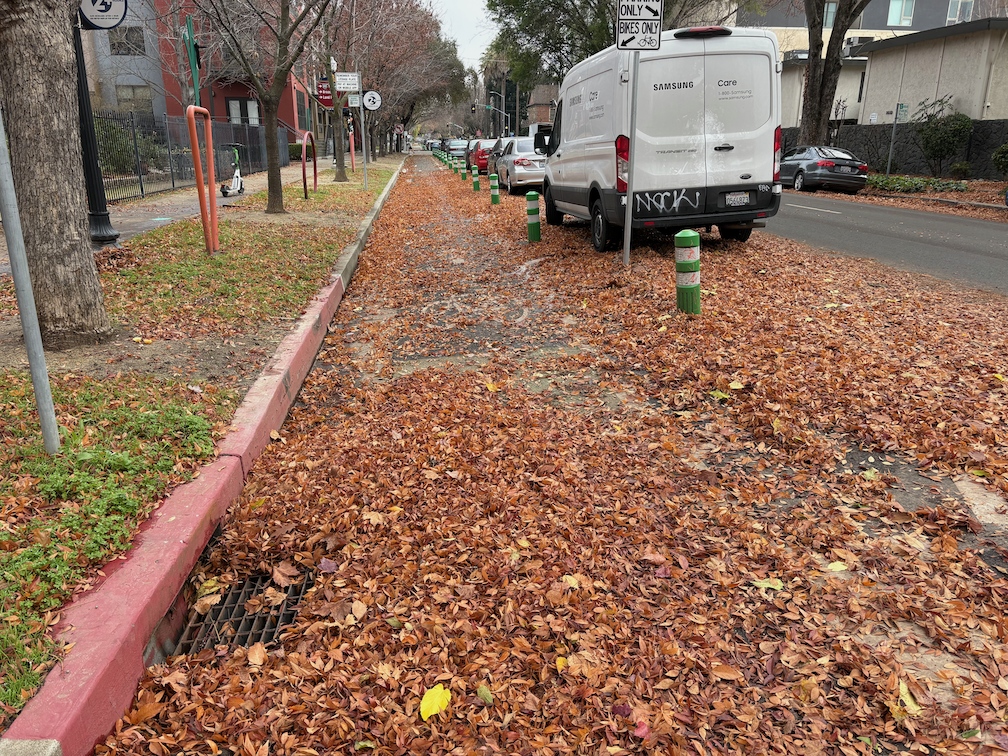
The City of Sacramento is not sweeping its separated bikeways, as it promised to do when it installed them. The separated bikeways, on I St, P St, Q St, 9th St, 10th St, 19th St, and 21st St have not been swept by the city. The city has a sweeper designed specifically for these bikeways. It may be broken down, or the city may be choosing not to sweep. Some of the bikeways are being swept by landscape maintenance services associated with adjacent properties, a few spots are being swept by individual owners or residents, and even the parks department is cleaning up, but not consistently.

photo of Q St at 14th St, separated bikeway, not swept by city
Q St at 14th St, separated bikeway, not swept by city

In a few places that have heavier bicycle and scooter traffic, such as P St between 15th and 14th, the leaves have turned into leaf slime, which is extremely hazardous for anyone on two wheels. I’ve seen people almost spin out here, and I have as well.

Most people seem to have realized that the place for piled leaves is NOT in the bikeway, but in the adjacent buffer, and in some locations that buffer is labeled as such. But some people are still piling in the bikeway.

Regular bike lanes are an issue as well. Most are not swept. Dry leaves are sometimes swept away be motor vehicle traffic, but once they are wet, they don’t move. If there is motor vehicle traffic across or along the bike lane, such as approaching an intersection, the leaves are quickly turned into slime. Very slippery! Be cautious anywhere there are leaves.

Palm trees – ack!

And just in case you need to be reminded, palm trees and the fronds they drop are an ongoing hazard to people walking and bicycling. A single frond can block a sidewalk from use by anyone with a mobility device. A single frond can block a bikeway or bike lane, and can throw a bike rider off their bike. With every wind storm or heavy rain storm, palm trees drop huge numbers of fronds. Why do we continue to allow this hazard for walkers and bicyclists? In a few locations where they have historic value, such as Capitol Park, they might be justifiable. But nowhere else. They need to be removed!

photo of palm fronds on Q St
palm fronds on Q St

this week 2024-12-16

SacMoves Coalition hosts an event calendar at https://sacmoves.org/events/, which is maintained by STAR (Sacramento Transit Advocates and Riders) and Getting Around Sacramento.

Monday 16

Tuesday 17

Wednesday 18

  • House Sacramento ? (uncertain meeting date)

Thursday 19

Friday 20

Saturday 21

  • Winter Solstice

Sunday 22

red light cameras and law enforcement

Earlier posts on red light running and automated enforcement are available at category: automated enforcement.

The City of Sacramento has a crisis in biased law enforcement against people of color and low income, and also has a crisis of red light running.

The city had red light cameras at eleven locations, part of a program managed by Sacramento County Sheriff’s Office. The county dropped the program in early 2024, and all cameras were removed. The county claimed that the fines from red light running were not paying the cost of the program, and of the contractor. The City of Sacramento therefore dropped its program and has made no effort to restart it. At the dollar value of human life being $10M or more, it is hard to understand how the county saw this program as too costly. City of Sacramento paid $27M in traffic crash lawsuits over five years. The county information does not seem to be available, but it would likely be larger due to higher population, more road miles, and more poorly designed roadways and intersections.

The nature of red light running is that a motor vehicle driver T-bones someone, impacting other motor vehicles, walkers and bicyclists at a perpendicular angle at high speeds, frequently resulting in a fatality. This is not the leading cause of fatalities, but it is significant.

There are reasonable objections to any law enforcement of traffic laws. Traffic stops are often pre-textual, intended to discover illegal activity or warrants that have nothing to do with traffic law, and to oppress people of color and low income. Law enforcement officers not infrequently escalate interactions, resulting in intimidation, unlawful arrest, and death. Law enforcement often focuses on communities with people of color and low income, both because of the pre-textual nature of stops and intended intimidation of people in those communities. Even when justified, tickets for traffic violations have an outsized impact on lower income people because fines are a flat amount no matter the income of the violator, so are strongly regressive. Court fees add a great deal to the cost of a ticket, often sending low-income people in a downward economic and legal spiral. 

Automated enforcement of traffic law removes some of these concerns, but not others. By removing the interaction with officers, law enforcement intimidation and violence is eliminated. But the issue of outsized economic impact remains.

If a red light camera program were to be restarted in the City of Sacramento, it would have to have these characteristics:

  1. The program would be operated by Public Works as part of their transportation management responsibilities, not by the Police Department.
  2. Camera locations would be selected based on traffic crash location hot-spots, but adjusted so that low-income communities do not have a higher number of cameras per-capita than other areas 
  3. For camera locations with a history of traffic crashes resulting in fatalities and severe injuries, and with a higher than average number of citations issued, the city would commit to making changes to that intersection to reduce the incidence of red light running and crashes.
  4. The fines for red light running would be reduced for low-income people. The reduction could be a) across the board for income levels below a certain set percentage of the median household income, or b) based on the value of the vehicle driven by the violator. Alternatives to fines could also be implemented. Though income based fines are often mentioned, and are used in other countries, concerns about privacy and availability of the data make this impractical. The value of a vehicle is easily available, and does track to some degree with the income of the owner. It is not certain whether these options could be implemented by the city now, or if changes in state law would be required, but the city should commit to exploring options and committing to a solution.

Two other types of automated law enforcement have been discussed. Automated speed cameras are legal under a pilot program for several cities, but Sacramento is not one of them. It is unlikely that other cities would be added, or statewide implementation would occur before the pilot is completed. It is possible that active intelligent speed assistance will become law in California, and obviate the need for automated speed enforcement, at least in urban areas.

Automated enforcement of ‘failure to yield’ to walkers (pedestrians) law would be very useful. Failure to yield sometimes results in fatalities and severe injuries, but it always results in intimidation of people walking by people driving, reducing the frequency and comfort of walking trips. The technology for detection of ‘failure to yield’ is not well developed, but has been implemented in some cities and is practical. ‘Failure to yield’ is another crisis on our roadways.

This recommendation to restart the red light camera program in the city does not indicate that it is the primary solution to the traffic violence crisis. It is one among many tools. Changes to the roadway, temporary (quick-build) or permanent, are by far the most effective solution and should be the lead action by the city.

influences: podcasts

I’ll be make a few posts on things that influence my thinking about transportation and housing, in case you are unaware of them and would like to check them out. First, podcasts.

Talking Headways: A podcast on Streetsblog by Jeff Wood about a wide ranging issues in transportation. A ‘Monday’s at the Overhead Wire’ analyzes items in the news, while the main ‘Talking Headways’ has in-depth interviews with individual leaders or panels.

The War on Cars: A podcast on efforts to make streets safer and overcome automobile dominance.

The Strong Towns Podcast: A podcast covering the breadth of Strong Towns concepts and current issues.

Arrested Mobility: A podcast on the ways in which automobile dominance and funding limit the mobility of Blacks and people of color, by Charles T Brown.

Strong Towns Upzoned: Another Strong Towns podcast, this one going in-depth on recent news articles.

The Break: A podcast on Streetsblog USA on current issues in transportation safety and equity, by Kea Wilson.

99% Invisible, a podcast on urban form and other topics, used to be my favorite, but it became so dominated by advertising that I stopped listening.

this week 2024-12-09

SacMoves Coalition hosts an event calendar at https://sacmoves.org/events/, which is maintained by STAR (Sacramento Transit Advocates and Riders) and Getting Around Sacramento.

Monday

  • SacRT Board, 4:00 PM, 1102 Q Street 4 thFloor, Suite 4600, Sacramento (close to 13th St light rail) or steaming from website during meeting; comment in person or by email to boardcomments@sacrt.com before 1:00 PM on Monday

Tuesday

Wednesday

  • Organizing for Bicycle and Pedestrian Safety Coalition December Meeting, 11:30 AM via Zoom; this is a collection of interest groups on transportation and equity, organized by Civic Thread; if this applies, and your organization is not already on the invite list, email Julia Jackson Oill, Jjacksonoill@civicthread.org

Thursday

Friday

Saturday

Sunday

  • Strong SacTown walk audit for daylighting, 10:00 AM, Temple Coffee, 1615 16th St, Sacramento
  • Strong SacTown Member Mingle, 1:00 PM, Kupros Craft House, 1217 21st St, Sacramento

Strong SacTown: Things that work: traffic posts

Things That Work: Traffic Posts is the eighth post by Strong SacTown to improve and promote the City of Sacramento update to its Street Design Standards. Other posts at tag: street design standards.

You don’t often hear news about the crashes that didn’t happen. Today we’d like to highlight something already making real-world safety impacts in Sacramento: traffic posts (aka. delineators) on 15th & 16th Streets in Downtown. These traffic posts reduce the speed of cars (and severity of injuries) as well as channelize traffic – stopping cars from changing lanes at the crosswalk and potentially striking pedestrians who have started crossing.

SacCity Council to consider extending Howard Chan

On the agenda for the Sacramento City Council for this Tuesday, December 10, is an extension of Howard Chan’s contract for one year, to December 31, 2025. Approval of an Amendment of the City Manager’s Employment Agreement

I am opposed to this extension. The city is in crisis, a crisis due to both the City Manager form of government, and to the individual in the position of City Manager. Both must end, as soon as possible. Extending Howard Chan for a year ensures that the crisis will continue, for at least a year.

What is the crisis? There is a budgetary crisis. The City Manager failed to see a reduction in tax income coming, and so there was a sudden need to balance the city budget by cutting critical programs, but failing to reduce excess staff. The budget crunch is now being used to justify all kinds poor decisions by city staff and city council. There is a homeless crisis. The City Manager has failed to follow the direction of council to address homelessness by opening more homeless shelters, specifically in every council district.

Most importantly, there is a traffic violence crisis. The rate of traffic crashes resulting in fatalities and severe injuries continues to escalate, putting Sacramento at or near the top of most dangerous cities in California. Yet Howard Chan has refused to allocate city general funds to address this issue, beyond the minimum necessary for grant matches. The grants are long term solutions, when what is also needed is immediate change to roadways, called quick build, at high risk intersections where the fatalities and severe injuries occur. Howard Chan has refused to fund this. The city is considering Declaring a State of Emergency Regarding Traffic Deaths. If Howard Chan had not resisted funding for real solutions for the last eight years, it is unlikely that we would need this emergency declaration. Not that we would not have traffic fatalities – Vision Zero has been a failure for many reasons – but the rate would likely be much less.

Howard Chan believes that the only solution to the public safety crisis is to add more police officers. This is a misunderstanding of public safety. Expenditures, and staff, should reflect actual threats to the public. In Sacramento, they do not. The number of people killed in traffic crashes is similar to the number of people killed by gun and knife violence. Traffic collisions increase, the police budget increases, but the police budget does nothing to address the problem.

Darrell Steinberg, in his ‘exit interview’ with Ryan Lillis earlier this week at New Helvetia Brewing said that a partial solution for the failure of the City Manager model would be to give the Mayor hire and fire authority over the City Manager, subject to review by the council. If this had been in place, we might already have a new city manager. Darrell said that he had a good relationship with Chan, but clearly the council does not, and Darrell acknowledged that the City Manager model is failing Sacramento.

What are the alternatives? The National League of Cities has a page: Cities 101 — Forms of Local Government, which outlines five forms of city governance. Sacramento does not have exactly any of these categories, but is closest to Council-Manager. Sacramento elects its mayor as a specific office, not a rotating selection. Most significantly, in Sacramento, the council actually has very little control over the manager. I believe we need something closer to the Mayor-Council model, where the city manager works for the council, which governs on behalf of the citizens. could a council-manager model work? Perhaps, but only with a strong council or mayor that is willing to stand up to the city manager and hold that person accountable.

Sacramento voters have twice rejected a strong mayor model, probably in part due to getting burned by Kevin Johnson who wanted to be a strong mayor. It seems unlikely that voters would support a strong mayor. What I want to see is a strong council model, where the council proactively directs the City Manager, and fires that person if they are not following direction. Something must change.

Our city is in crisis because we have a failed governance model, and the wrong person in the City Manager position. Rather than just extending the City Manager for a year, the council must come to terms with the crisis, and determine a solution. As quickly as possible.