The California legislature is meeting in special session to discuss sources of funding for transportation (they are on summer break, but will get back to it). The state uses the number $5.7B as the annual shortfall in funds available for maintenance, and these discussion are largely an effort to close that gap. Some of the solutions are: 1) indexing the gas tax so that it doesn’t fall behind (it was last raised in 1990); 2) increasing transportation related fees such as vehicle registration; 3) increasing the tax on specific fuels such as diesel; and 4) basing taxes on VMT (vehicle miles traveled) rather than fuel purchase. Of course there have been other ideas such as redirecting high-speed rail funds (which would be illegal unless legislation and the voter-passed bond are completely undone), and using cap-and-trade funds for highways (also illegal because maintenance and certainly construction would not reduce greenhouse gases), but those right-wing ideas won’t receive consideration by me.

I think it extremely important that all taxes and fees be at least partially based on the weight of the vehicle. The amount of damage caused to roadways and bridges is almost exactly proportional to the weight of the vehicle, and those that weigh more should pay more, at least for the maintenance portion of the transportation budget. If, for example, VMT were used instead of or in addition to fuel tax, one mile by a lightweight passenger vehicle is in no way proportional to one mile by a heavy truck. The tax should instead be a multiplier of VMT and weight, with a strong component of weight. And yes, all vehicles should be charged, including government-owned vehicles, which cause just as much damage to roadways as commercial vehicles. There has been a ballooning of vehicle sizes and weights with the government to match the commercial sector, and this is one way of bringing that under some control. Yes, I realize this means public buses would be paying weight fees, and I think this is appropriate since they do cause significant damage to the roadways. However, public transportation could be more than compensated as we save money on wasteful parts of our transportation system.
Vehicle registration fees are based on the type and price of a vehicle, which means that commercial vehicles are already paying relatively more than less expensive private vehicles, but they are not paying their fair share in relationship to damage caused to roads. It is not just an issue of commercial vehicles, however. Heavy passenger vehicles (you know what I’m talking about) also pay much less than their share of maintenance because the price differential is not as great as the weight differential.
Commercial vehicles do pay a weight fee, which is the sort of thing I’m requesting, but it is not assessed at a high enough level to pay for the damage caused, and at least for now these fees are being diverted to the general treasury rather than being used for maintenance.
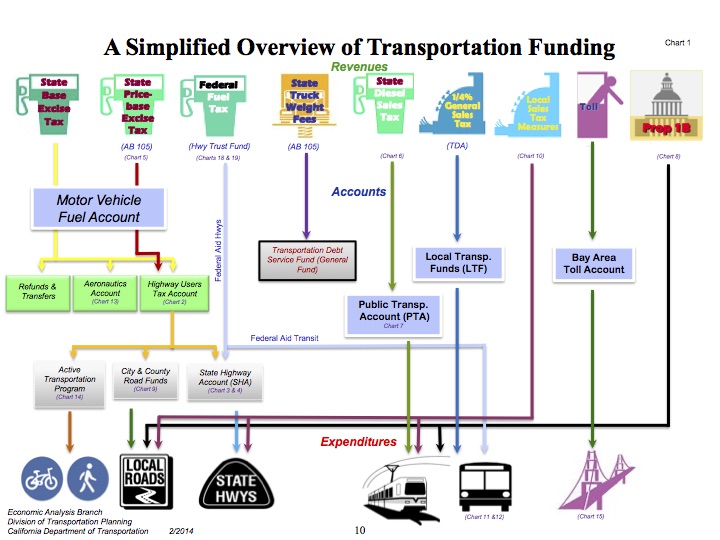
Note that I am intentionally ignoring the finer points of sales tax, excise tax, and the arcane fuel tax swap. They are important, but not important to this issue of all users paying their way. It is important to remember that only a portion of transportation funds in the state flows through the federal and state government. Local governments are actually the larger and more significant players. As well, the idea that gas tax pays for roadways is myth, it pays less than half, and has never paid all.
A lot of information about funding, including the chart above, is in the Transportation Funding in California – 2014 document from Caltrans. If this document doesn’t make your head spin, I don’t know what will.



 Getting Around Sacramento