A previous post about new beg buttons on Alhambra Blvd noted that there are now beg buttons where there used to be auto-recall pedestrian crossings. I walked Alhambra this week, and noted that there are eight intersections with these new beg buttons (technically called pedestrian actuators or Accessible Pedestrian Signals APS). At auto-recall crosswalks, the pedestrian signal comes on at every signal cycle. At beg button crosswalks, the signal comes on only if requested by the pedestrian. The city has many of both types of crosswalks, but these particular locations are new. The intersections are Alhambra and: J Street, K Street, L Street, Capitol Avenue/Folsom Blvd, N Street, P Street/Stockton Blvd, Q Street, S Street. At each intersection there are eight of these new beg buttons on new posts, for a total of 64 new beg buttons.
No one seems to know who authorized this project, nor what funds were used to pay for it. I have confirmed that the project never came before the Active Transportation Commission (SacATC). All significant pedestrian projects are supposed to come before SacATC, and the fact that this one did not probably indicates that the staff in Public Works knows that this is a motor vehicle project, and not a pedestrian project. Though it is a good bet that pedestrian safety funds were used to pay for it.
Though these beg buttons are not signed with the ‘wave at’ sign R10-3j(CA) that the new ones at 21st Street and I Street, they do seem to have the same function, that they detect people, waving or not, up to about 18 inches. It seems odd that the city would have purchased these infrared detector actuators, which must be more expensive than plain touch buttons, but then did not indicate them as such. Installation of new accessible pedestrian signals is about $70K per intersection, though replacement of buttons at existing locations is only about $14K per intersection. I have been unable to find costs for passive detection systems (they all seem to require a quote process).
A reminder, if one is needed, that beg buttons have no safety benefit for people walking. They are a motor vehicle device, meant to reduce the length of signal cycles so that more cars can go faster.
The solution to this is to prohibit the use of pedestrian beg buttons throughout the city. Existing locations can be converted to the audible crossing signals that are now required by PROWAG. The relevant sections of PROWAG are R307 Pedestrian Push Buttons and Passive Pedestrian Detection and R308 Accessible Pedestrian Signal Walk Indications. Unfortunately PROWAG does not have a definition for ‘passive detection’ to specify what the detection radius or functionality is. It might be presumed this is the same at automated pedestrian detection, but not certain. Under PROWAG, new or changed locations require audible signals, but this can be met by audible/tactile push buttons or passive detection.
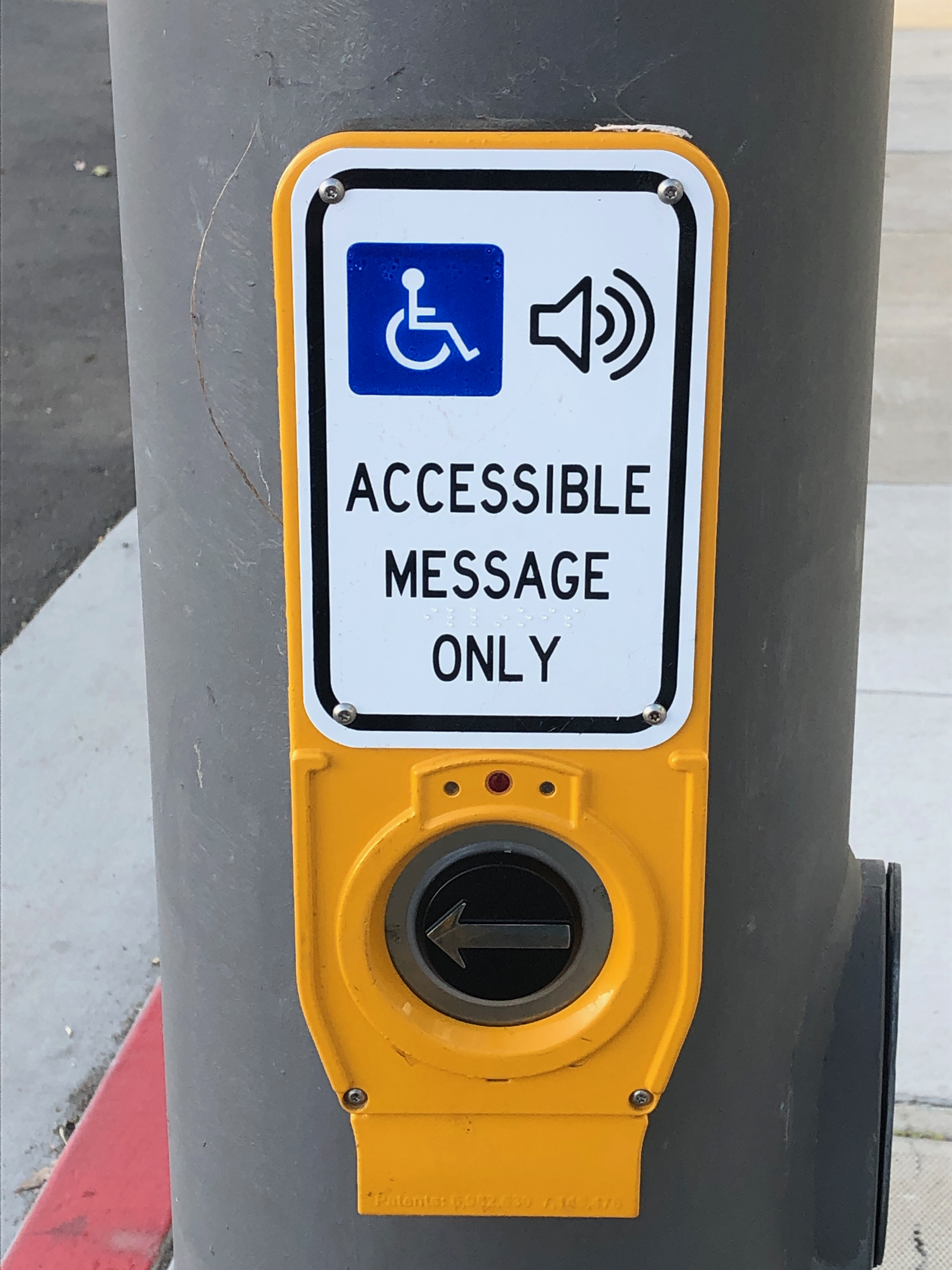
San Francisco is replacing the signing on their pedestrian actuator locations with the signing below.
 Getting Around Sacramento
[…] earlier posts Central City Mobility: new beg buttons on 5th Street, update on SacCity new beg buttons on Alhambra, Sac City NEW beg buttons, beg button signs, and Beg buttons on […]
LikeLike